An offshore accounting team is a dedicated unit of remote financial professionals—such as staff bookkeepers, senior accountants, and RCM specialists—who integrate directly into an organization’s existing software and workflows to build financial capacity while preserving direct management oversight.
Building an offshore accounting team requires shifting focus from buying transactional headcount to constructing dedicated operational capacity. Many business owners who attempt outsourcing accounting services walk away disappointed. Financial accounting executives frequently note that 90% of the time it fails and has to be scaled back because unmanaged work gets rebuilt by expensive domestic talent.
Core Findings:
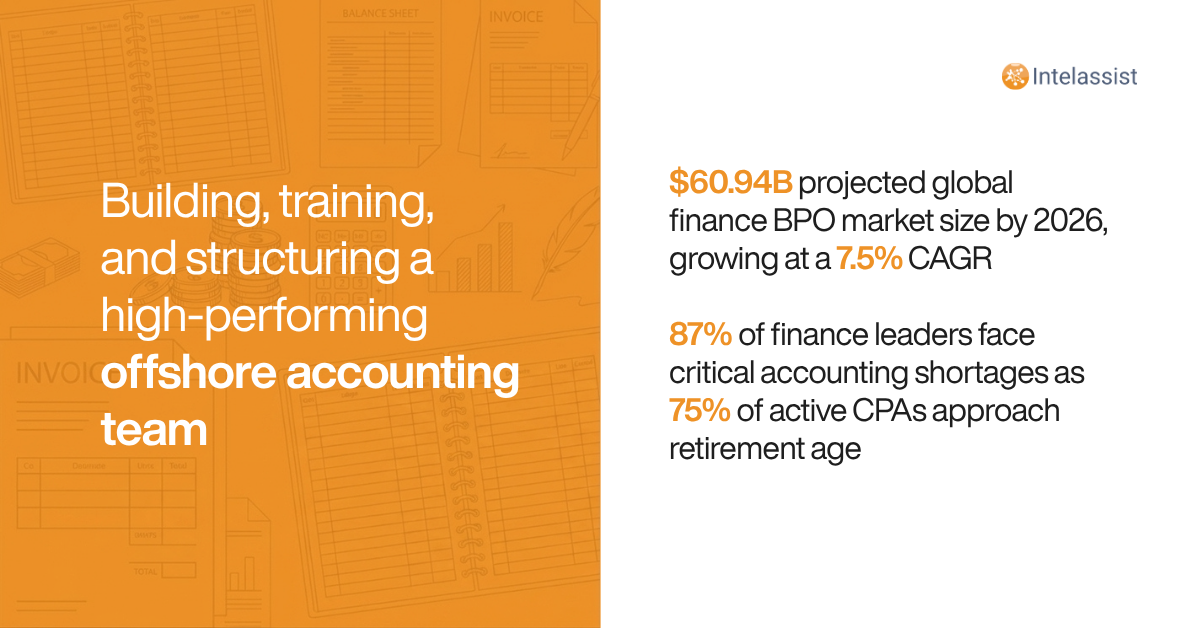
- 87% of finance and accounting leaders struggle to find critical accounting skills, as 75% of active CPAs reach retirement age alongside accounting program enrollments declining.
- The finance and accounting BPO market is projected to reach $60.94 billion in 2026, expanding at a compound annual growth rate (CAGR) of 7.5%.
- Research indicates that relying solely on a weekly status call fails; outsourced staff require firm-specific context and operational workflows beyond basic system credentials to succeed.
How to Structure an Offshore Accounting Team for Operational Control
A properly structured offshore accounting team separates foundational task execution from executive oversight, allowing growing businesses to scale without losing control over their General Ledger.
When deciding the setup of your offshore finance team, define roles by operational responsibility rather than vague job titles:
- Staff Bookkeeper / AP Specialist: Manages high-volume invoice processing, vendor payments, daily transaction tagging, and preliminary reconciliation.
- AR & Billing Specialist: Oversees customer invoicing, payment application, collection follow-ups, and revenue recognition schedules.
- Senior Offshore CPA: Executes complex reconciliations, trial balance reviews, revenue accruals, and preliminary financial statement preparation.
- Financial Analyst: Handles variance analysis, cash flow forecasting, and KPI dashboard updates.
Integrate your dedicated offshore accountant directly into your internal communication channels (such as Slack or Teams) and provide direct access to your cloud GL platforms (QuickBooks Online, Xero, or NetSuite).
Timelines and Expectations: How Long Does It Take to Build the Team?
Building a dedicated offshore accounting team typically takes 2 to 4 weeks from initial role specification to complete system onboarding.
The recruitment pipeline involves candidate sourcing, technical accounting assessments, language fluency evaluations, and hardware/VDI provisioning. Unlike generic outsourcing agencies that assign arbitrary workers from a shared pool, you interview and select the exact offshore CPA or accountant who will join your business.
Once selected, we guide your hire through our structured 90-day offshore team member onboarding framework, ensuring they achieve full operational autonomy—aligning with your existing workflows.
System Training: Moving Beyond Basic Software Access
System training for an offshore accountant should focus on firm-specific operational context and approval workflows, not basic software mechanics.
Qualified offshore accountants already understand U.S. GAAP, debit/credit logic, and standard GL platforms. Training friction occurs when managers hand over login credentials without explaining internal rules. Successful onboarding requires:
- Documented Standard Operating Procedures (SOPs): Clear rules for chart-of-accounts mapping, vendor approval thresholds, and expense categorization.
- Contextual Workflows: Explanations of why specific entries occur, including custom contract terms or unique revenue recognition rules.
- Escalation Guidelines: Explicit thresholds detailing when an item requires onshore management approval.
| Training Focus Area | Common Issues with Traditional BPO | Operational Standards with Dedicated Remote Staffing |
|---|---|---|
| Software Onboarding | Hands over credentials with no documentation | Integrated walk-through of firm-specific SOPs and GL rules |
| Process Context | Focuses solely on task completion | Explains background rules, approval limits, and reporting dependencies |
| Workflow Escalation | Errors buried until month-end review | Immediate daily escalation via internal Slack/Teams channels |
Shadowing and Parallel Running: Executing Your First Month-End Close
Executing a successful first month-end close with offshore accountants requires a 30-day parallel-running strategy where remote staff perform reconciliations alongside your existing onshore team.
The first month-end close is the critical test of any finance & accounting outsourcing initiative. Rather than handing over full closing authority on day one, structure the first month around active shadowing and dual execution:
- Days 1–15 (Shadowing & Daily Entry): The offshore team logs daily transactions, enters bills, and reconciles bank feeds under direct onshore supervision.
- Days 16–25 (Parallel Preparation): During trial balance preparation, the offshore team completes schedules and reconciliations independently while the onshore lead executes a parallel review to verify accuracy.
- Days 26–30 (Close Review & Refinement): Compare both sets of reconciliations. Identify variance causes, refine SOP documentation, and adjust approval rules before the next cycle.
Case Study: Scaling Financial Reporting with Dedicated Staff
When a fast-growing U.S. automotive dealership group expanded across multiple high-volume locations on the East Coast, internal finance and accounting operations faced severe strain. Manual data entry, inconsistent inventory reporting, and growing administrative tasks began to create backlogs, delaying critical financial reporting cycles.
To restore operational continuity without compromising quality or control, the company partnered with Intelassist to build a dedicated offshore accounting team:
- The dedicated team successfully took ownership of recurring workflows, including routine bookkeeping, report generation, and mid-month financial reporting.
- To reinforce the stability of the offshore accounting team, structured daily check-ins and proactive tracking were established, allowing remote staff to flag account inconsistencies independently.
- Remote professionals successfully operated within client systems to eliminate reporting delays and reduce manual error risks.
Governance and Review Gates: Who Signs Off and at What Stage?
Governance for an outsourced finance and accounting function relies on clear sign-off gates that dictate when tasks move from preparation to final executive sign-off.
Establish four strict review gates across the closing cycle:
- Data Entry: Staff accountants flag missing receipts or unmapped transactions before statement generation.
- Reconciliation: Senior offshore staff review bank, credit card, and balance sheet reconciliations against source documents.
- Draft Review: Preliminary trial balances and variance reports undergo review by the onshore finance manager or controller.
- Final Approval: Executive leadership signs off on finalized financial statements.
Phased Handover Roadmap: What to Delegate in Months 1, 3, and 6
A phased handover prevents operational bottlenecks and allows your offshore accounting team to build competency systematically over their first six months.
| Handover Phase | Operational Focus | Key Deliverables & Tasks | Oversight & Review Gate |
|---|---|---|---|
| Month 1 | Foundation & Shadowing | Daily transaction tagging, bank reconciliations, AP invoice entry | 100% Onshore Manager Sign-off |
| Month 3 | Core Execution | Full AP/AR management, preliminary trial balance prep, variance reporting | Peer Review & Manager Spot Checks |
| Month 6 | Full Autonomy | Complete month-end close prep, financial statement drafting, audit support | Final Executive Leadership Approval |
What to Avoid: Four Common Mistakes That Cause Offshore Accounting to Fail
Building an offshore accounting team fails when companies rely on shortcut BPO models or neglect standard process documentation.
Make sure to avoid these four common operational traps:
- Treating Remote Staff as Transactional Vendors: Assigning work to an anonymous ticket queue prevents account familiarity and damages quality. Dedicated talent must operate as true team members.
- Skipping Parallel Closing Runs: Handing over closing responsibilities without a parallel trial run creates reporting errors and forces expensive onshore cleanups.
- Omitting Firm-Specific SOPs: Assuming a certified CPA knows your company’s unique billing quirks leads to miscategorized entries and delayed reconciliations.
- Ignoring Retention Metrics: Partnering with low-cost BPO vendors experiencing 50%+ annual turnover forces you into a continuous hiring cycle. Discover how dedicated structures prevent constant re-onboarding with your accounting teams.
Frequently Asked Questions About Offshore Accounting Teams
Dedicated remote staffing provides full-time, exclusive professionals who integrate directly into your communications software, tools, and daily workflows. Traditional BPO outsourcing distributes work across a shared pool of unassigned agents, leading to inconsistent quality and zero process visibility.
Yes. Accountants in the Philippines receive education grounded in International Financial Reporting Standards (IFRS) and U.S. GAAP. They hold expert proficiency in standard financial platforms, including QuickBooks, Xero, NetSuite, and Sage.
Data security is managed through compliant protocols, encrypted Virtual Desktop Infrastructure (VDI), dual-factor authentication, and restricted user permissions that prevent local data downloading or unauthorized file transfers.
Intelassist provides ongoing skills enhancement, dedicated client success managers, and operational support to help remote accounting staff master new software updates or client-specific tools.