Finance and accounting outsourcing (FAO) is the strategic delegation of bookkeeping, financial reporting, payroll, and revenue cycle management to dedicated external specialists. In 2026, the industry has evolved from acquiring transactional BPO call centers toward transparent, high-retention dedicated remote staffing models that integrate directly into a firm’s accounting software and security protocols.
The State of the Finance & Accounting Outsourcing Market in 2026
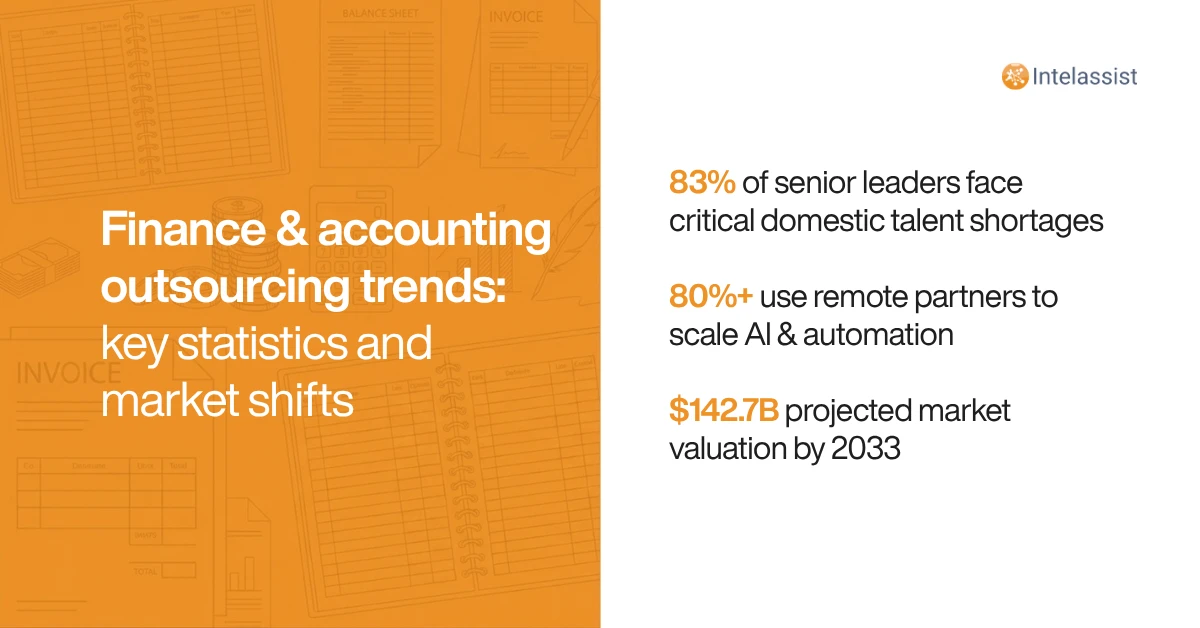
Industry analysis indicates that the worldwide finance & accounting business process outsourcing sector holds a 2026 valuation of $59.05 billion, with projections pointing toward $142.7 billion by 2033, driven by an annual compound growth rate of 9.3%.
This expansion reflects a structural realignment in how organizations manage financial operations. Rising labor costs, persistent shortages of qualified accounting professionals in Western markets, and compressing operating margins are pushing small-to-medium businesses (SMBs) and middle-market enterprises to re-evaluate traditional domestic hiring. Finance leaders increasingly view global talent integration as a baseline requirement for maintaining fiscal accuracy and operational resilience. According to market data, adoption is accelerating beyond routine transactional data entry into complex financial management, driven by a growing need for scalable, specialized back-office capabilities.
4 Major Finance & Accounting Outsourcing Trends Shaping 2026
1. Overcoming the CPA Talent Shortage with Dedicated Remote Professionals
The shortage of qualified accountants and certified public accountants (CPAs) in North America and Western Europe has reached a tipping point, forcing organizations to adopt dedicated remote staffing models.
Research indicates that 83% of senior finance leaders struggle to fill open accounting roles domestically. The traditional domestic talent pipeline continues to shrink as fewer graduates enter the accounting profession while senior staff reach retirement age. In response, business owners and financial controllers are moving away from expensive local recruiters and temporary contracting agencies.
Instead, growing firms are hiring dedicated remote professionals in regions like the Philippines. Rather than outsourcing tasks to an anonymous pool of contractors, companies hire full-time offshore bookkeepers, accounts payable/receivable specialists, and controllers who work exclusively for their organization. These specialists operate directly inside the client’s software systems and participate in daily team communications, eliminating the disruption caused by high-turnover local temp staffing.
2. Accelerating AI & Automation Adoption via Outsourced Operations
Modern finance and accounting teams are combining human expertise with artificial intelligence to streamline repetitive workflows.
Over 80% of finance organizations leverage outsourcing partners to access advanced automation capabilities without committing to massive upfront capital expenditures. Integrating machine learning into core financial tasks requires direct technical execution, software maintenance, and continuous quality assurance—resources that internal finance departments often lack.
By embedding dedicated remote professionals into accounting and finance workflows, CFOs and operations leaders can deploy AI-driven tools for automated invoice processing, optical character recognition (OCR) data extraction, and automated bank reconciliations. Strategic insights highlight that artificial intelligence in finance augments human analysis rather than replacing it. Savings from labor optimization allow firms to reinvest in automated financial reporting and predictive cash flow modeling, raising operational efficiency across the entire department.
3. Geographic Demand Shifts: Regional Shortages and Top Offshoring Hubs
Finance & accounting outsourcing trends show heavy demand from North America and Western Europe, with delivery concentrated in English-proficient, highly educated offshore hubs.
North America accounts for the largest share of buyer demand at 40.88%, driven by severe domestic labor deficits and elevated compensation expectations. Meanwhile, the Asia-Pacific region stands as the fastest-growing delivery market, expanding at an 8.84% CAGR.
Within Asia-Pacific, the Philippines has solidified its standing as a premier destination for finance and accounting staffing. The country graduates tens of thousands of business and accounting majors annually who are educated in International Financial Reporting Standards (IFRS). Combined with high English fluency and cultural alignment with Western business practices, growing companies can build dedicated offshore teams that deliver consistent financial accuracy without operational friction.
4. Enterprise-Grade Data Security and Regulatory Compliance Protocols
Data privacy, infrastructure security, and regulatory compliance have become mandatory criteria for evaluating remote staffing partners.
Data security and regulatory compliance rank as primary decision factors for more than 65% of finance executives selecting an outsourcing vendor. Managing sensitive financial records, payroll details, and client banking information requires strict protection protocols that go far beyond standard freelance agreements.
Growing businesses are shifting away from unvetted gig platforms toward established remote staffing partners that provide enterprise-grade infrastructure. This includes SOC 1 and SOC 2 compliance, ISO 27001 data security management, physical office security, hardware-level endpoint protection, and strict adherence to industry regulations like HIPAA for medical revenue cycle management (RCM). Clear security standards ensure that offshored financial operations remain compliant, secure, and audit-ready.
Build a Resilient Finance and Accounting Team with Dedicated Remote Professionals
Scaling your accounting department does not require accepting domestic hiring constraints, ballooning payroll overhead, or dealing with high vendor turnover. Intelassist provides dedicated, highly skilled finance & accounting specialists in the Philippines—from bookkeepers and AP/AR staff to revenue cycle management analysts and senior financial controllers—who integrate directly into your existing software and operate as an extension of your internal team.