Remote staffing services directly employ, compensate, and manage mandatory statutory benefits for offshore team members in their host country, while providing dedicated staff who execute administrative benefits workflows for client HR teams. Unlike a PEO or EOR, a remote staffing partner supplies dedicated talent integrated directly into client operations without taking over domestic payroll or legal employer status.
Core Findings:
- Rapid expansion in global employment infrastructure pushed the Employer of Record (EOR) industry to $7.45 billion in 2026, with Asia-Pacific markets expanding at an annual rate of 11.3% through 2035.
- Global enterprise demand for decentralized workforce operations continues to accelerate, with total market spend projected to grow from $20.1 billion in 2022 to $58.5 billion by 2027.
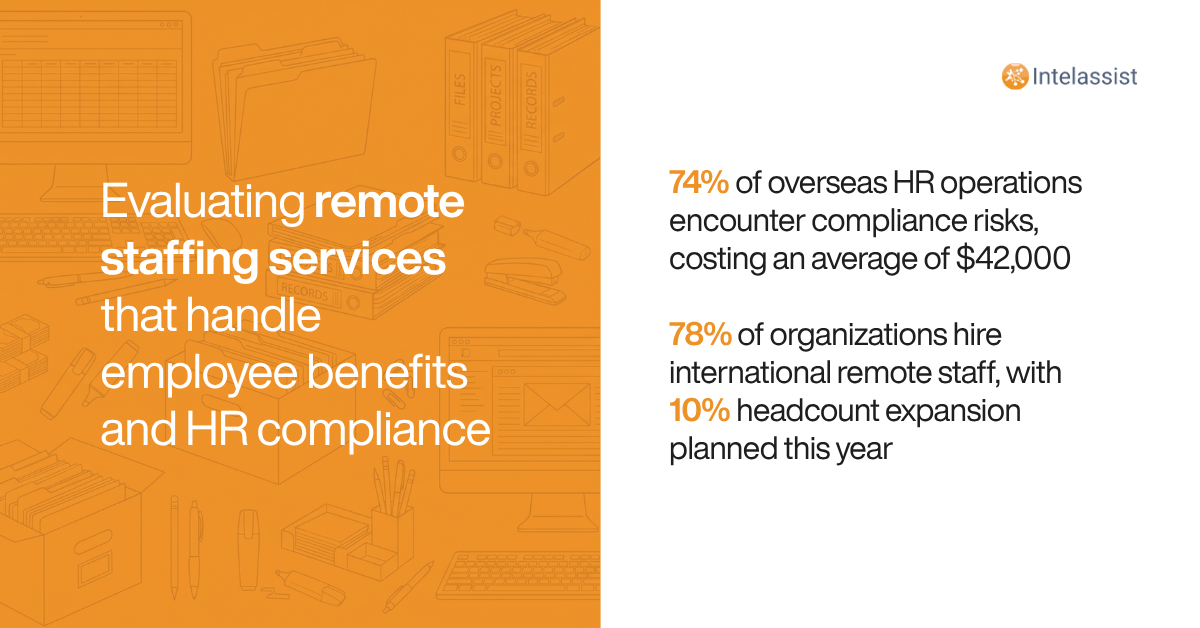
- Cross-border recruitment has become standard practice, with 78% of organizations employing international remote staff and planning to expand their offshore headcount by at least 10% over the next 12 months.
- Regulatory mishaps carry steep financial consequences, as 74% of HR teams operating overseas report encountering international compliance violations costing an average of $42,000 per occurrence.
- Operational friction remains widespread across global hiring, with only 8% of firms maintaining full compliance across foreign tax and labor laws and 46% reporting failed onboarding cycles due to legal roadblocks.
How Does Employee Benefits Work in Remote Staffing?
In cross-border hiring, employee benefits operate across two distinct functional areas: the compensation and health coverage provided directly to the remote workforce, and the administrative workflows executed to support domestic HR operations.
Does a remote staffing agency manage my employees’ benefits or their own?
A remote staffing agency manages healthcare, statutory contributions, and employment benefits for its own global workforce. Your domestic HR leadership retains complete authority and oversight over your US employee benefit plans.
When you partner with remote staffing services, the agency serves as the direct employer of record in the host nation. They absorb all payroll administration, local legal obligations, tax filings, and insurance provisions. Your internal team maintains zero legal liability for host-country labor compliance, allowing your HR department to maintain standard domestic operations without managing complex international structures.
What statutory benefits must offshore staffing partners cover locally?
Remote staffing agencies in key labor markets like the Philippines must provide full statutory benefits dictated by local labor laws under the Department of Labor and Employment (DOLE).
A compliant remote staffing partner covers full employer and employee portions for:
- Social Security System (SSS): Social insurance providing retirement and disability benefits, and more.
- PhilHealth: National health insurance program guaranteeing medical care coverage.
- Pag-IBIG Fund: Home Development Mutual Fund providing housing loans and savings programs.
- 13th-Month Pay: Mandatory annual monetary benefit equivalent to one-twelfth of the basic salary earned within a calendar year.
- Statutory Leave Entitlements: Paid service incentive leaves, maternity and paternity leaves, and emergency leave allocations.
Confirming these contributions protects operational continuity and strengthens employee retention. Full statutory compliance builds a secure, reliable foundation for long-term workforce stability.
Can offshore staff assist with US benefits administration tasks?
While remote staffing agencies handle local employment benefits for the personnel they employ, these agencies can also supply dedicated remote professionals to support your domestic HR team with US benefits administration.
This distinction reinforces the dual function of remote staffing: the partner assumes direct employer responsibility for your offshore team’s host-country benefits, while the dedicated professionals you hire through that agency assist your in-house HR leaders by managing domestic administrative workflows. Remote HR assistants, operational coordinators, and revenue cycle specialists routinely execute time-consuming tasks such as open enrollment data processing, invoice reconciliation, and leave documentation.
For specialized healthcare and medical billing teams, evaluating vendor alignment is critical before handing over administrative tasks. HR leaders should review key vetting criteria before signing to ensure strict process adherence. Delegating these routine administrative workflows gives your domestic HR staff back several hours every week, allowing them to focus on high-level talent strategy and internal employee engagement.
Remote Staffing Agency vs. PEO vs. EOR: Key Operational Differences
Selecting the right international growth model requires understanding where legal employer status sits, how talent is recruited, and how operational responsibilities are divided.
| Model Type | Primary Operational Focus | Legal Employer | Local Benefits Management | Operational Structure |
|---|---|---|---|---|
| Remote Staffing Services | Dedicated talent integrated into client workflows | Staffing agency in host country | Direct administration of local statutory & healthcare benefits | Client directs daily tasks; agency manages HR, facility, & compliance |
| Professional Employer Organization (PEO) | Domestic co-employment & workforce administration | Co-employer with client organization | Administers client-selected domestic plans | Shared employment liability within same domestic jurisdiction |
| Employer of Record (EOR) | Global employment compliance & payroll intermediary | EOR legal entity in host country | Mandatory statutory benefits pass-through | Platform compliance; client handles recruitment & management |
| Traditional BPO Vendor | Process outsourcing & service level deliverables | BPO entity | Provider-administered standard packages | Shared pool or ticket-based project delivery |
How is a remote staffing partner different from a PEO or an EOR?
A remote staffing partner combines recruitment, physical infrastructure, ongoing management, and local benefits for dedicated personnel, whereas PEOs focus on domestic co-employment and EORs operate primarily as legal compliance intermediaries.
- PEO: Establishes a co-employment arrangement within the same country to consolidate payroll and domestic benefit access.
- EOR: Acts as a legal passthrough entity allowing you to hire individual workers globally, but leaves recruitment, onboarding, equipment provisioning, and performance management on your internal management team.
Transactional vendor structures often present operational challenges when offshore staff are managed in isolated service pools. Understanding the outsourcing cycle and how dedicated teams fix it highlights how embedding dedicated personnel directly into your business processes establishes quality control and operational stability.
Dedicated remote staffing agencies recruit vetted candidates tailored to your specific role requirements, house them in secure environments, handle complete local benefit administration, and assign dedicated account management to safeguard retention.
What Benefits Should Remote Staffing Agencies Provide Their Teams?
Employee retention in offshore operations directly correlates with the security and professional environment provided by the staffing vendor. High attrition breaks institutional knowledge and increases operational overhead for client teams.
What benefits does Intelassist provide its remote staff?
Intelassist provides comprehensive host-country benefit packages that go beyond statutory minimums to build long-term career loyalty and operational consistency.
Intelassist team members receive private health insurance (HMO) coverage from day one, comprehensive SSS, PhilHealth, and Pag-IBIG contributions, 13th-month pay, paid time off, and structured professional growth pathways. By investing directly in staff well-being, Intelassist achieves a retention rate exceeding 90%, compared to the standard BPO industry average of 40%.
This workforce stability protects complex technical and creative functions as well as back-office roles. Providing comprehensive local benefits ensures that dedicated remote IT support specialists, Revit and CAD drafters, healthcare RCM personnel, and administrative professionals assigned to your business remain with your team for years.
Evaluating remote staffing agencies through a buyer evaluation framework
HR directors can evaluate remote staffing partners by inspecting six operational foundations:
- Recruitment Rigor: Role-specific testing and behavioral screening before candidate presentation.
- Management Structure: Clear organizational design defining operational and client relationship ownership.
- Quality & Security Infrastructure: Enterprise data protection, encrypted hardware, and physical site security.
- Cultural Integration: Programs that connect remote professionals directly into client team rhythms.
- Retention Metrics: Transparent reporting on agent attrition and average tenure across client accounts.
- Executive Involvement: Accessible ownership teams invested in long-term operational success.
Frequently Asked Questions
No, Intelassist is not a third-party benefits broker or insurance provider. Intelassist supplies dedicated, skilled remote staff who execute back-office benefits administration and HR support tasks directly inside your organization’s existing software platforms.
Providing full statutory coverage and private healthcare significantly reduces offshore turnover. Secure, valued remote employees stay longer in their roles, preserving institutional knowledge and protecting client workflows from frequent retraining cycles.
No, you do not need a foreign legal entity. The remote staffing agency acts as the legal employer in the host country, assuming all employment liability, local tax filings, and statutory benefit management.