Outsourced accounting and bookkeeping is a staffing model where a company hires dedicated remote staff in offshore locations to manage daily financial workflows, including accounts payable outsourcing, payroll reconciliation, and monthly reporting. Unlike transactional BPOs that rotate shared staff, a dedicated offshore team works exclusively under your direct management to maintain process continuity and error-free books.
Core Findings:
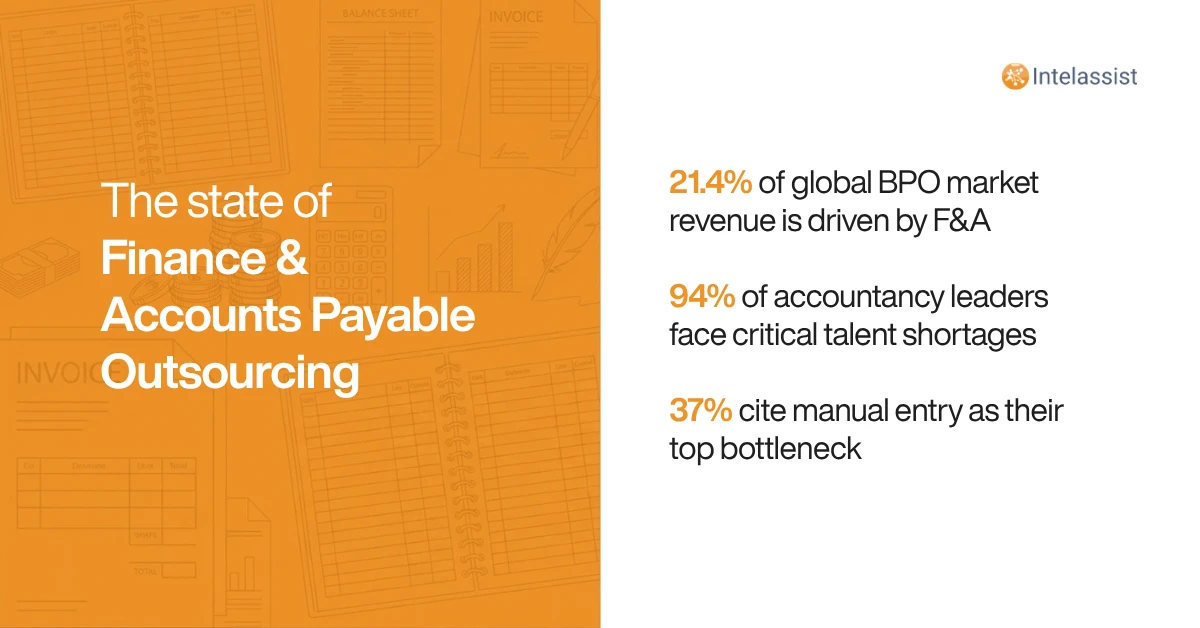
- Finance and accounting emerged as the largest segment in the global business process outsourcing market, representing 21.4% of global market revenue.
- The Accounting Talent Index reports that 94% of accountancy leaders worldwide state talent acquisition and recruitment bottlenecks directly impact their ability to expand business capacity.
- An industry survey of accounts payable (AP) professionals revealed that 37% identify manual data entry as their single largest operational pain point, followed by high processing costs (36%) and slow approval workflows (34%).
- The average organization takes between 9 and 17 days to process an invoice. The best-run finance teams do it in 3. The difference usually comes down to how the team is structured and whether the right outsourcing partner is supporting them.
Why Most Offshore Accounting Attempts Don’t Work Out
Offshore accounting arrangements frequently encounter roadblocks when companies rely on gig-economy marketplaces or low-cost BPOs that operate with shared, rotating labor pools. When remote workers handle multiple accounts simultaneously without direct accountability to your internal team, quality drops and administrative friction compound quickly.
High Turnover and the Constant Re-Onboarding Loop
Traditional BPOs experience high turnover rates, often averaging around 40% annually. For a financial controller, this creates an exhausting revolving door. You spend three to four weeks training a remote bookkeeper on your chart of accounts, approval hierarchies, and software tools, only to have them reassigned or leave.
This forces you into a continuous re-onboarding loop: re-explaining your core operational rules to a new contractor every few months. Over time, that kind of churn quietly wears on leadership in ways that don’t always show up on a report.
To eliminate this operational churn, founders must look into breaking the outsourcing cycle by shifting from task-based pools to a different model: one built around full-time, dedicated team members who are tied to your firm long-term.
Financial Package Rebuilds and Costly Rework
A common industry frustration occurs when business owners discover that cheap data entry requires expensive domestic CPAs to completely rebuild financial packages from scratch just to make them auditable.
With 37% of accounts payable professionals citing manual data entry as their top operational headache, unsupervised offshore processing frequently leads to:
- Misclassified operational expenses and capital expenditures.
- Duplicate vendor payments and uncollected receipts.
- Unreconciled merchant gateway balances and missing tax documentation.
At the end of the day, most low-cost engagements eventually get scaled back or abandoned because cleaning up broken balance sheets costs significantly more than hiring qualified professionals from the start.
Communication Friction and Fragmented Workflows
Transactional outsourcing vendors isolate remote workers behind rigid middle-management ticket queues. When an offshore bookkeeper cannot log in to your primary communication channels, a simple question about a line-item variance or vendor invoice takes days to resolve.
This communication gap directly impacts invoice cycle times. While top-performing organizations clear vendor invoices in 3.1 days, companies bogged down by fragmented communication often stretch invoice processing to more than half a month. Delayed approvals trigger late fees, strain key supplier relationships, and clear cash flow visibility becomes genuinely difficult to maintain.
How Intelassist Builds a Dedicated Offshore Team for Accounts Payable and Bookkeeping
Intelassist embeds vetted, full-time financial professionals directly into your company’s workflow. Rather than handing tasks off to a third-party queue, you hire dedicated accounting and finance staff who operate under your direct leadership as true extensions of your team.
Rigorous Vetting for Outsourced Accounting and Bookkeeping Teams
Filling accounting roles remotely requires far more than checking resumes for basic software keywords. Intelassist evaluates candidates through a multi-stage technical and behavioral assessment designed to match your specific tech stack.
- Software Testing: Verifying hands-on skills in Excel and whichever accounting or bookkeeping software your firm relies on, ensuring a smooth integration from day one.
- Technical Accounting Evaluation: Practical testing on double-entry bookkeeping, accrual adjustments, accounts payable three-way matching, and tax compliance.
- Communication Assessment: Real-time evaluation of written and verbal English skills to ensure proactive problem-solving within your daily workflow tools.
Understanding why US businesses choose the Philippines for financial talent reveals a key advantage: a highly educated labor pool trained specifically trained in US and global international accounting standards.
Direct Operational Control with Zero Middle Management Layers
With Intelassist, you maintain total operational control. Your dedicated outsourced accounting and bookkeeping team adheres to your internal standard operating procedures, attends your morning standups, and works within your software environment.
While you direct daily tasks and process priorities, Intelassist takes care of the administrative overhead:
- Local compensation and health benefits (HMO).
- Physical office infrastructure, dual-monitor hardware, and enterprise security policies.
- On-site IT management and continuous HR engagement to support staff retention.
To ensure your team hits the ground running without operational hiccups, Intelassist implements a structured 90-day integration and onboarding process that aligns new hires with your business communication styles and software workflows from week one.
Signs It’s Time to Hire Dedicated Remote Accounting Staff
Knowing precisely when to transition from internal DIY handling to dedicated offshore accounting prevents operational bottlenecks from stalling commercial growth.
Financial admin is consuming executive time.
As businesses grow, handling multiple payment gateways, tracking contractor invoices, filing multi-state sales tax, and performing delayed bank reconciliations quickly consumes 5 to 10 hours a week.
When company leaders spend nights categorizing expenses rather than focusing on customer acquisition or product development, shifting routine ledger management to dedicated remote staff immediately restores executive focus where it drives revenue.
Your AP process has become a bottleneck.
When invoices get lost, duplicated, or misallocated, supplier relationships suffer, and late fees add up. Implementing structured accounts payable outsourcing gives your business a dedicated remote staff to handle:
- Automated invoice capture and three-way matching against purchase orders.
- Systematic vendor statement reconciliations.
- Scheduled batch payment prep for final executive approval.
Hiring locally doesn’t make financial sense.
With finance and accounting capturing 21.4% of global outsourcing revenue, market adoption reflects a clear economic reality: domestic payroll costs for entry-level bookkeepers and AP clerks may be unsustainable for mid-market and growing businesses.
Base salaries, payroll taxes, health coverage, and office equipment for domestic hires often exceed $65,000 to $80,000 per employee annually. Utilizing dedicated offshore staff allows you to secure experienced accounting talent for a fraction of that cost—without sacrificing work quality or direct daily oversight.
The common thread across all three is that they’re solvable, and usually faster than most businesses expect. That’s exactly what the dedicated outsourced accounting and bookkeeping model is built for. Schedule a free consultation to see what that could look like for your team.
Frequently Asked Questions About Outsourced Accounting and Bookkeeping
Shared BPO services assign your tasks to an arbitrary pool of agents who handle multiple client accounts simultaneously, leading to high turnover, context loss, and slower turnaround times.
Dedicated outsourced bookkeepers work exclusively for your company full-time, integrating directly into your communication tools, software stack, and daily team workflows.
Unlike a transactional outsourcing setup where errors often go undetected until a domestic CPA has to rebuild entire packages, your dedicated bookkeepers work directly within your accounting software and under your day-to-day oversight.
Whether you’re on QuickBooks, Xero, or NetSuite, they are proficiency-tested in your tools before they start. That combination of direct supervision and software familiarity keeps the work accurate and your books audit-ready from day one.
The standard timeline to match, evaluate, interview, and onboard dedicated remote staff for accounts payable or bookkeeping roles is between 2 to 4 weeks.
Yes. You retain total operational control over your dedicated team. You assign daily task priorities, set workflow expectations, and communicate directly with your team members via Slack, Microsoft Teams, email, or video calls.