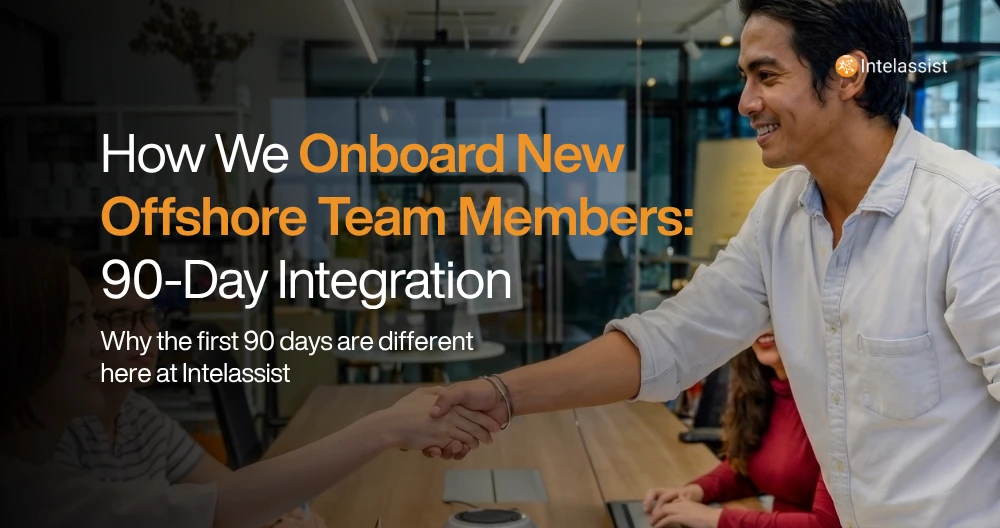
Why the first 90 days are different here at Intelassist
To successfully execute an onboarding process for offshore teams, businesses must combine client-led skill and workflow training with an offshore partner’s local HR infrastructure, cultural integration, and day-one technical readiness. This balanced approach guarantees that remote professionals are culturally connected and technically supported from day one, establishing long-term role continuity rather than treating staff as temporary transactional headcount.
Why Traditional Offshore Staffing Models Experience High Attrition
Many leaders hesitate to build offshore teams due to one core frustration: the high-attrition, transactional Business Process Outsourcing (BPO) model. In standard outsourcing setups, remote workers are frequently treated as interchangeable units. They are given a login, provided minimal local support, and left isolated from both the client’s business culture and their local peers.
When offshore staff feel isolated, they quickly disengage and cycle out. This high turnover rate routinely disrupts institutional knowledge and forces HR managers into a constant, exhausting loop of recruiting and retraining. While the traditional BPO industry average attrition rate can reach up to 60%, a culture-first approach changes the entire trajectory of the partnership. By investing heavily in employee integration, local engagement, and career development, achieving a 90%+ employee retention rate is possible.
How Intelassist Compares to Standard BPOs
When evaluating how to onboard a remote employee, the operational differences between a standard BPO team and a dedicated remote staff can directly impact long-term retention.
| Onboarding Element | Standard Transactional BPO | Intelassist Dedicated Model |
|---|---|---|
| IT & System Provisioning | Left to chance; hardware is often shipped late, unconfigured, or without secure network access. | Handled entirely by our local Manila IT department; systems are secure, fully configured, and ready on day one. |
| SOP & Process Training | Left entirely to the client with zero local operational support or performance tracking. | Collaborative process setup during Partnership Alignment; operations managers support knowledge transfer. |
| Employee Engagement & Culture | Disconnected remote workers lacking peer relationships, local HR touchpoints, or physical community. | Active Manila office culture, regular team events, transparent local management, and career pathing. |
| Average Employee Retention | Low retention (~60% industry average) resulting in frequent operational restarts and loss of expertise. | 90%+ stable retention rate, preserving your operational knowledge and team stability. |
Implementing the Dedicated Remote Staffing Model: Our 5-Stage Framework
Successfully building an offshore team requires a deliberate, structured framework that covers everything from initial discovery to long-term performance management.
01. Discovery & Role Definition (~1 Week)
Our process begins by mapping out your business’s unique requirements. During this phase, we define the exact candidate profile, core responsibilities, daily schedules, communication preferences, and key success metrics. This ensures we target professionals who possess both the hard skills and the operational alignment required for your business.
02. Partnership Alignment (~1 Week)
Before any hiring begins, we formalize our partnership framework. This includes establishing communication protocols, clarifying key performance indicators (KPIs), setting data protection rules, and setting up secure system access. Laying this groundwork prevents technical bottlenecks when your new team member begins.
03. Targeted Recruitment (~2–3 Weeks)
We source highly skilled professionals in the Philippines, customizing our search to your specific needs. Candidates undergo skill-based assessments and structured multi-stage interviews. We encourage client participation at your preferred level, allowing you to make the final selection with complete confidence.
04. Client-Led Onboarding & Training (~2–4 Weeks)
True onboarding starts in Manila. While you lead the systems, workflow, and SOP-specific training, Intelassist’s onsite team coordinates the local logistics. We ensure your remote workers have workspace access, operational IT support, and clear training metrics to guide them through their initial learning curve.
05. Ongoing Support & Performance Management (Ongoing)
Once training is complete, your team member transitions into daily operations. We provide continuous IT support, local HR management, local office engagement activities, and regular KPI tracking. This constant, localized care is why our teams remain stable and motivated over the long term.
How a Structured Onboarding Process Keeps Teams Aligned
A structured onboarding process for offshore teams does more than just lower attrition; it directly drives scalable growth.
For instance, when a growing medical organization needed to scale its administrative operations, a structured transition and deep compliance training allowed them to successfully expand their specialized radiology capacity. By pairing client-led technical training with our local compliance oversight, they expanded operations smoothly without sacrificing service quality.
Similarly, in the customer service space, a premier RV resort optimized its call handling by onboarding a dedicated offshore team. The success of this transition relied on clear, pre-planned communication protocols and rapid system configuration, allowing the new team members to resolve customer inquiries efficiently from day one.
Read more about these success stories here:
| How a Dedicated Healthcare Team Expanded Radiology Capacity Read the case study here | Premier RV Resort Optimizes Call Handling With a Dedicated Offshore Team See the full story |
Common Questions About Onboarding Offshore Staff
The most effective onboarding process combines client-led training on business systems and SOPs with a local partner’s administrative, technical, and cultural support. This ensures new hires are technically prepared and culturally integrated from their very first day.
Successful cross-border onboarding requires setting clear communication guidelines during the initial Partnership Alignment phase. Establishing overlapping work hours, utilizing asynchronous update tools, and setting clear performance expectations ensures everyone stays aligned, regardless of location.
Intelassist acts as the employer of record in the Philippines. We manage local payroll, comprehensive benefits, compliance, and workspace facilities. We also cultivate a vibrant Manila office culture, providing your remote team members with a physical community, career support, and regular team engagement.
The client is responsible for teaching the specific workflows, internal systems, and daily responsibilities of the role. While Intelassist handles IT setups, office space, and local HR management, you retain operational control over how the daily work is executed.