Medical coding and billing outsourcing is the practice of assigning revenue cycle tasks, including chart abstraction, eligibility verification, and claim submission, to certified external specialists inside an organization’s existing EHR and billing systems.
For practice administrators and revenue cycle directors, this model pairs human judgment with HIPAA-certified controls to protect claim accuracy and clear backlogs.
Core Findings:
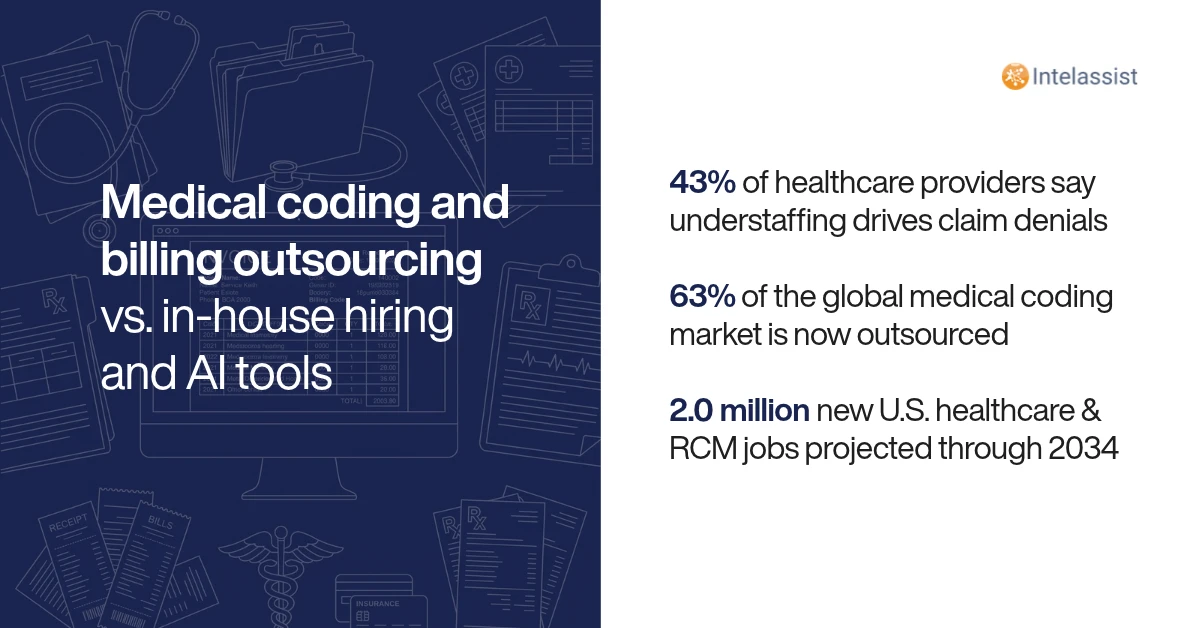
- The U.S. healthcare and social assistance sector is projected to add roughly 2.0 million jobs between 2024 and 2034, the largest gain in U.S. Bureau of Labor Statistics employment projections, driving sustained demand for revenue cycle and health information roles.
- 43% of surveyed healthcare providers report understaffing as a key driver of claim denials, simply because medical coders balance strict productivity targets, specialty complexity, shifting rules, and documentation gaps.
- Estimates project the global medical coding market to grow from USD 25.32 billion in 2026 to USD 42.47 billion by 2031 at a 10.9% CAGR.
- Outsourced services represent roughly 63% of global medical coding market share as healthcare organizations engage external coding providers to manage complex administrative workflows.
How Does Medical Coding and Billing Outsourcing Compare to In-House Hiring and AI Tools?
Medical coding and billing outsourcing through a dedicated staffing model combines certified human judgment, HIPAA-HITECH security governance, and predictable retention, whereas local hiring faces prolonged recruitment timelines and unsupervised AI tools create high denial risk. Evaluating these approaches side by side helps practice administrators align clinical quality standards with IT security and financial expectations, a framework explored in the CFO’s guide to offshore RCM and finance staffing decisions.
| Evaluation Criteria | In-House Local Hiring | AI Coding Tools | Dedicated Offshore RCM Team |
|---|---|---|---|
| Clinical and Payer Judgment | High when staffed; vulnerable to specialty shortages | Low; struggles with clinical context and rule updates | High; AAPC and AHIMA certified human coders matched by specialty |
| HIPAA and IT Governance | Managed within internal network policies | Requires third-party data and model training audits | HIPAA-certified with BAAs, VDI controls, and role-based EHR access |
| Error and Claim Denial Risk | Low to moderate; rises during team overtime | Roughly 75% projected claim denial risk without human auditing | Controlled via multi-tier pre-bill QA audits and denial tracking |
| Hiring Timeline and Retention | Months to recruit locally; turnover disrupts continuity | Rapid setup followed by heavy human rework | Dedicated remote staff with 90%+ retention vs. 40% BPO average |
| Revenue Cycle Role Coverage | Single function per local requisition | Partial code suggestions only; requires separate billing staff | Coordinated medical coders, billers, and patient access reps |
When healthcare leaders hire dedicated remote staff through a specialized healthcare outsourcing partner, specialists integrate into daily EHR queues and weekly revenue cycle reviews, preserving institutional knowledge across payer contracts.
What Does a Medical Coder Actually Do in Healthcare RCM?
A medical coder reviews clinical records from patient encounters and translates diagnoses, procedures, and services into standardized ICD-10-CM, CPT, and HCPCS codes for reimbursement and compliance. Within healthcare RCM, accurate code assignment governs whether claims pass clearinghouse edits on initial submission or enter costly denial cycles.
Translating Clinical Documentation Into Compliant Claims
Clinical records rarely arrive ready for direct payer submission. Physicians document encounters across narrative notes, operative summaries, and diagnostic reports, requiring a certified medical coder to identify primary diagnoses, comorbidities, surgical approaches, and medical necessity.
Once the clinical picture is clear, the coder applies payer modifiers, evaluates bundling edits, and verifies alignment with local coverage determinations. When physician documentation contains conflicting details or lacks specificity, the coder issues a structured clinical documentation query before the claim leaves the billing queue, preventing upcoding exposure and undercoding revenue loss.
How Medical Coders, Billers, and Patient Access Reps Coordinate the Revenue Cycle
Clean reimbursement depends on structured coordination across three specialized revenue cycle roles:
- Patient access reps perform insurance discovery, complete eligibility verification, capture demographics, and secure prior authorizations prior to scheduled procedures.
- Medical coders abstract clinical charts, assign compliant diagnosis and procedure codes, and validate modifier usage once clinical encounters conclude.
- Billers scrub coded claims against payer rules, transmit electronic claims to clearinghouses, investigate rejections, work aged accounts receivable, and post remittance advice.
When these functions operate in silos, front-end eligibility errors cascade into back-end coding holds and payer rejections. Healthcare organizations that map clear handoffs across these roles, as outlined in our complete guide to offshore RCM for healthcare organizations, connect eligibility verification with coding turnaround and denial resolution under measurable service-level agreements.
Why Are Coding Roles Hard to Fill Across US Healthcare Organizations?
Medical coding roles are difficult to fill locally because expanding outpatient complexity, annual code revisions, and retirements among veteran health information specialists have outpaced the domestic supply of certified coders. Mid-sized practices routinely compete against hospital networks for the same limited local candidate pool.
Vacancy Bottlenecks and Downstream Revenue Delays
An open requisition for an experienced RCM specialist creates immediate operational bottlenecks. Uncoded encounters accumulate in the EHR queue, pushing up Days Not Final Billed (DNFB) and delaying cash collections by weeks.
To keep claims moving, practice administrators often redistribute complex charts across existing RCM staff through overtime. Compressed review windows increase fatigue and elevate the risk of missed modifiers, unbundled procedures, or incomplete diagnosis linking, which eventually drives burnout and turnover.
Evidence That Medical Coding Succeeds in Remote Workflows
Compliance and clinical leaders occasionally question whether chart coding maintains accuracy outside an on-site office. Labor data confirms remote execution is established across U.S. health systems, ranking medical coding specialists among the eight most remote-heavy healthcare roles.
Because coding, eligibility checks, and claim follow-up occur inside cloud-hosted EHR platforms, physical proximity to a clinic does not govern chart accuracy. Practice managers who apply daily productivity benchmarks and peer audit protocols maintain full operational oversight across remote workflows.
Can AI Replace a Medical Coder?
Current artificial intelligence coding tools cannot replace credentialed medical coders because automated platforms misinterpret clinical context and still require multi-person human review before claim submission. While natural language tools suggest codes from structured templates, patient charts contain clinical nuance, overlapping comorbidities, and shifting payer rules that software engines struggle to reconcile.
Where Automated Coding Software Fails on Real Patient Charts
Software vendors frequently promote autonomous coding as a shortcut for staffing shortages, yet operational findings show that current AI coding tools regularly miscode clinical records and require multiple human reviewers to audit each AI-generated chart before billing.
In practitioner evaluations, experienced coders report that unsupervised AI coding would drive roughly 75% claim denial rates. Automated engines struggle with nuanced clinical scenarios, including distinguishing acute versus chronic conditions in multi-system notes, selecting surgical modifiers when operative complications arise, and interpreting payer medical necessity policies that change mid-year. Correcting flawed machine output often consumes as much time as coding the chart manually.
Why Human Judgment Protects Clean Claim Rates
For practice administrators and revenue cycle directors evaluating healthcare outsourcing companies, relying on unverified automation introduces severe denial and audit exposure. Credentialed human coders bring clinical reasoning to ambiguous charts, recognize when a physician query is necessary, and adapt immediately when commercial or Medicare Administrative Contractor (MAC) guidelines shift.
Effective medical coding and billing outsourcing centers on human expertise supported by disciplined quality assurance. Pairing certified medical coders, billers, and patient access reps with documented audit workflows strengthens clean claim rates through verified human accountability.
What Certifications Should a Medical Coder Hold?
A qualified medical coder should hold active credentials from the American Academy of Professional Coders (AAPC) or the American Health Information Management Association (AHIMA), paired with verified HIPAA-HITECH training and specialty chart experience. Credentials verify knowledge of anatomy, pathophysiology, payer rules, and standardized code sets before accessing patient records.
Recognized Credentials for Outpatient, Inpatient, and Specialty Coding
When vetting candidates for a dedicated offshore team or domestic opening, revenue cycle leaders take a look at these baseline certifications and capabilities:
- Validates outpatient physician practice and clinic coding across CPT, ICD-10-CM, and HCPCS Level II code sets.
- Able to demonstrate hospital inpatient and facility coding proficiency, including ICD-10-PCS procedure coding and MS-DRG assignment.
- Certifies specialized inpatient hospital facility coding (CIC) and outpatient hospital or ambulatory surgical center coding (COC).
- Confirms targeted competency in verticals such as obstetrics and gynecology, orthopedics, or medical auditing.
- Matching the coder’s credential to the clinical specialty prevents learning-curve errors on surgical, behavioral health, or diagnostic encounters.
HIPAA Compliance and IT Security Governance
For compliance officers, IT directors, and clinical leadership, credential verification is only the initial gate. Protecting Protected Health Information (PHI) requires verifiable technical safeguards before an external specialist accesses an EHR.
Intelassist operates as a HIPAA-certified staffing partner, structuring remote healthcare engagements around strict security governance:
- Executed Business Associate Agreements (BAAs): Formal legal accountability binding covered workflows to HIPAA Privacy, Security, and Breach Notification Rules.
- Encrypted Virtual Desktop Infrastructure (VDI): Remote specialists connect through secure VDI or client-managed Citrix environments with local USB ports, printing, screen capture, and file downloads disabled so PHI remains inside the provider’s network.
- Role-Based Access Controls: IT administrators provision least-privilege credentials limited strictly to the EHR, clearinghouse, and payer portals required for each role.
- Multi-Tier Quality Assurance Audits: Pre-bill coding reviews and ongoing accuracy sampling catch documentation discrepancies before claims reach payers.
Organizations that skip security and credential vetting face regulatory exposure, an operational risk examined in how rushed offshore RCM staffing creates compliance liabilities. Before executing a vendor agreement, RCM managers should also review five essential questions to ask a specialized billing partner before signing to confirm audit transparency, escalation paths, and data custody terms.
Frequently Asked Questions About Medical Coding and Billing Outsourcing
Healthcare organizations verify compliance by reviewing active HIPAA certification, executing a Business Associate Agreement (BAA), and auditing technical access controls with internal IT leadership. Qualified partners enforce zero-local-storage rules via encrypted VDI or Citrix environments, multi-factor authentication, and role-based EHR permissions so patient records stay inside the provider’s network.
Coding accuracy is monitored through structured pre-bill quality assurance audits, specialty-matched credential verification, and weekly denial root-cause reporting. Dedicated RCM staff follow defined accuracy benchmarks, typically targeting 95% or higher coding precision, while lead auditors review complex charts and track clearinghouse rejections to prevent repeat denials.
Remote medical coders, billers, and patient access reps use standard role-based credentials inside the existing EHR, practice management system, and clearinghouse portals over VDI or VPN, allowing IT teams to maintain audit logs and revoke access immediately.
Healthcare practices can staff certified medical coders, billers, patient access reps, and prior authorization specialists across front-end eligibility verification and back-end denial follow-up so clean claims move smoothly through billing.
Human-led medical coding and billing outsourcing applies clinical reasoning to ambiguous notes, initiates physician queries, and adapts quickly to payer policy changes, whereas AI coding tools miscode complex records and require multiple human reviewers per chart.