The pressure around offshore RCM and finance staffing has been building for a while, and for most healthcare CFOs, it’s coming from both directions at once. Domestic hiring costs keep climbing, qualified professionals are harder to find, and the alternative of working with unvetted offshore agencies introduces a different set of risks entirely.
This guide is written for financial leaders navigating exactly that tension. It lays out a practical framework for evaluating offshore staffing options in a way that accounts for both cost and quality, so the decision isn’t just about what’s cheaper, but what’s actually sustainable.
Core Findings:
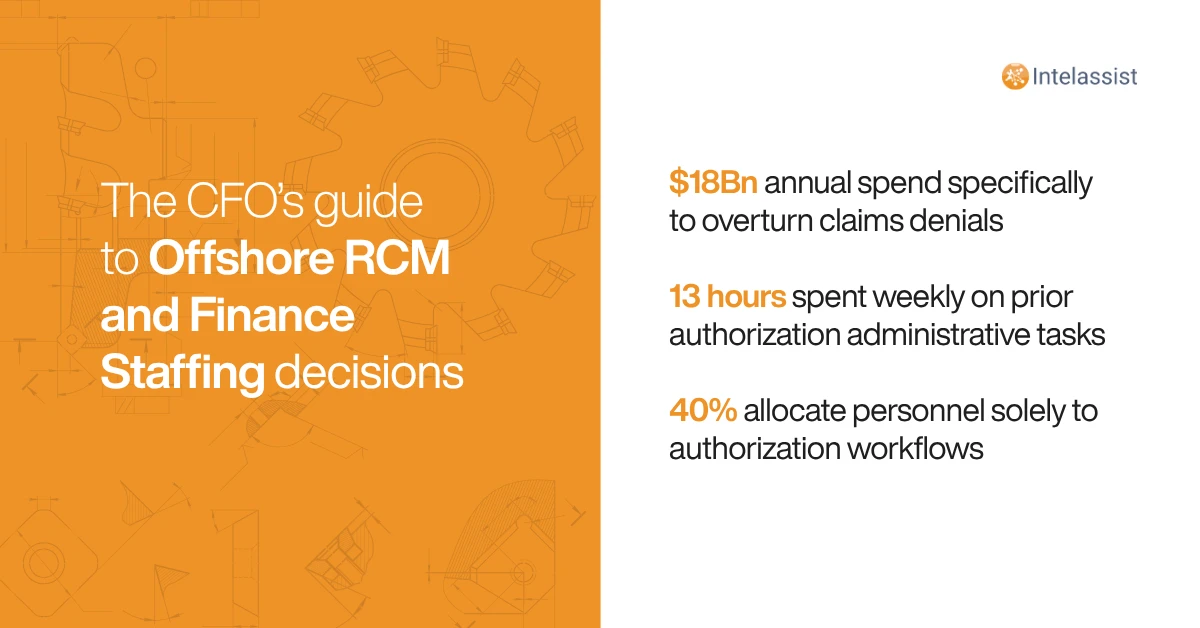
- The American Hospital Association reports that U.S. hospitals spent $43 billion in 2025 attempting to collect insurer payments for care already delivered, with nearly $18 billion dedicated specifically to overturning complex claims denials.
- According to survey data from the American Medical Association, practices complete roughly 39 prior authorization requests per physician each week, requiring 13 combined physician-and-staff hours. This administrative burden has forced 40% of practices to allocate dedicated personnel solely to authorization workflows.
- A global finance survey from Deloitte identifies accounting skill shortages, declining employee engagement, and cross-border operational complexity as primary cost drivers inflating corporate balance sheets and disrupting traditional global sourcing strategies.
What Is Offshore RCM and Finance Staffing?
Offshore RCM and finance staffing is an operational delivery model where healthcare and corporate organizations integrate full-time, dedicated remote staff into their internal revenue cycle management (RCM) and accounting workflows while retaining direct management authority and process control.
Unlike transactional outsourcing models, dedicated offshore staffing allows healthcare providers and financial officers to recruit specialized talent, such as an experienced RCM specialist or accounting assistant, who operate within the institution’s existing enterprise resource planning (ERP) platforms, electronic health record (EHR) systems, and practice management software.
For healthcare institutions, the primary operational triggers driving offshore evaluation extend far beyond simple claim volumes. CFOs and revenue cycle managers face four systemic operational challenges:
- Revenue Loss: Uncollected patient balances, unbilled services, and uncaptured charge entries that permanently erode operating margins.
- Increased Work Queues: Unprocessed billing backlogs and aging Accounts Receivable (AR) items that stall operational cash flow.
- Staffing Instability: High domestic turnover among billing, prior authorization, and accounting staff, leading to continuous recruiting overhead.
- Compliance Risks: Growing regulatory scrutiny around billing accuracy, coding precision, and patient privacy protections.
The Offshore Execution + Onshore Control Operational Model
The organizations that get offshore RCM staffing right tend to follow the same basic logic: let remote staff handle the work that’s high in volume and low in decision-making risk, while keeping your onshore team in charge of everything that requires real authority.
In practice, that means dedicated remote staff managing document collection, payment posting, account reconciliation, and claims follow-up — the work that’s necessary and time-consuming but doesn’t require a policy call. Your onshore controllers and administrators own approvals, clinical and financial decisions, and anything where the stakes are high enough to warrant internal oversight.
RCM Task Allocation: Offshore vs. Onshore Oversight
Selecting which revenue cycle workflows to outsource requires segregating repetitive administrative tasks from complex clinical judgements. The table below outlines appropriate task distribution for offshore RCM and finance staffing and onshore specialists:
| Best Suited for Offshore Delivery | Requires Onshore Specialist Oversight |
|---|---|
| Eligibility and benefit verification | Complex clinical documentation interpretation |
| Demographic and insurance updates | Provider education and clinician-facing escalation |
| Charge entry, claim submission, and claim-status work | High-value payer negotiations and contract disputes |
| Payment posting and cash reconciliation | Final coding decisions requiring certified legal accountability |
| Standard denial categorization and follow-up | Complex clinical appeals, legal reviews, and utilization management |
| Prior-authorization intake, document collection, and status tracking | Patient escalations involving clinical advice or sensitive financial hardship |
| A/R follow-up, work-queue administration, and operational reporting | Payer strategy and revenue-integrity governance |
When dedicated RCM staff are integrated with the right workflow tools, the capacity gains go further. Specialized care facilities have seen this play out clearly: automated workflows in settings like infusion centers, for example, are making a measurable difference in scheduling and throughput.
Finance & Accounting Delivery by Role Type
Corporate finance and healthcare accounting departments must similarly segment general ledger, treasury, and transactional roles based on control requirements:
| Transactional / Scalable Roles | Specialist / Controlled Hybrid Roles |
|---|---|
| AP processing and vendor-master maintenance | Controllership and monthly close ownership |
| Billing, cash application, and collections support | Technical accounting and complex consolidation |
| Expense auditing and employee-query support | Treasury, payment release, and primary bank authority |
| Reconciliations and account-schedule preparation | Tax sign-off and jurisdiction-specific compliance |
| Journal-entry preparation with approval workflow | FP&A business partnering and executive narrative development |
| Payroll administration support | Statutory reporting and audit representation |
| ERP data cleanup and reporting operations | Policy decisions, financial governance, and board reporting |
Evaluating Core Financial Risks: Turnover, Compliance, and Scalability
Assessing an offshore staffing model requires financial leaders to analyze key operational risks that impact net margins, data security, and long-term operating efficiency.
Quantifying Turnover Risk in Offshore RCM and Financial Staffing
Turnover risk in revenue cycle and finance operations directly impacts cash flow velocity, increasing administrative overhead and extending average days in Accounts Receivable.
Traditional transactional vendor environments suffer from high annual attrition rates ranging between 30% and 40%. When a billing specialist or accounting clerk departs, the organization incurs substantial hidden operational costs:
- Training Lag: 30 to 60 days required to onboard new vendor personnel on specific payer policies.
- Claim Backlogs: Aging work queues caused by unassigned accounts during staffing transitions.
- Denial Escalation: Increased initial denial rates due to learning curves among replacement staff.
In contrast, dedicated offshore RCM and finance staffing models prioritize employee engagement, competitive compensation, and structured career pathways. Maintaining team continuity ensures consistent claims follow-up, reduces billing errors, and stabilizes monthly revenue collection.
Mandatory HIPAA and Compliance Audits for CFOs
Offshore healthcare administration teams operating in foreign jurisdictions must strictly comply with U.S. health data privacy standards, including the HIPAA Privacy, Security, and Breach Notification Rules under the HITECH Act.
According to regulatory guidelines established by the U.S. Department of Health and Human Services, covered entities retain full legal responsibility for electronic protected health information (ePHI) accessed by foreign partners. CFOs and compliance officers must execute a rigorous compliance audit across three security pillars before signing an offshore agreement:
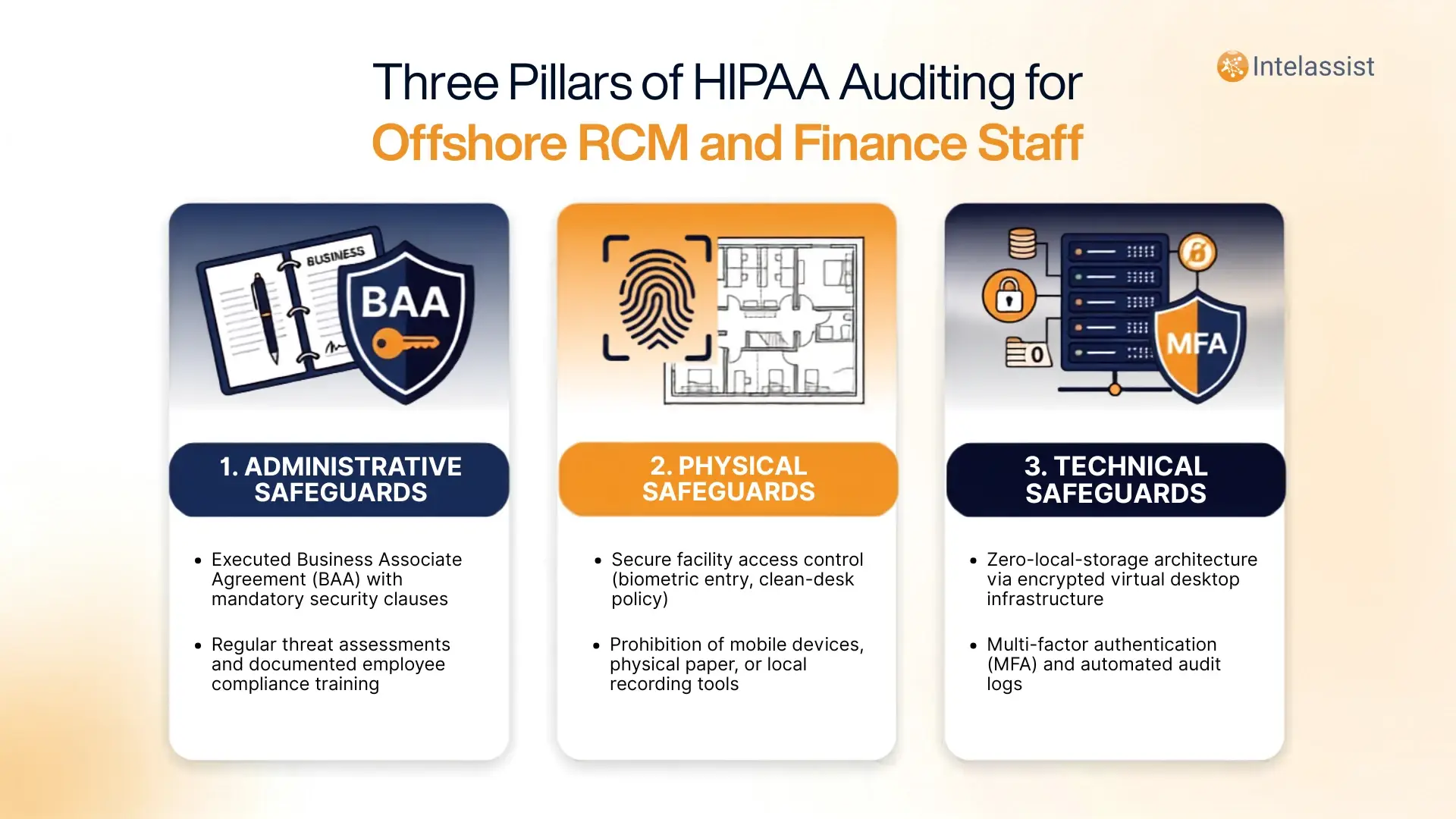
- Administrative Safeguards: Both parties must execute a binding Business Associate Agreement (BAA) that explicitly outlines ePHI handling rules, notification protocols within 24 to 48 hours, and mandatory annual employee security training.
- Physical Safeguards: Offshore facilities must enforce secure workstation environments. This includes biometric access controls, clean-desk environments devoid of paper or personal recording devices, and restricted facility access.
- Technical Safeguards: Offshore remote staff must access client systems exclusively through secure, encrypted Virtual Desktop Infrastructure (VDI) or Virtual Private Networks (VPN) featuring zero local data storage. Remote workstations must disable USB ports, local printing, and screen capture capabilities, backed by multi-factor authentication (MFA) and immutable audit logs.
Factoring Scalability into Total Cost of Ownership
Scalability directly affects total cost of ownership by transforming fixed domestic labor overhead into flexible, predictable operational expenses (OpEx).
Healthcare systems and enterprise finance teams frequently experience operational spikes driven by seasonal patient volumes, practice acquisitions, or system migrations. Recruiting domestic staff to absorb temporary administrative volume surges introduces significant long-term costs:
- High recruitment and sign-on expenses.
- Fixed long-term health insurance and payroll tax obligations.
- Potential severance liabilities if market volumes contract.
Dedicated offshore RCM and finance staffing provides elastic capacity. Leadership can scale capacity up or down with standard 30- to 60-day notice periods. This allows institutions to maintain low administrative overhead during normal operations while rapidly deploying dedicated remote staff during peak work queue cycles.
Key Questions Finance Leaders Must Ask Offshore RCM Providers
Before entering into a contractual agreement with an offshore staffing provider, CFOs, practice administrators, and controllers should conduct a structured operational audit using the checklist below:
- Data Governance & System Access: “How do offshore staff access our software, and how are security protocols adapted to align with our specific system access requirements?”
- Contractual Liability & Compliance: “What is your process for reviewing and signing our organization’s Business Associate Agreement (BAA) to support HIPAA compliance?”
- Dedicated vs. Shared Staffing: “Are the assigned specialists dedicated exclusively to our healthcare organization, or will they manage work queues for other accounts?”
- Staff Retention & Attrition Data: “What is your provider organization’s documented employee retention rate over the past 12 and 24 months for RCM and accounting specialists?”
- Performance Monitoring & Visibility: “What real-time dashboard tracking, screen auditing, and daily activity logs will finance leadership have access to?”
- Error Escalation Protocols: “What standard operating procedures govern quality assurance, billing error corrections, and immediate escalation of payer denial trends?”
Frequently Asked Questions (FAQ)
Dedicated offshore RCM and finance staffing provides healthcare organizations with full-time remote specialists who work directly within the client’s internal systems, software, and workflows under direct client management. In contrast, traditional medical billing companies operate as third-party black boxes that charge a percentage of collections, control proprietary software, and limit operational visibility into daily work queues.
Yes, offshore healthcare administration is fully compliant provided the service provider enforces strict technical, physical, and administrative safeguards required by the U.S. Department of Health and Human Services. Compliance requires a signed Business Associate Agreement (BAA), zero-local-storage remote desktop environments, encrypted communications, biometric facility security, and continuous compliance auditing.
Dedicated RCM specialists focus exclusively on specific administrative workflows, such as pre-claim eligibility verification, prior authorization processing, and timely claim-status follow-up. By ensuring accurate patient demographics and coding clean claims prior to submission, dedicated staff eliminate common error types that cause payer rejections, thereby accelerating claims processing and reducing average days in Accounts Receivable.
Organizations can offload scalable, transactional, and rules-based positions to dedicated remote staff. Key healthcare RCM roles include eligibility verification specialists, medical coders, charge entry clerks, payment posting representatives, and prior authorization coordinators. Key corporate finance roles include Accounts Payable (AP) specialists, billing coordinators, bank reconciliation clerks, and payroll support staff.