Article
How Remote Staffing Differs from Outsourcing
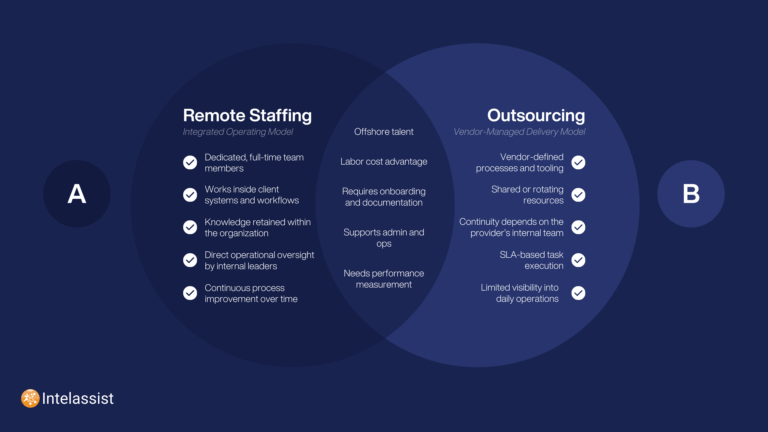
Remote staffing and outsourcing are often grouped together, but they represent distinct operating models with materially different effects on execution, accountability, and long-term performance. While both approaches can involve offshore labor, the way work is structured, managed, and improved over time differs significantly.
Remote staffing focuses on building dedicated team members who operate inside an organization’s workflows, systems, and performance standards. Outsourcing is designed around task execution through an external provider, typically using shared resources and vendor-managed processes. These differences shape how work is owned, how knowledge accumulates, and how organizations respond when conditions change.
For operational leaders evaluating offshore support, the distinction becomes most relevant after the initial transition period. The early phases of offshore engagement often feel similar across models. The divergence appears over time, as volume increases, edge cases emerge, and expectations evolve.
The two models function differently in real operating environments, and each can shape how work is owned, how teams are managed, and how knowledge is retained over time. Understanding these structural differences helps organizations align their support model with the type of work they need to sustain, especially when accountability, continuity, and quality matter.
Why the Distinction Is Often Overlooked
Organizations rarely begin offshore evaluations by comparing operating models. The decision is usually prompted by operational pressure: increasing workload, staffing constraints, or the need to improve cost efficiency without reducing service levels. Offshore support is introduced as a capacity lever.
Vendor language can obscure structural differences. Terms like “offshore teams,” “delivery support,” and “managed services” are often used interchangeably, even when the underlying models differ substantially. During early discussions, the focus tends to remain on headcount, cost, or speed of deployment rather than ownership and integration.
As a result, the practical implications of the model may not become apparent until the work is already in motion. At that point, the structure determines how easily teams adapt, how problems are resolved, and how performance is sustained.
How Traditional Outsourcing Operates in Practice
Traditional outsourcing is built around delegation. Responsibility for defined tasks or processes is transferred to a third-party provider, which manages execution using its own internal structure. Performance is typically governed by service-level agreements, escalation paths, and periodic reporting.
This model is well suited for work that is stable, standardized, and largely independent of internal decision-making. When inputs and outputs are predictable, outsourcing can deliver efficiency by reducing management overhead and consolidating execution within the vendor’s operation.
In more dynamic environments, outsourcing introduces separation between the people performing the work and the teams affected by the outcomes. Communication often flows through formal channels, such as account managers or ticketing systems. Process changes require coordination across organizational boundaries, which can slow iteration.
Over time, knowledge tends to remain with the vendor rather than becoming embedded within the client organization. While this can be acceptable for discrete functions, it can create friction when work requires judgment, contextual awareness, or ongoing refinement.
These characteristics are not the result of poor execution. They are structural features of a model designed to prioritize delivery over integration.
How Remote Staffing Is Structured Differently
Remote staffing approaches offshore support as an extension of the internal team rather than an external service. Dedicated offshore professionals are hired for specific roles and embedded into existing workflows, reporting structures, and performance expectations.
In this model, work is assigned directly rather than routed through vendor processes. Remote team members use the same systems, follow the same procedures, and are measured against the same outcomes as onshore staff. Ownership remains internal, even though execution is geographically distributed.
This structure allows institutional knowledge to accumulate over time. Context is retained across cycles, and improvements are made within the operating flow rather than negotiated across organizational boundaries. Changes in priority or process can be implemented quickly because decision-making authority remains with the client team.
Remote staffing requires more deliberate setup than outsourcing. Roles must be clearly defined, documentation must be maintained, and communication norms must be established. The upfront investment supports greater continuity and adaptability once the model is in place.
Ownership and Accountability Over Time
One of the most significant differences between the two models is how ownership evolves.
In outsourcing arrangements, accountability is externalized. When issues arise, resolution often involves escalation to the vendor, review against contractual terms, and negotiation around scope or responsibility. This can be effective when boundaries are clear, but it can introduce delays when work does not fit neatly into predefined categories.
Remote staffing maintains accountability within the organization. Offshore team members are part of the same operational structure as onshore staff, which simplifies responsibility for outcomes. Issues are addressed through the same management channels rather than escalated externally.
For operational leaders, this difference affects how quickly problems are identified and resolved, particularly in environments with frequent exceptions or changing requirements.
Communication and Workflow Integration
Communication patterns differ substantially between the two models.
Outsourcing relies on structured communication mechanisms designed to manage external delivery. These may include formal status updates, ticket queues, or account reviews. While these systems provide clarity, they can limit real-time collaboration and slow response to emerging issues.
Remote staffing supports direct, day-to-day interaction. Offshore team members participate in the same meetings, use the same communication tools, and collaborate with internal stakeholders in real time. This integration supports faster feedback loops and more consistent execution.
As operational complexity increases, the ability to communicate directly within the workflow becomes increasingly valuable.
Knowledge Retention and Process Improvement
Process improvement depends on continuity and context.
In outsourcing models, improvements are often driven by the vendor’s internal optimization efforts. While this can produce efficiencies, those gains may not fully align with the client’s evolving priorities. Knowledge developed during execution may not transfer back into the organization.
Remote staffing embeds learning within the client team. As offshore staff gain experience, they contribute to documentation, process refinement, and institutional memory. Improvements accumulate over time and remain accessible even as volume or scope changes.
For organizations managing ongoing operations rather than finite projects, this distinction has long-term implications for quality and consistency.
Flexibility Under Changing Conditions
Operational environments rarely remain static. Volume fluctuates, regulations evolve, and internal priorities shift.
Outsourcing models accommodate change through renegotiation of scope, pricing, or service levels. While this provides structure, it can slow adaptation and introduce friction when changes are frequent or incremental.
Remote staffing allows organizations to adjust workflows internally. Because offshore staff are integrated into the operating model, changes can be implemented without renegotiating vendor terms. This flexibility is particularly relevant in regulated or fast-moving environments.
Cost Structure and Value Over Time
Both models can deliver cost advantages compared to onshore staffing, but the nature of those savings differs.
Outsourcing often emphasizes short-term cost efficiency through labor arbitrage and process consolidation. Pricing is tied to outputs or service levels, which can be attractive for predictable workloads.
Remote staffing shifts the cost conversation toward long-term value. While offshore labor costs remain lower, the primary benefit comes from improved continuity, reduced rework, and more efficient internal coordination. Over time, these factors can produce meaningful operational savings beyond wage differentials.
For leaders responsible for sustained performance rather than one-time cost reduction, this distinction matters.
Choosing the Right Model
Neither remote staffing nor outsourcing is inherently better. The appropriate model depends on the nature of the work, the level of integration required, and the organization’s tolerance for external dependency.
Outsourcing is well suited for standardized, transactional functions with stable requirements. Remote staffing is better aligned with roles that require judgment, ongoing collaboration, or deep integration into internal systems.
Understanding these differences allows organizations to make more deliberate choices and avoid misalignment between structure and operational reality.
Closing Perspective
Offshore support decisions are often framed around cost or speed. In practice, the operating model determines how effectively work is executed once those initial benefits are realized.
Remote staffing and outsourcing solve different problems. Clarifying how each behaves under real operating conditions enables leaders to align offshore support with their broader operational goals, rather than retrofitting structure after issues emerge.
For organizations evaluating offshore models, the most important question is not how quickly capacity can be added, but how work will be owned, improved, and sustained over time.
About Intelassist
Intelassist supports organizations with integrated remote teams in the Philippines, providing structured operational support across administrative, technical, and business-critical functions. Our model is designed to improve execution, continuity, and efficiency while allowing teams to maintain control and oversight. Learn more at www.intelassist.com or contact info@intelassist.com.
contact US
How can we help?
Get in touch with one of our local experts today. We typically respond within 24 hours.