Behavioral health workforce burnout is primarily driven by non-clinical administrative overhead, including reauthorizations, claim denials, and complex billing, which consumes up to one-third of provider working hours. Offloading non-clinical revenue cycle management (RCM) and patient access workflows to dedicated, embedded specialists reduces clinician fatigue and prevents network departure while preserving practice oversight and HIPAA compliance.
Core Findings:
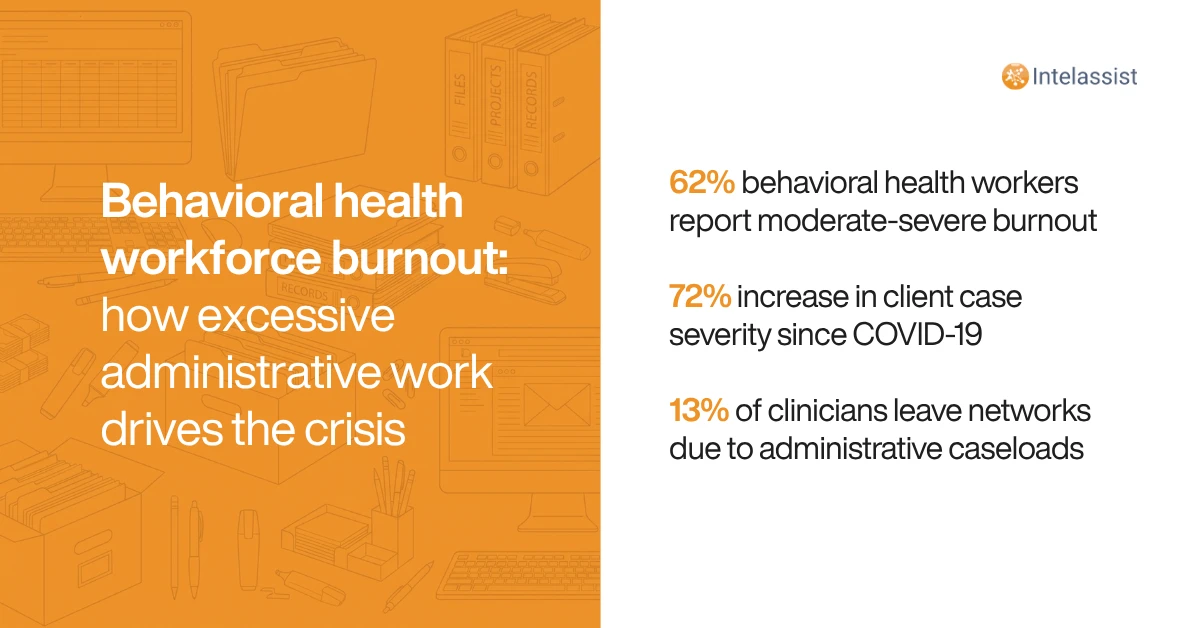
- While behavioral health employees find fulfillment in client care, 62% report moderate or severe levels of burnout, and 80% (4 in 5) state that work-related stress negatively impacts their personal life, including mental health (37%).
- Since the onset of the COVID-19 pandemic, 72% of behavioral health workers report seeing an increase in client case severity.
- One-third of the behavioral health workforce spends the majority of their work hours on administrative tasks, and 68% of care providers state that administrative demands directly reduce time available for patient care.
- Administrative friction creates barriers to network participation, with clinicians citing insufficient reimbursement rates (82%), prior authorization and audit demands (62%), and payment delays or refund clawbacks (52%) as major obstacles.
- Administrative burden directly accelerates provider departures, with 13% of clinicians leaving insurance networks specifically citing burnout tied to excessive administrative caseloads.
The Hidden Operational Weight of Non-Clinical Administrative Work
Clinicians enter behavioral health to treat patients, yet non-clinical tasks absorb a massive portion of their schedule. Routine documentation, scheduling back-and-forth, and insurance verifications consume over 30% of a provider’s average workday. For behavioral health centers, this administrative overload directly limits clinical capacity.
When paperwork expands, patient care contracts. Survey data from the National Council for Mental Wellbeing reveals that 68% of care providers report administrative demands actively subtract from direct client interaction time. As administrative tasks accumulate alongside rising client case severity, providers experience cognitive exhaustion. This operational friction drives 48% of the behavioral health workforce to consider alternative employment options, turning administrative inefficiency into an acute retention threat.
Every hour a licensed clinician spends navigating insurance forms or clearinghouse rejections is an hour removed from revenue-generating clinical care and patient access.
Why Clinicians Are Leaving Insurance Panels and Private Practice
According to a report by the American Psychological Association, clinicians opting out of insurance networks identify three primary administrative barriers:
- Insufficient reimbursement rates (82%)
- Prior authorization requirements and audit demands (62%)
- Payment delays and refund clawback demands (52%)
The administrative strain associated with commercial insurance plans is causing many licensed providers to abandon the behavioral health workforce entirely. Managing insurance claims requires extensive documentation, frequent denial follow-ups, and ongoing audit defenses.
How Does Administrative Overhead Impact Behavioral Health Operations?
Behavioral health workforce burnout is often a symptom of a deeper operational problem: too much non-clinical work landing on clinical and administrative staff with no structural relief in sight. When that happens, claims processing slows, revenue cycle performance drops, and the people holding everything together start burning out. Identifying where that friction lives in your practice is the first step toward addressing it before it affects your capacity to deliver care.
Reauthorization Demands, Denials, and Revenue Loss
Insurance friction in the behavioral health workforce is not limited to initial claims filing. Payer authorization protocols require recurring justification for continued care. Treatments typically require formal reauthorization every 8 to 20 sessions, costing practices an estimated 5% to 10% of total session revenue in administrative overhead.
Payers frequently employ predictable denial playbooks, approving initial treatment plans only to issue retrospective denials citing a “lack of medical necessity.” When denials occur, in-house practice staff must appeal claims, gather secondary clinical notes, and resubmit documentation. Without dedicated behavioral health billing services, these denial workflows fall back onto practice administrators or clinicians themselves, delaying cash flow and inflating days in Accounts Receivable (AR).
Compounding National Provider Shortages and Administrative Attrition
Data from HRSA indicates that 40% of Americans—approximately 137 million people—live in a designated Mental Health Professional Shortage Area. Long-term workforce projections further highlight severe impending deficits across core clinical roles:
- 99,840 psychologists
- 99,780 mental health counselors
- 77,050 addiction counselors
- 36,780 psychiatrists
When behavioral health centers allow administrative overhead to consume clinical hours, it compounds provider shortages within their own clinics. Protecting existing clinical staff from billing, coding, and prior authorization duties is the single most actionable strategy practice managers and HR leaders can deploy to improve staff retention.
Solving Behavioral Health Workforce Burnout Through Dedicated Administrative Delegation
By delegating administrative responsibilities to dedicated offshore specialists, behavioral health practices restore care capacity while protecting clinician retention. Transitioning to this model preserves clinical energy without sacrificing quality control or operational visibility.
Offloading Non-Clinical Workflows to Protect Clinical Bandwidth
Resolving behavioral health workforce burnout requires separating clinical duties from non-clinical operational tasks. Licensed therapists, psychologists, and psychiatrists should focus exclusively on diagnostic evaluations, treatment planning, and patient care.
A thorough operational audit identifies non-clinical workflows that do not require a medical license:
- Prior authorization requests and reauthorization tracking
- Claims coding, billing submission, and clearinghouse rejection fixes
- Insurance eligibility and benefit verifications
- Patient intake, appointment scheduling, and co-pay collection
Systematically transferring these tasks to dedicated support specialists removes non-clinical friction from licensed clinicians, restoring focus and reducing daily fatigue.
Role-Specific Administrative Offloading: Coders, Billers, and Prior Auth Specialists
Rather than expecting general administrative staff to handle specialized billing workflows, behavioral health centers benefit from specialized roles:
- Prior Authorization Specialist: Manages session reauthorizations, tracks payer response windows, submits clinical justification attachments, and resolves auth-related rejections before appointments occur.
- Medical Coding and Billing Specialist: Oversees clean claim generation, applies proper CPT service and ICD-10 diagnostic codes for mental health encounters, submits electronic claims, and appeals denied claims.
- Patient Access Representative: Handles insurance verification, confirms copays and deductibles, processes intake paperwork, and reduces front-desk bottlenecks.
Traditional Outsourcing vs. Dedicated Remote Staffing: Preserving Oversight and Control
When evaluating healthcare outsourcing, practice administrators often express concern over traditional Business Process Outsourcing (BPO) models. Traditional medical billing companies frequently operate as a “black box”: taking over billing processes while offering limited transparency, rigid workflows, and minimal control over quality.
Intelassist provides an alternative model. Instead of handing off operations to an external agency, dedicated offshore specialists integrate directly into your practice’s existing software, EHR platform, and daily communication tools. You retain direct management, workflow visibility, and operational oversight, while gaining dedicated, role-specific RCM support that operates as a natural extension of your team.
Learn more about our dedicated offshore healthcare & RCM staffing model here. →
How Behavioral Health Centers Can Transition Administrative Work Safely
Practice administrators in behavioral health centers must satisfy internal IT, compliance, and clinical leadership that patient data remains secure during any operational expansion. Implementing proven compliance standards and onboarding protocols ensures a smooth transition without interrupting revenue collection or patient care.
Protecting Patient Data with Certified HIPAA-HITECH Standards
Bringing in external administrative support introduces real data security responsibilities and practice managers need to be confident that any vendor they work with meets HIPAA standards from day one. The process of vetting an offshore RCM partner is where that confidence gets built, and it’s worth doing thoroughly before any engagement begins.
Intelassist enforces enterprise-grade security protocols across all remote placements:
- HIPAA Certification: Comprehensive administrative, physical, and technical safeguards.
- Secure Infrastructure: Strict data access controls, encrypted communication channels, and secure virtual desktop environments that prevent local data storage or unauthorized exports.
- Audit Readiness: Documented compliance frameworks and clear operational procedures to satisfy internal IT and legal compliance evaluations.
Integration Framework for Dedicated Medical Billing and Coding Specialist and Administrative Support
Scaling administrative capacity with Intelassist follows a structured, risk-mitigated timeline designed to prevent operational disruption. That process is anchored by our offshore integration framework* that ensures every new team member is fully embedded before taking on independent responsibility:
- Workflow & Role Mapping (Days 1–10): Documenting non-clinical tasks, software requirements, and key performance metrics for the open role.
- Sourcing & Talent Screening (Days 11–25): Pre-screening experienced healthcare outsourcing candidates with specific behavioral health RCM experience.
- Placement & Systems Integration (Days 26–45): Onboarding dedicated specialists into your existing EHR and billing platforms, establishing daily communication protocols, and initiating live workflow handoffs within a 30 to 45-day window.
* Timelines may vary depending on role complexity and coordination with your practice.
Frequently Asked Questions About Behavioral Health Workforce Burnout
Behavioral health workforce burnout is primarily caused by non-clinical administrative overhead—including documentation, prior authorizations, and complex billing—combined with increased client caseloads and case severity.
Excessive prior authorization demands, claim denials, payment delays, and below-market reimbursement rates force clinicians to spend uncompensated hours on billing, driving them toward cash-pay practice models.
Approximately one-third of provider working hours are consumed by administrative tasks, with 68% of care providers reporting that paperwork directly reduces time available for patient care.
Traditional medical billing companies act as external “black box” vendors with limited visibility. Dedicated remote staffing integrates dedicated specialists directly into your existing EHR, software, and team workflows, giving you complete visibility and control.
Behavioral health centers can delegate prior authorization specialists, medical billers and coders, patient access reps, and care management support staff to handle administrative tasks.
What’s Your Next Step?
Start with one week of data. Ask your clinicians to track how much time they’re spending on administrative work — not clinical care, just the paperwork and coordination tasks that pile up alongside it. (Note: Most practices find that a significant portion of that time is going toward work that doesn’t require a clinical license at all.)
Once you have that baseline, you’ll have a much clearer sense of where the real opportunity is. We’re happy to walk through it with you.