Before signing a contract with a behavioral health billing partner, practice owners and revenue cycle leaders must ask for HIPAA compliance certification, role-specific workflow integration, strict key performance indicator (KPI) benchmarks, and verified agent retention metrics. Demanding these five standards prevents cash flow interruptions, eliminates unbilled claim backlogs, and protects practice oversight.
Core Findings:
- Industry RCM standards require maintaining a clean claim rate of at least 85% to 95% on first submission.
- According to the APA, 82% of psychologists cite insufficient reimbursement rates, 62% struggle with preauthorization or audit requirements, and 52% face payment reliability issues such as delays and clawbacks.
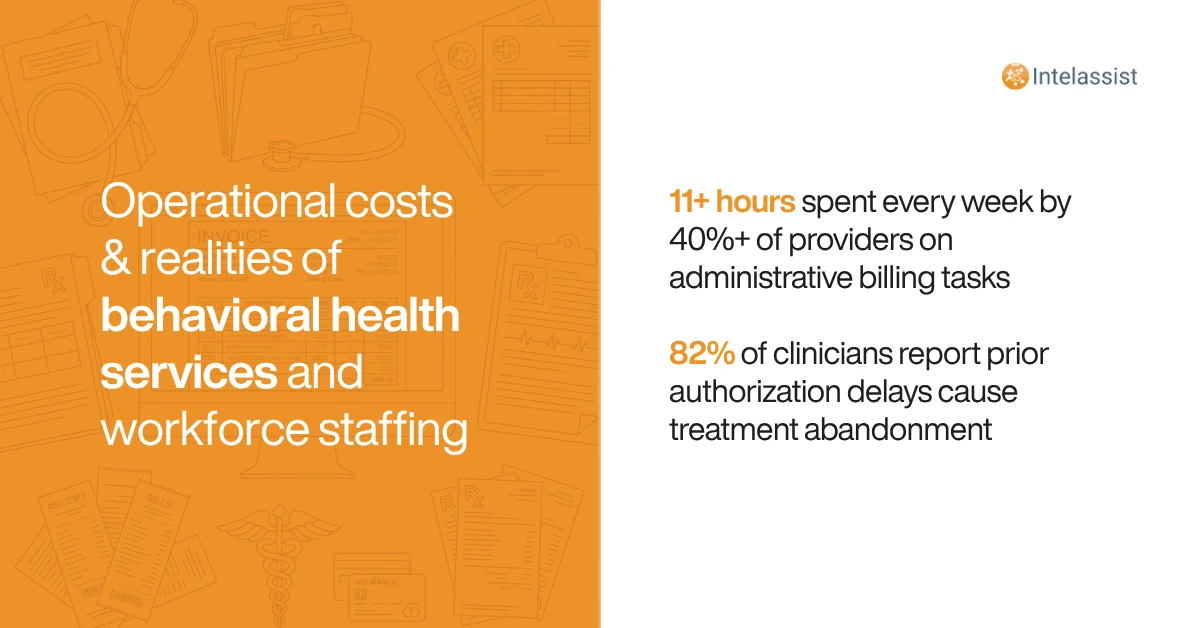
- Over 40% of surveyed behavioral health providers spend 11 or more hours every week on documentation, billing, and non-clinical administrative tasks.
- AMA survey data indicate that 93% of physicians report prior authorization delays patient care, while 82% report it causes patients to abandon recommended treatment courses entirely.
- Behavioral health revenue cycles face distinct hurdles, including frequent “lack of medical necessity” rejections, benefit denials, and out-of-network status friction.
Why Generic Medical Billing Outsourcing Doesn’t Work for Behavioral Health
Most generic billing agencies treat mental health claims the same as high-volume physical medicine, creating friction with prior authorizations and coding rules. Recognizing these structural mismatches helps practice owners avoid repeating costly vendor switches.
Low-Cost Vendors, Billing Errors, and In-House Repatriation
Outsourcing revenue cycle management (RCM) to generic billing vendors often leads to compounding financial losses. Low-cost agencies assign rotating generalists who lack familiarity with mental health claims. When offshore reps make coding errors or mismanage clearinghouse rejections, claim denials spike and days in Accounts Receivable (AR) stretch past 50 days.
Practices end up spending more recovering lost revenue than they saved on vendor fees, forcing practice owners to bring billing back in-house.
Specialty-Specific Revenue Cycle Friction
Behavioral health RCM differs significantly from general medical billing. Multi-layered treatment plans, strict reauthorization windows, and payer-specific quirks around telehealth and Medicaid simply aren’t set up for generic RCM providers to handle.
If you’re comparing medical coding and billing outsourcing options, ask directly whether the team has real behavioral health experience—not just general healthcare experience. Not all healthcare outsourcing companies structure their teams the same way, and the pool of people who genuinely understand this corner of the behavioral health workforce is smaller than most vendors let on.
1. Ask for HIPAA Compliance Proof Before Any Commercial Discussion
HIPAA compliance proof must precede any commercial or pricing discussion. Practice administrators, IT directors, and legal compliance teams need concrete evidence that patient data remains secure. Demand verifiable compliance documentation directly from the vendor:
- Active Security Certifications: Recent third-party audit reports and verified HIPAA compliance certification.
- Binding Legal Frameworks: Fully executed Business Associate Agreements (BAAs) covering all offshore operational touchpoints.
- Infrastructure Controls: Secure Virtual Desktop Infrastructure (VDI) blocking local data storage, disabling external hardware drives, and enforcing encrypted communication protocols.
A qualified offshore healthcare RCM partner provides turnkey compliance documentation packages ready for immediate internal review. Pre-packaged audit logs, infrastructure diagrams, and compliance credentials allow practice managers to satisfy internal IT and legal standards without delaying partner evaluation.
2. Role-Specific Expertise and Direct Workflow Integration
Behavioral health revenue cycles require distinct skill sets spanning authorization management, coding accuracy, and patient intake coordination. Asking how a partner structures its staff clarifies whether you are acquiring dedicated team members or shared pool generalists.
A behavioral health services billing partner must provide dedicated specialists who integrate directly into your existing Electronic Health Record (EHR) systems:
- Prior Authorization Specialist: Tracks authorization windows, files reauthorizations every 8 to 20 therapy sessions, and attaches required clinical justifications to prevent care drop-offs.
- Medical Coding and Billing Specialist: Applies exact CPT codes, manages diagnostic coding, and resolves clearinghouse rejections before submission.
- Patient Access Representative: Verifies patient insurance coverage, confirms copays and deductibles, and handles patient intake paperwork.
Reauthorization Tracking and Payer Management
Commercial insurance carriers typically require formal treatment reauthorization every 8 to 20 sessions. When authorizations expire without renewal, practices are forced to absorb uncollectible care costs.
Dedicated medical coding and billing specialists implement proactive tracking schedules, securing authorizations well before care thresholds are reached.
3. Contractual Alignment on Key Behavioral Health RCM Benchmarks
Establishing contractual key performance indicators ensures both practice leadership and the billing partner evaluate progress against standard revenue cycle benchmarks. Requiring explicit SLA targets protects working capital and maintains consistent cash flow.
Ask your billing partner to enforce clear revenue cycle management benchmarks based on industry standards:
| RCM Performance Metric | Target Benchmark | Warning Threshold | Operational Risk |
|---|---|---|---|
| Clean Claim Rate | ≥85 – 95% | <80% | Clearinghouse rejections & delayed cash flow |
| Denial Rate | <5% | >10% | Uncollected care revenue & heavy appeal workloads |
| First-Pass Resolution | ≥90% | <80% | Excessive rework & extended collection cycles |
| Days in AR | <40 days | >50 days | Stalled working capital & bad debt write-offs |
| Net Collection Rate | ≥95% | <90% | Direct practice revenue loss |
| Charge Lag | <3 days | >7 days | Delayed initial billing cycles |
4. Complete Pricing Transparency and Scope Exclusions
Understanding industry pricing norms allows practice owners to evaluate quotes accurately:
- Percentage of Collections: Standard fees range from 5% to 10% of collections, with most practices paying 6% to 8%.
- Flat Rate / Per Claim: Rates range from $2 to $8 per claim or $1,000 to $5,000 per month.
- In-House Cost Baseline: Managing billing in-house for solo and small practices averages 10.9% of total collections. Comparing external billing costs against this 10.9% baseline provides an exact reference point for evaluating true return on investment.
Many medical billing companies advertise low collection percentages, only to mask essential billing tasks behind add-on fees. Before signing, get a straight answer on whether these are covered or billed separately:
- Denial management and appeal submissions
- Telehealth coding and modifier handling
- Medicaid billing and superbills
- Setup and onboarding fees
- Provider credentialing
5. Verified Staff Retention Rates
High agent turnover represents one of the most overlooked risks in healthcare outsourcing. When a behavioral services billing partner experiences constant turnover, your practice absorbs the cost of retraining, leading to billing errors and lost productivity. Focusing on employee retention data provides a true indicator of vendor stability.
Choosing a partner that maintains a 90%+ staff retention rate ensures operational continuity. Dedicated billing specialists who stay with your account build deep familiarity with your EHR system, specific payer guidelines, and practice-specific billing nuances—protecting steady revenue collection.
Frequently Asked Questions About Behavioral Health Billing Services
A billing partner must provide verifiable proof of HIPAA compliance, executed BAAs, third-party audit reports, secure tech environments, and restricted local device storage.
Industry standards set by HFMA require a clean claim rate between 85% and 95% on initial submission. Falling below 80% indicates structural coding errors.
Payers often issue retrospective denials after initial care approvals. Dedicated RCM specialists counter this by attaching complete clinical notes during primary submission and filing prompt appeals.
Most commercial payers require formal prior authorization renewals every 8 to 20 therapy sessions, making automated tracking essential to avoid unbilled treatment hours.