What’s the real difference for your business?
The debate between outsourcing vs. dedicated remote staffing comes up a lot, and on the surface, the two can look similar. Both involve bringing in external talent, but how that talent is managed and how much visibility you have into the work is where things diverge significantly.
Traditional outsourcing hands off a task or process to a third-party vendor who runs it largely on their own terms. You get an output; you don’t always know what’s happening behind it. Dedicated remote staffing works differently. You hire full-time professionals through an offshore partner, people who are custom-vetted for your needs, and you keep full control over how they work, what tools they use, and how their days are structured. They function like in-house staff, just based elsewhere.
Here’s why the distinction between outsourcing vs. dedicated remote staffing matters when you’re scaling, and why more businesses are making the switch.
Traditional Outsourcing vs. Dedicated Remote Staffing
To scale operations, especially for mid-market businesses, leaders must understand the trade-offs between traditional outsourcing and a dedicated remote team. While traditional outsourcing models seem simple because they reduce local administrative overhead, they almost always require sacrificing day-to-day process transparency and direct communication with the people doing the work.
The table below breaks down the structural differences between these two models:
| Feature / Model | Traditional Project-Based Outsourcing | Dedicated Remote Staffing |
|---|---|---|
| Operational Oversight | Vendor-managed black box model | You retain 100% daily task and process control |
| Recruitment & Skill Vetting | Assigned from a generic, rotating bench | Custom-vetted, role-specific candidates |
| Team Integration | Fragmented communications; vendor-owned | Direct daily collaboration via Slack, Teams, or Zoom |
| Data & IP Security | Shared vendor infrastructure and devices | Secure endpoints, direct client-controlled networks |
| Retention Rate | High churn (industry standard 40%+ BPO average) | 90%+ long-term retention rate |
If you are evaluating offshore strategies, understanding the benefits of building a remote staff in the Philippines helps clarify why specific regions are highly suited for dedicated technical and administrative teams. Deciding between outsourcing vs. dedicated remote staffing is the critical first step in determining how those teams will be managed.
Why Outsourcing Fails Complex, Technical Verticals
For simple, repetitive tasks like basic data entry, a traditional outsourcing setup can work. However, this model fails when applied to specialized roles that require real-time collaboration, tool-specific expertise, and deep integration:
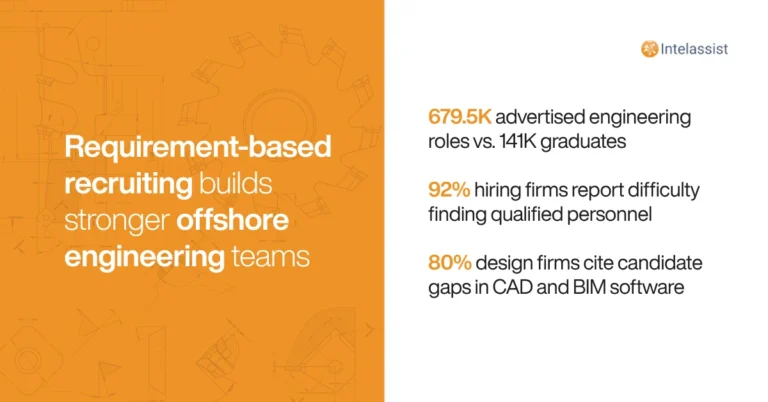
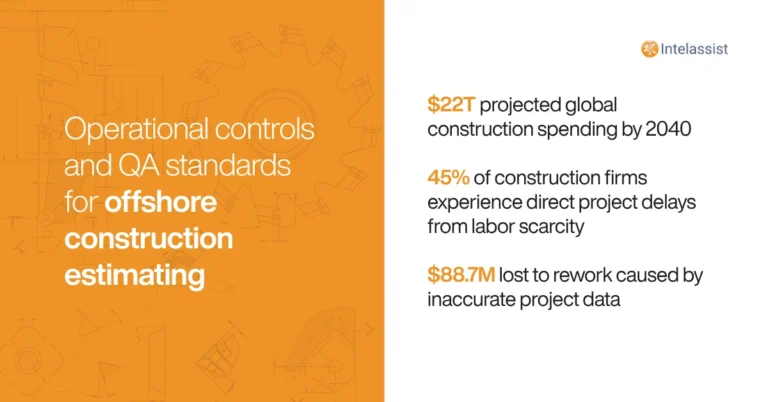
- A/E/C Operations: Drafting and engineering roles involving Revit modeling, structural CAD drafting, and civil engineering design require immediate communication. A black-box vendor cannot adapt to the rapid, daily changes in drawings required to keep a major construction project on schedule, resulting in costly errors.
In technical design, choosing between outsourcing vs. dedicated remote staffing is often the difference between continuous project delays and real-time execution.
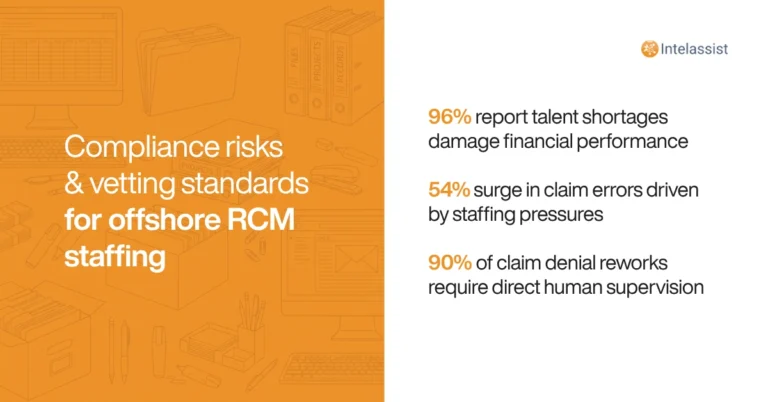
- Healthcare Revenue Cycle Management (RCM): Complex medical billing, coding, and denial management operations require strict adherence to regulatory standards such as HIPAA. Isolating your billing team from daily clinical updates increases claims rejection rates and exposes your practice to audit risks.
- IT & Technical Support: Managing complex cloud environments, multi-tiered helpdesk operations, and systems administration demands deep institutional knowledge. Shared transactional support agents lack familiarity with your proprietary environments, resulting in slow ticket resolutions and system downtime.
- Finance & Accounting: Tasks like multi-entity bookkeeping, tax preparation support, and detailed management reporting demand high precision. When outsourced to a generic, rotating bench, standard operating procedures are easily lost, leaving local teams to correct errors during the month-end close.
- Back Office & Admin Support: Complex CRM management (such as WordPress-to-HubSpot database integrations), customer service, and executive assistance are highly contextual. Treating these workflows as simple, robotic ticketing tasks ignores the need for brand-specific communication styles, leading to disorganized databases and fractured customer experiences.
Because these roles require direct access, continuous training, and high-security compliance, a hands-off transactional setup is a recipe for operational failure. Implementing robust global team security standards is the only way to safeguard proprietary operational data and maintain client trust when scaling across borders.
How the Dedicated Remote Staffing Model Bridges the Gap
The modern dedicated remote staffing model has evolved to solve the visibility, quality, and control issues of traditional outsourcing. Rather than bearing the massive financial and administrative burden of establishing a legal foreign entity (captive offshoring), companies partner with a boutique provider in Metro Manila to build a dedicated remote team.
This hybrid approach combines the geographic cost advantages of offshoring with the operational control of direct hiring:
- You Direct the Work: Your remote team uses your systems, attends your daily stand-ups, and operates under your management style.
- Intelassist Handles the Rest: As your local partner, Intelassist manages payroll, compliance, HR, benefits, and provides top-tier office workstations in Eastwood City, Metro Manila.
This model is highly scalable and has been successfully implemented across demanding, technical sectors:
| Architecture & Engineering Technical operations leads have used this hybrid framework to scale complex drafting divisions, such as building a 60-person offshore CAD drafting team to handle major commercial development pipelines. | Corporate Finance Financial organizations regularly optimize their standard operating procedures by scaling financial reporting with dedicated remote staff, ensuring continuous compliance and timely close-of-month reporting. |
Frequently Asked Questions
The primary difference is operational control and team ownership. Traditional outsourcing delegates entire projects to an external vendor who manages the staff behind a “black box”. Dedicated remote staffing allows you to hand-pick your team members, who work directly under your daily management and systems as if they were local employees.
Companies choose the Philippines due to its highly educated, English-fluent professional workforce, deep cultural alignment with Western business environments, and cost-effective labor market. For executive leadership teams seeking to scale sustainable operations, reviewing a comprehensive offshoring evaluation framework provides the necessary data points to make structured decisions regarding talent quality and long-term retention.
Yes. Because dedicated remote staff work directly inside your platforms (such as QuickBooks, Revit, or HubSpot) and report to your managers daily, you maintain complete oversight of work quality, communication, and project timelines.
Our technical vetting process is highly customized and rigorous. For specialized positions, such as Revit draftsmen, structural estimators, IT support engineers, or corporate bookkeepers, candidates undergo rigorous skills testing and portfolio reviews before they are presented to your team. We screen for specific software proficiencies, industry certifications, and practical problem-solving capabilities, ensuring that every professional is fully equipped to match your existing operational standards from day one.
Key Takeaways
The conflict between outsourcing vs. dedicated remote staffing has been cleared. Traditional outsourcing inevitably compromises project visibility and quality, making it a poor fit for specialized disciplines. By transitioning to a dedicated remote staffing model, companies bypass these failure points, placing custom-vetted professionals directly inside their native systems and day-to-day communication loops.
Partnering with an offshore outsourcing model like Intelassist provides the ultimate hybrid advantage: mid-market businesses secure elite, highly screened technical talent in the Philippines, all while retaining 100% daily operational control.