Outsourcing construction estimating means embedding dedicated remote technical estimators into a general contractor or subcontractor’s workflow to manage quantity takeoffs, cost calculations, material schedules, and bid documentation.
Unlike shared vendor pools where staff rotates across clients, dedicated outsourcing construction models assign full-time estimators directly to your operational framework. These estimators work within your file repositories, use your division codes, and follow your internal pricing formulas under the direct management of your in-house leadership.
Core Findings:
- Global construction spending is projected to grow from $13 trillion in 2023 to $22 trillion by 2040 at a 3.2% CAGR, yet internal estimating throughput still constrains firms.
- Construction productivity grew only 0.4% annually between 2000 and 2022, falling behind the broader economic average of 2%.
- 92% of construction firms hiring report difficulty finding qualified technical workers, with 45% experiencing direct project delays due to labor scarcity.
- 30% of project data is classified as “bad data,” leading to poor decision-making that costs the construction industry $88.69 million in rework alone.
- 60% of industrial firms are moving beyond regional hiring constraints to integrate remote technical teams.
What Construction Estimating Duties Can Be Done by Integrated Remote Teams?
Integrating offshore capacity requires identifying the labor-intensive, technical mechanics of bid preparation that consume in-house engineering hours. By delegating these to a remote team, operations leaders free their senior local estimators to focus on pricing strategy, site visits, and subcontractor negotiations.
When firms evaluate what engineering services outsourcing actually looks like, they find that technical estimating tasks follow the same systematic handoffs as remote design and coordination roles.
Core Technical Scope & Takeoff Processing
A dedicated remote estimator handles the manual and analytical mechanics of bid preparation. Primary construction estimator duties include:
- Digital Quantity Takeoffs (QTO): Extracting exact spatial measurements, material counts, and linear footages across architectural, structural, and MEP drawings.
- Bill of Quantities (BOQ) & Material Schedules: Generating itemized Material Takeoffs (MTO) mapped to project specifications and unit rate databases.
- Database Maintenance: Updating unit prices, labor constants, and material inflation factors within company pricing sheets.
- Bid Package Compilation: Organizing scope sheets, submittal binders, and trade line-item breakdowns prior to executive review.
Scope Allocation Matrix: In-House vs. Dedicated Offshore Estimator
| Estimating Stage | Dedicated Offshore Estimator | In-House Operations Lead / COO |
|---|---|---|
| Plan Ingestion & Audit | Organizes drawing sets, verifies scale, logs addenda, and Flags plan omissions. | Sets project selection criteria and makes final bid/no-bid decisions. |
| Quantity Takeoff (QTO) | Executes line-item spatial counts, material schedules, and assembly calculations. | Reviews complex structural, site work, or high-risk scope conditions. |
| Vendor & Subcontractor Contact | Issues quote solicitations, tracks bids, and builds scope comparison sheets. | Manages core vendor relationships and negotiates final subcontractor pricing. |
| RFI Management | Drafts technical Requests for Information (RFIs) for plan discrepancies. | Reviews, approves, and submits formal RFIs to architects or engineers. |
| Final Bid Assembly | Compiles bid packages, summary tabs, and compliance documentation. | Determines profit margins, applies risk contingencies, and issues final bid sign-off. |
How Does the Outsourced Construction Estimating Process Work Step-by-Step?
Transitioning from an in-house estimating workflow to a hybrid offshore model does not require changing your software stack or operating philosophy. The process relies on aligning internal division standards, provisioning cloud access to existing tools, and establishing a predictable daily handoff rhythm.
Step 1: Onboarding Terminology,Trade Classification Standards, and SOPs
The onboarding phase establishes operational alignment before active plan sets are assigned:
- Classification Alignment: The estimator adopts your active division structure, whether standard CSI MasterFormat (16 or 50 Division) or custom trade breakdown structures.
- Standard Operating Procedure (SOP) Ingestion: Company-specific waste factors, assembly templates, and historical pricing rules are codified into standardized checklists.
- Communication Protocols: Daily standup schedules, project tracking software (Asana, ClickUp, or Monday), and direct messaging channels are configured for direct daily access.
Step 2: Tooling Integration, Software Stack, and Estimating AI Workflows
Dedicated estimators operate directly within your existing technology stack. Rather than introducing proprietary software, remote staff are provisioned with access to your licensed tools:
- Takeoff Software: Bluebeam Revu, Planswift, Cubit, Trimble, or OST.
- BIM & CAD Alignment: Revit and AutoCAD for extracting model quantities.
- Construction Estimating AI Integration: Modern estimating workflows utilize construction estimating AI tools to automate preliminary spatial counts and geometric measurements. Remote estimators apply human verification protocols over AI outputs to eliminate phantom counts and scale errors before data enters the pricing sheet.
Before transferring plan sets or digital assets, establishing robust protocol guidelines when vetting a CAD outsourcing partner ensures IP protection and data security across remote environments.
Step 3: Bid Turnaround Timelines, Capacity, and Workflow Cadence
The construction estimating process relies on structured handoffs between team members:
- Plan Assignment: In-house leads upload bid documents to a central cloud repository and define the estimating scope.
- Overnight & Parallel Processing: Remote estimators execute quantity takeoffs during offset work hours or dedicated day-shift schedules, accelerating turnaround times for complex plan sets.
- Review & Delivery: Verified takeoff sheets and drafted BOQs are delivered 24 to 48 hours prior to bid submission deadlines, giving in-house leads sufficient buffer for strategic pricing.
How Is Bid Accuracy Maintained Before a Submittal Goes Out?
Maintaining estimate precision across complex commercial and industrial projects requires strict operational oversight rather than trust alone. Dedicated remote staffing models eliminate single-point-of-failure risks by combining peer-level technical audits with standardized calculation templates.
Furthermore, long-term team continuity is critical to quality control. While traditional BPOs experience ~40% annual turnover, Intelassist maintains a 90%+ retention rate. This stability ensures that institutional project knowledge stays within your dedicated team.
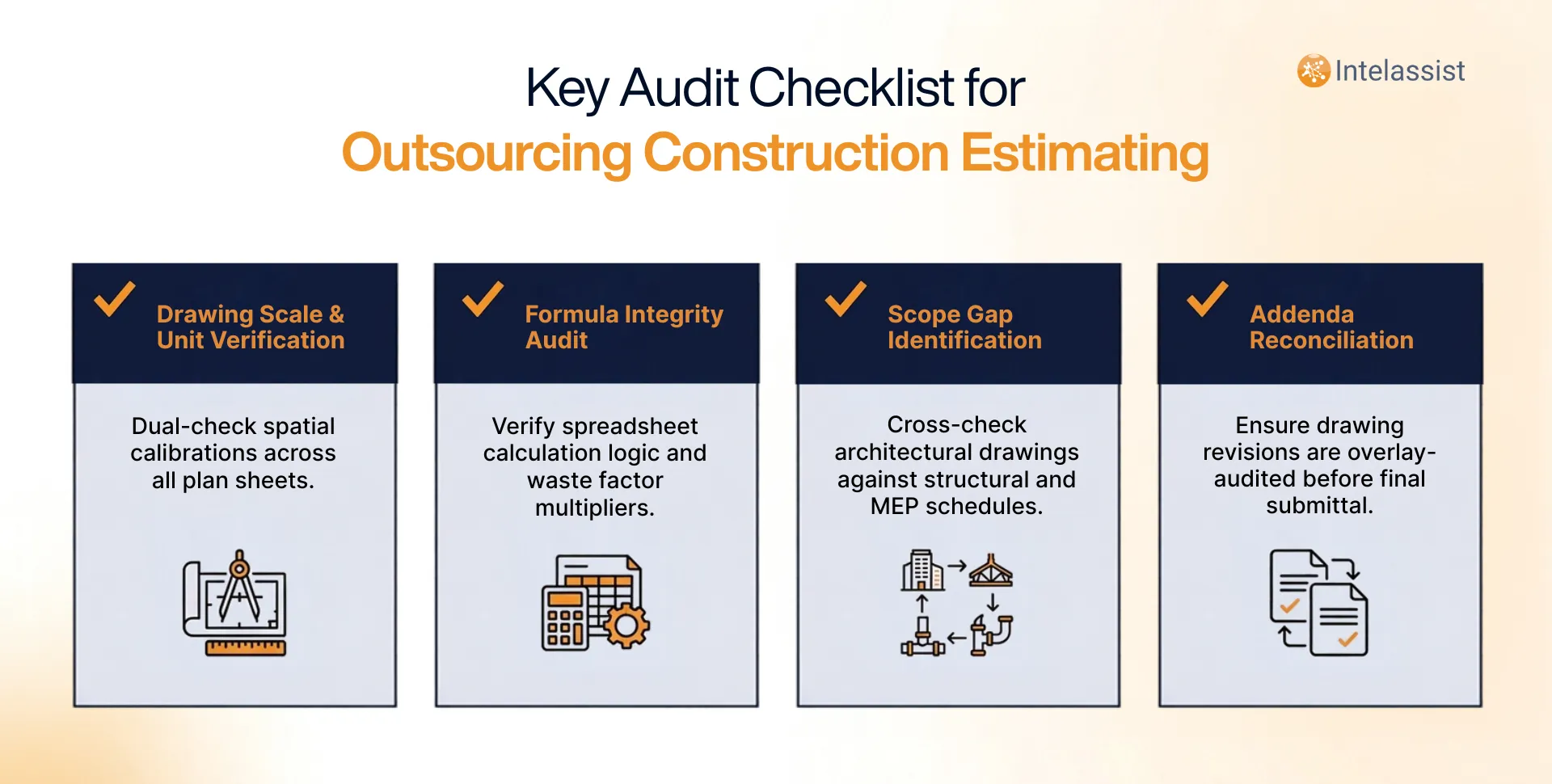
Multi-Tier Quality Assurance (QA) Loop
The structural framework behind these QA loops is detailed in our case study on building a 60-person offshore CAD drafting team, which outlines how standardized auditing preserves accuracy across high-volume technical deliverables.
- Level 1 (Self-Audit): Estimators execute built-in template formulas, scale verification steps, and line-item completeness checks against raw drawing sets.
- Level 2 (Peer Review): A senior offshore technical lead audits complex assemblies, high-cost materials, and mathematical formulas for variance against historical benchmarks.
- Level 3 (In-House Executive Approval): The final output is handed over to the internal COO or Chief Estimator, who applies localized risk factors and final margins.
Managing RFIs, Addenda, and Material Takeoff Revisions
During active bidding windows, design revisions are processed using a simple three-step protocol:
- Addenda Logging: Incoming drawing revisions are overlay-compared in Bluebeam to identify scope additions or deletions.
- RFI Generation: Missing details, ambiguous specifications, or conflicting dimensions are flagged immediately. The estimator drafts a detailed technical RFI for in-house approval.
- Dynamic Takeoff Updates: Quantity modifications are isolated and updated in the active estimate spreadsheet without resetting the entire line-item structure.
What Stays Under In-House Operations Control?
Outsourcing construction estimating processes does not mean surrendering control of your commercial strategy. Executive leadership maintains total authority over project selection, financial risk exposure, and client negotiations, using remote talent strictly to power the technical data engine behind each bid.
These tasks should remain entirely under the executive control of your in-house leadership team:
- Final Pricing & Profit Margins: Setting trade markups and commercial strategy.
- Risk & Contingency Assessment: Evaluating liquidated damages, site complexity, and contract terms.Subcontractor Award & Negotiation: Final contract sign-off and buy-out pricing.
- Official Bid Sign-Off: Authorizing and submitting final proposals to project owners.
Remote estimators do not issue final commercial proposals or make unapproved risk assumptions. Their function is to handle the labor-intensive mechanics of takeoff drafting, line-item measurement, and data assembly—delivering pristine, audited technical data so executive leadership can make fast, informed pricing decisions.
Frequently Asked Questions
A qualified remote estimator typically ramps up within 2 to 4 weeks. Because estimators hold formal civil engineering or technical drafting backgrounds, onboarding focuses on learning your firm’s specific SOPs, software templates, and division conventions rather than basic drawing interpretation.
Yes. Dedicated estimators operate directly inside your software licenses, including Bluebeam Revu, Planswift, Cubit, Trimble, RSMeans, and Revit. No proprietary platform migration or custom software adoption is required.
Errors are prevented through multi-tier QA checklists, standardized template formulas, scale re-verification protocols, and human audit requirements over AI-assisted takeoff tools. Additionally, dedicated staffing eliminates staff rotation, ensuring the same trained estimators handle your account continuously.