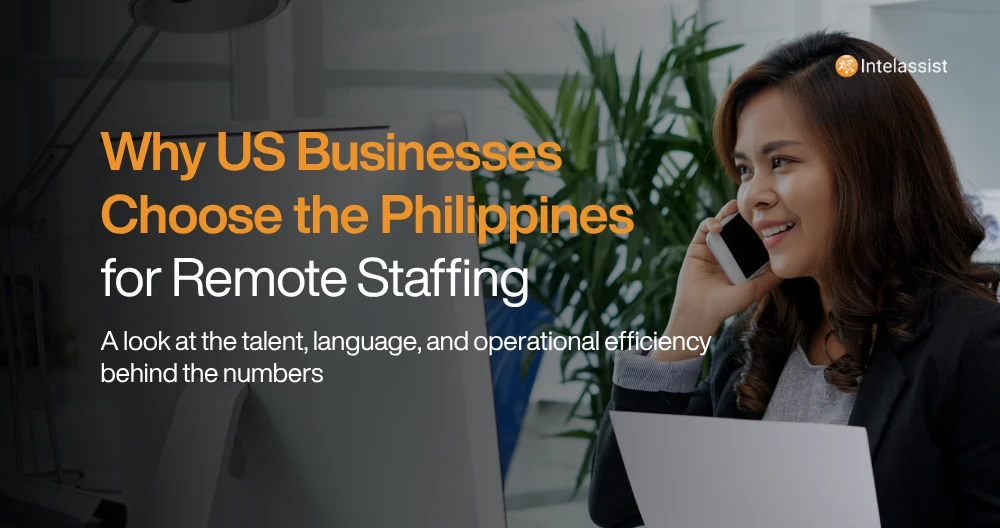
A look at the talent, language, and operational efficiency behind the numbers
The Philippines is the default destination for offshore staffing among US businesses, and not because it is the cheapest option on the market. It is the default because it has earned it, through two decades of building the talent, the language proficiency, and the operational maturity that dependable dedicated remote staff require.
Cost is real, but it is the byproduct, not the reason. The reason is depth. This guide sets out what the data actually shows. Here is the evidence.
Core Findings
- The IT and business process sector closed 2025 near $40 billion in revenue with about 1.9 million workers, and is projected to approach $42 billion in 2026 (IBPAP).
- Kearney ranks the Philippines 12th of 78 countries in its 2023 Global Services Location Index and calls it the BPO engine of Asia.
- The US and Canada make up an estimated 75 to 80 percent of the Philippine healthcare information management client base, and North America is the largest client base overall (PEZA).
- Sector growth is led by higher-value services such as finance, healthcare, and technical support, work that reaches well beyond voice tasks (IBPAP).
- In IBPAP’s 2024 member survey, 56 percent of member firms were actively implementing AI and 11 percent had reached full deployment, far above the roughly 4 percent global B2B average, with the technology augmenting staff rather than replacing them (IBPAP 2024).
- Retention improves as the work moves up-market. Contact-center voluntary attrition eased to about 19 percent in the first half of 2023, down from 31 percent in 2022 (CCAP / Willis Towers Watson).
Why Do Global Businesses Choose the Philippines for Remote Staffing?
Four durable strengths of why Philippines remain the top choice show up in the numbers:
- Language that removes friction. High-band English proficiency, second in Asia, means communication is a strength rather than a risk to manage.
- A deep, educated talent pool. Near-universal literacy among college graduates, feeding a workforce of roughly 1.9 million professionals.
- Two decades of operational maturity. More than a thousand firms and twenty years of serving Western clients have built deep management talent and infrastructure.
- Alignment with US business norms. With North America as the largest client base, working practices, hours, and service culture are already oriented toward US clients.
What the Data Shows, at a Glance
The massive scale, technical education pipeline, and rapid technology adoption of the Philippine workforce provide the raw depth required to scale specialized teams. When matched with a dedicated retention model rather than a high-churn call center environment, these industry strengths translate directly into long-term operational security.
To build a sustainable global team, leaders must look past hourly wages and evaluate the structural metrics that drive stability.
| Metric | Figure |
|---|---|
| Industry scale (2025) | ~$40B revenue, ~1.9M workers |
| 2026 outlook | ~$42B projected |
| Technical graduates / year | ~47K engineering & tech; ~32K IT |
| Retention trend | Voluntary attrition ~31% (2022) to ~19% (H1 2023) |
| AI adoption (IBPAP members) | 56% implementing; 11% full deployment |
| Global services ranking | 12th of 78; “BPO engine of Asia” |
| Primary client base | North America (large majority) |
How Does the Philippines Compare with Other Destinations?
Kearney’s 2023 index placed the Philippines at rank 12, as nearshore locations like Mexico and Colombia rose on the strength of US proximity and Spanish-language capability. For work that benefits from same-time-zone overlap or Spanish, those markets compete well.
| Country | Financial Attractiveness | People Skills and Availability | Business Environment | Digital Resonance |
|---|---|---|---|---|
| Philippines | 2.77 | 1.30 | 1.09 | 0.50 |
| Thailand | 2.63 | 1.05 | 1.45 | 0.57 |
| Singapore | 0.77 | 1.48 | 2.11 | 1.13 |
| Japan | 0.94 | 1.69 | 1.90 | 0.82 |
| South Korea | 1.06 | 1.45 | 1.82 | 0.80 |
For English-language professional and support work at scale, the Philippines’ combination of language, education, and two decades of maturity is difficult to match, which is why it stays the default for US businesses building English-language remote teams.
What Does the Talent Pool Actually Look Like?
The workforce numbers roughly 1.9 million, and the depth of the pool is what lets firms hire for specific roles and standards rather than settling for whoever is available.
That depth starts with supply. Filipino universities graduate hundreds of thousands of students each year, including roughly 47,000 in engineering and technology and 32,000 in IT (DOLE), alongside large cohorts in accountancy, business, and allied health.
For the roles dedicated remote teams most often fill, the relevant pools run deep:
- AEC support, including CAD and BIM technicians, drafters, and project coordinators, drawn from the engineering and architecture graduates.
- Healthcare and RCM roles, including medical coders, billers, and AR specialists, drawn from allied-health and business programs.
- IT and finance roles, including developers, QA analysts, and accounting staff, drawn from the IT and accountancy pipelines.
Depth also shows up in continuity. Voice-based call-center work has long carried the sector’s highest churn, with contact-center voluntary attrition near 31 percent in 2022 and easing since (CCAP / Willis Towers Watson). The non-voice, relationship-based work that dedicated remote teams handle is built for tenure, which keeps trained knowledge on a client’s account.
Intelassist sets its hiring bar accordingly. It staffs dedicated remote teams with professionals who hold a college degree and bring five to seven years of experience in their field, so clients add people who already know the standards, tools, and workflows of their discipline and can contribute early rather than ramp from scratch. Whether the role sits in AEC, IT, or healthcare, the starting point is an experienced hire, closer to a senior local team member than an entry-level one.
Frequently Asked Questions
Language, education, and operational maturity. High-band English proficiency, near-universal literacy among college graduates, and two decades of serving Western clients make it the default for English-language remote work.
No. Cost savings are real, but the data points to depth of talent, language, and maturity as the durable reasons. Cost is the byproduct.
The IT and business process sector reached roughly $40 billion in revenue with about 1.9 million workers in 2025 and is projected to approach $42 billion in 2026 (IBPAP).
It sits in the high band of the EF English Proficiency Index, second in Asia behind Singapore.
Kearney’s 2023 Global Services Location Index placed it 12th of 78 and described it as the BPO engine of Asia.
Healthcare administration and RCM, AEC support such as CAD and BIM, finance and accounting, and customer care, among others.