Offshore RCM staffing integrates dedicated remote medical billing, coding, and revenue cycle specialists into a provider’s administrative workflow. When healthcare organizations rush recruitment to cover labor shortages, shortcuts in credentialing, background checks, and supervision can turn remote teams into major compliance liabilities and audit risks.
Core Findings:
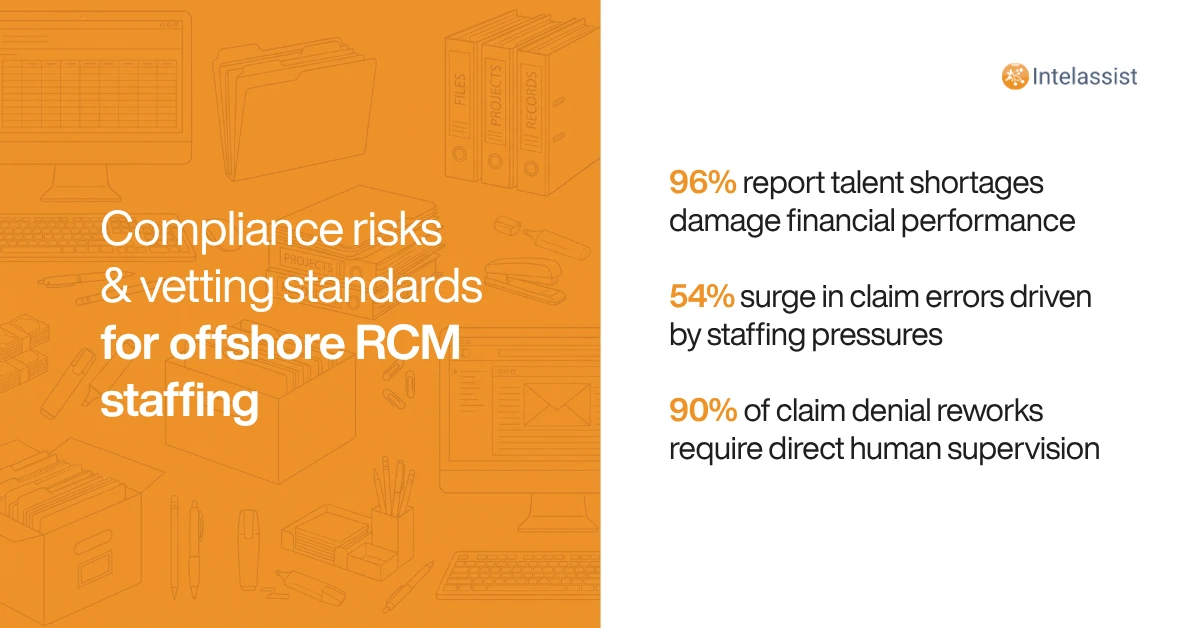
- Over half of healthcare organizations (54%) report an increase in claim errors, with 68% stating that clean claim submission is growing increasingly difficult.
- Six out of ten revenue cycle leaders plan to modify their outsourcing strategies, and 75% of those leaders intend to expand their outsourced operations.
- Nine in ten claim denials require human intervention during rework, with 47% handled manually through work queues, 42% reviewed via automated tools before entering manual queues, and only 10% fully automated by AI.
- A striking 96% of revenue cycle executives report that talent shortages directly damage their organization’s financial performance.
How Does Rushed Hiring Create Severe Compliance and Audit Risks?
When acute labor shortages threaten daily revenue cycle operations, healthcare administrators face pressure to onboard administrative support immediately. However, accelerating recruitment without rigid compliance checks introduces unvetted personnel into regulated data environments, turning operational shortcuts into potential regulatory citations and audit penalties.
The Hidden Costs of Bypassing Primary Source Verification
Rushed hiring forces healthcare practice administrators to skip primary source verification and comprehensive background checks to fill administrative gaps quickly. When labor shortages create operational backlogs, facilities often grant system permissions before validating credentials. This unverified access to Protected Health Information (PHI) turns a temporary staffing solution into an immediate compliance vulnerability during regulatory surveys.
High operational stress frequently causes staff turnover and oversight failures. Addressing what is driving behavioral health workforce burnout and how to fix it requires establishing controlled hiring pipelines rather than simply speeding through the recruitment process. When administrators rush onboarding under pressure, missing background clearances in personnel files become survey findings that threaten facility accreditation.
Why Labor Shortages Drive High Denial Rates in Offshore Healthcare Administration Teams
Severe talent scarcity directly correlates with spikes in medical claim errors and denial rates. Up to 96% of revenue cycle leaders confirm that qualified worker shortages harm organizational revenue channels. When unvetted remote billing and coding specialists manage complex claims without strict qualification checks, error rates multiply rapidly across revenue cycle operations.
Navigating these talent shortages without exposing the facility to compliance risk requires strategic planning. Having a complete guide to offshore RCM for healthcare organizations helps administrators build sustainable, pre-vetted teams. Without structural vetting, healthcare offshoring efforts result in higher claim denial rates, delayed reimbursements, and costly rework queues.
What Mandatory Credentials Belong in an Offshore RCM Personnel File Before Day One?
Regulatory compliance requires every remote revenue cycle team member to have a fully documented, audit-ready personnel file before system access is provisioned.
Primary Source Verification vs. Basic Resume Screening
Primary source verification requires contacting issuing institutions directly to confirm medical coding and billing certifications, whereas basic resume screening relies solely on self-reported applicant documentation.
For offshore medical coding and billing roles, self-reported credentials fail state and federal healthcare audit standards. Practice administrators must verify an offshore RCM staffing provider directly with the certifying bodies before granting system credentials.
To establish a compliant personnel file, administrators must document a rigorous pre-start protocol:
- Direct primary source validation of professional coding credentials.
- Verification of educational degrees and previous healthcare administrative employment history.
- Documented testing scores on specialty-specific billing rules and modifier usage.
Background Checks and HIPAA Attestations
Every remote worker accessing provider EHRs or billing software must have documented background screenings and exclusion clearances in their personnel record prior to start. Non-negotiable pre-start personnel file items include:
- National and local criminal background check clearances.
- Signed HIPAA privacy, security, and clean-desk compliance attestations.
Why Are Supervision Requirements the Most Common Compliance Failure Point in Offshoring?
Even fully credentialed offshore RCM staff will drift from billing compliance standards if continuous oversight structures are absent from daily operations. Unmonitored workflows across time zones create blind spots where improper modifier usage, unaddressed coding updates, and erroneous claims multiply undetected until audit flags are raised.
Maintaining Oversight Across Dedicated Offshore Healthcare Support
Compliance failures in remote billing operations stem primarily from absent supervision and lack of daily work-queue auditing. Distance and time zone differences can produce oversight gaps when remote teams operate without structured management. Effective oversight requires real-time productivity tracking, daily random audit samples of coded charts, and structured feedback loops to prevent billing errors from compounding.
Dedicated supervisory structures prevent operational drift and enforce standardized billing workflows. Establishing clear monitoring frameworks ensures offshore healthcare administration teams adhere strictly to provider-specific compliance protocols, payer guidelines, and documentation standards every day.
Denial Queue Management and Human Error Exposure
Denial management carries severe compliance and financial risks when handled by unsupervised staff. Industry data shows that 90% of claim denials require human review before resubmission; 47% are reviewed manually and assigned to a resubmission queue, while 42% undergo automated review before reaching a manual work queue. Without qualified supervision, staff may resubmit claims without correcting root cause coding errors.
What Questions Should You Ask a Staffing Partner Before Signing a Contract?
Protecting your facility from compliance vulnerabilities requires thorough due diligence before selecting an offshore RCM staffing partner. Practice leaders must move past generic sales promises and rigorously evaluate a provider’s data security architecture, vetting rigor, and specialized billing expertise.
Verifying HIPAA-Compliant Infrastructure and Clean-Desk Standards
Evaluating an offshore partner requires auditing physical, technical, and administrative data safeguards before signing an agreement. Practice administrators must demand proof of compliance, mandatory Business Associate Agreements (BAAs), and strict technical controls such as virtual desktop infrastructure (VDI) with disabled local download capability.
Before entering an agreement, practice leaders should review the key things to ask your behavioral services billing partner before you sign to ensure proper vetting. Key infrastructure verification criteria include:
- Are clean-desk policies enforced with biometric access controls and prohibited personal devices in work areas?
- Is all patient data encrypted in transit and at rest using AES-256 standards?
- Are network activities logged and reviewed regularly by dedicated information security teams?
Testing Role Specificity in Medical Billing, Coding, and Revenue Cycle Operations
Generic administrative staffing fails in complex revenue cycle environments because medical billing requires specialized domain knowledge. Staffing partners must prove candidates possess direct experience in your specific healthcare niche, such as behavioral health, outpatient facility billing, or specialty physician practices.
Essential evaluation questions for prospective partners:
- What percentage of your medical coders hold active, verified AAPC or AHIMA certifications?
- How do you assess candidate knowledge of specialty-specific billing rules, ICD-10/CPT coding, and denial resolution?
- What are your baseline accuracy metrics, and how do you handle ongoing quality assurance audits?
The Pre-Start Compliance Verification Matrix for Offshore RCM Staffing
A pre-start compliance verification matrix establishes non-negotiable audit standards that must be met before granting system access to remote revenue cycle staff.
| Vetting Dimension | Required Personnel Evidence | Primary Verification Protocol | Compliance Standard |
|---|---|---|---|
| Credential Verification | Primary source verification certificate | Direct lookup through certifying body registry | 100% verified active credentials prior to system access |
| Exclusion & Background | Background check clearance | Monthly automated re-screening and pre-start verification | Zero active exclusions or disqualifying criminal history |
| Data & Technical Security | HIPAA certification, VDI configuration log | Verified network isolation, disabled local storage/printing | Full compliance with HIPAA Security Rule technical safeguards |
| Operational Supervision | Daily QA audit logs, supervisory hierarchy assignment | Mandated 10% daily chart audit by senior coding supervisors | Minimum 95% coding and billing accuracy threshold |
Frequently Asked Questions (FAQ)
HIPAA-compliant offshore RCM providers maintain up-to-date certifications, execute Business Associate Agreements (BAAs), and enforce strict technical controls such as secure Virtual Desktop Infrastructure (VDI). Verification requires auditing their physical clean-desk policies, network security protocols, and independent third-party compliance assessment reports.
The primary compliance considerations include technical HIPAA safeguards, role-based system access controls, data encryption, and prohibition of local data storage. Organizations must also maintain complete audit trails for all offshore personnel accessing patient health information.
Health systems ensure compliance by partnering with dedicated staffing providers that enforce mandatory pre-start credential verification, background checks, and continuous supervisory monitoring. Conducting routine chart audits and maintaining centralized personnel files ensure full readiness for regulatory surveys.
Pre-vetted offshore medical coders directly lower denial rates by maintaining high coding accuracy and adherence to payer policies. Conversely, unvetted or improperly supervised remote coders increase clean claim rejections, trigger payer audits, and create compliance risks through improper modifier usage.
Traditional BPOs utilize shared talent pools focused on transaction volume, often limiting provider control over individual qualifications. A dedicated offshore RCM staffing model integrates pre-vetted, full-time remote specialists directly into your existing workflows under your management and compliance standards.