Unifying healthcare revenue cycle management (RCM) and accounting under one dedicated offshore team closes the costly operational divide between patient billing and financial reporting. Instead of splitting workflows across separate vendors where unapplied cash and write-offs slip through the cracks, a cross-functional pod directly reconciles clinical charges, insurance remittances, and denial adjustments to the general ledger daily.
Core Findings:
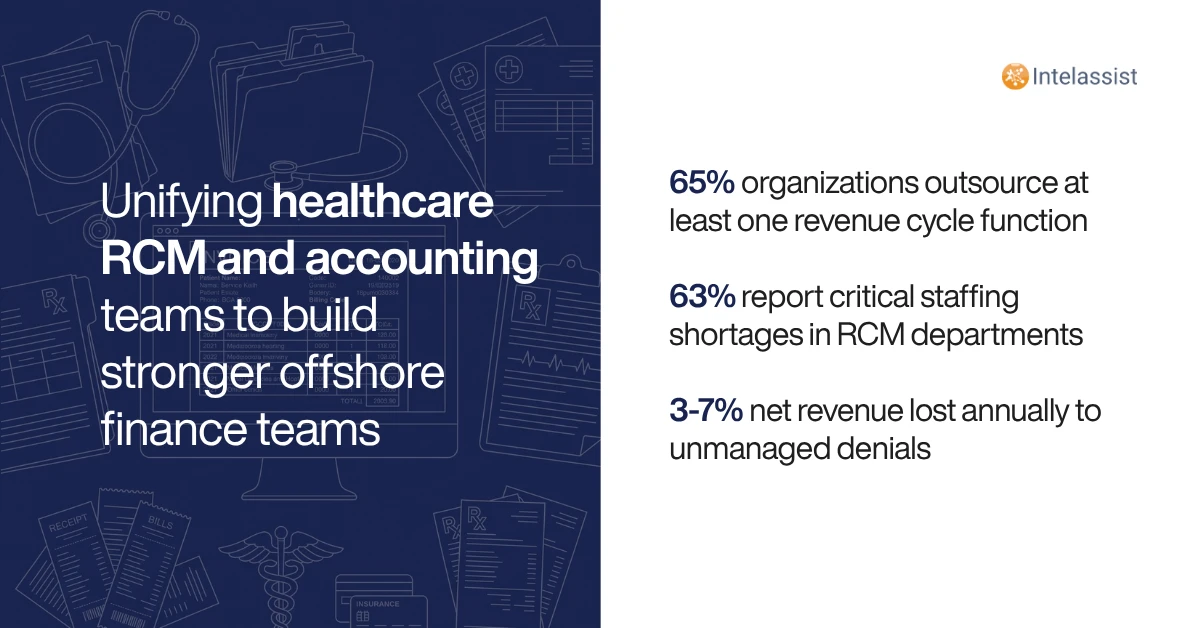
- Over 65% of healthcare organizations outsource at least one revenue cycle function, with 58% prioritizing specialized partners to improve reimbursement accuracy.
- Driven by contracting margins, the global healthcare revenue cycle management industry outsourcing market is projected to reach $123.4 billion by 2034, expanding at a 14.0% CAGR.
- 63% of healthcare providers report critical staffing shortages in RCM departments, leaving over 41% of billing and claims roles more than half vacant.
- Entry-level billing positions are vanishing as billing rules grow complex, forcing organizations to recruit analytical, technical talent earlier in candidate careers.
- While 63% of healthcare providers integrate AI automation into revenue workflows, automated claims engines still stall if human teams fail to audit clearinghouse exceptions against bank deposits.
Can One Offshore Team Handle both Revenue Cycle and Accounting?
Yes. A specialized offshore team can manage both revenue cycle management and accounting by pairing dedicated medical billing specialists with trained finance professionals under a single operational manager.
When healthcare leaders explore outsourcing, they frequently divide these functions across separate vendors. An outsourced billing agency works inside the Electronic Health Record (EHR), submitting claims and posting adjustments, while a separate vendor handling outsourced accounting services manages the general ledger in another platform. Because these systems operate independently, reconciling practice management summaries with actual bank deposits often becomes an extended manual exercise.
When organizations choose to outsource accounting and medical billing to separate entities, alignment requires significant administrative effort. A unified offshore pod resolves this friction naturally: payment posters log electronic remittance advice files while accounts receivable accountants match those deposits to bank lockboxes on the same business day.
Operational Advantages of a Unified Pod
- Synchronized Cash Application: Rather than allowing insurance remittances to sit in clearing suspense accounts while claims are marked paid in the EHR, a unified team matches payments directly to bank deposits daily.
- Audited Adjustment Tracking: Having both disciplines in one synchronized team ensures contractual adjustments and fee schedule write-offs are systematically validated against managed care contracts rather than absorbed without accounting review.
- Streamlined Administrative Governance: Practice executives maintain a single point of operational accountability, replacing the coordination time required to align separate billing and accounting account managers.
What does the Reconciliation Gap between RCM and the General Ledger Actually Cost?
The reconciliation gap between RCM and the general ledger costs healthcare practices between 3% and 5% of net revenue each year in unchased denials, untracked contractual write-offs, and prolonged month-end closes.
When clinical billing and accounting operate in silos, cash reported in the practice management system rarely matches operating account deposits in real time. Synchronizing healthcare RCM and accounting provides complete visibility into cash flow, making sure adjustments reflect actual payer contracts rather than unverified write-offs.
When a hospital finance department overwhelmed managing AR follow up alongside monthly reporting receives dedicated operational reinforcement, internal teams regain the capacity to focus on core strategic planning. Integrating cohesive finance & accounting outsourcing ensures claims are pursued systematically before reaching timely filing limits.
Proactive Value Created by Connecting Workflows
- Targeted Denial Prevention: Root-cause tracking allows billing specialists to address recurring documentation gaps before claims are submitted.
- Validated Contractual Allowances: Fee schedule variances are flagged immediately, ensuring practices collect every contractually agreed reimbursement dollar.
- Accelerated Month-End Close: Daily transaction tie-outs reduce month-end financial closing cycles from several weeks to just a few business days.
Which Roles sit on Each Side of the Workflow?
A coordinated offshore finance structure pairs front-end clinical billing specialists with back-end accounting professionals to maintain daily operational accountability across every financial touchpoint.
| Operational Domain | Dedicated Role | Primary System of Record | Core Responsibilities | Cross-Functional Hand-Off Point |
|---|---|---|---|---|
| Patient Access & Claims | Prior Auth & Billing Specialist | Electronic Health Record (EHR) | Claim submission, eligibility checks, clean claim scrubbing | Batches daily billing summaries into the practice management system |
| Denial Recovery | AR & Denial Management Specialist | Payer Portals & Clearinghouse | Appealing payer rejections, CARC/RARC pattern tracking | Distinguishes contractual adjustments from bad debt write-offs |
| Remittance Posting | Payment Posting Specialist | EHR & Bank Lockbox | ERA/EOB posting, manual check allocation | Matches lockbox deposits directly to daily bank transaction logs |
| General Ledger Accounting | Staff Accountant / Bookkeeper | Accounting System (QBO, NetSuite) | Bank reconciliations, unapplied cash audits, month-end close | Reconciles practice management batch reports with general ledger cash balances |
| Financial Oversight | Senior Financial Analyst | BI Dashboards & Financial Reports | Net collection rate audits, AR variance analysis | Delivers auditable monthly reporting packages to practice leadership |
By assigning specialized talent to each operational side, practices can have a dedicated RCM specialist manage clinical claims while healthcare-trained bookkeepers handle RCM accounting entries.
How Dedicated Offshore RCM Teams Integrate with an Existing EHR and Accounting System
Data security forms the foundation of every technical integration. In healthcare, safeguarding patient privacy is top priority. Dedicated staff connect via secure virtual desktop infrastructure (VDI) with disabled peripheral ports, multi-factor authentication, and zero local data storage, governed by signed Business Associate Agreements (BAAs) that comply with HIPAA standards.
Once secure access is established, the team executes a standardized daily tie-out protocol. Payment posters clear clearinghouse batches in your EHR, while accounting staff verify deposits in your general ledger. When structuring these workflows, building and training your offshore accounting team around clear standard operating procedures ensures unapplied cash is resolved before daily books close.
The 4-Step Daily System Integration Cadence
- Clearinghouse Batch Closure (5:00 PM Local): The RCM specialist locks daily ERA batches and exports 835 transaction files from the clearinghouse.
- EHR Ledger Balance Verification: The payment posting lead matches posted patient receipts and commercial insurance payouts against EHR practice management totals.
- Bank Lockbox Reconciliation: The staff accountant matches EHR batch deposits line-by-line against actual bank deposits in the general ledger.
- Exception Logging & Unapplied Cash Audit: Unmatched transactions or partial payments are flagged into an active exception queue and resolved within 24 hours.
Pre-Integration Checklist with an Offshore Healthcare RCM and Accounting Partner
Healthcare leaders should evaluate operational transparency, compliance safeguards, and role specialization to find a partner capable of executing both disciplines effectively.
When determining which staffing companies support hospital financial reporting teams offshore, consider these practical questions:
- Can you provide weekly denial logs itemized by code? Look for partners that deliver granular root-cause analytics rather than broad, aggregated collection numbers.
- How do your payment posters alert the accounting team to unposted remittances? Confirm that the team maintains a documented, active daily tie-out process between your EHR and general ledger.
- What is your staff retention rate over 12 months? Dedicated professionals assigned exclusively to your organization build familiarity with your specific payer contracts and clinical workflows.
- What is your deployment timeline? An established partner can achieve an offshore finance team setup 2-4 weeks from role scoping to production.
Verifying that staffing companies offshore support hospital financial reporting requires proof of hands-on experience in both RCM specialist workflows and general ledger reconciliations.
As practice administrators and founders grow their organizations, establishing a single dedicated team across both functions closes the operational gap and reinforces financial stability. For a broader look at clinical workflows, check our complete guide to offshore RCM for healthcare organizations.
Frequently Asked Questions
Medical billing and general ledger accounting require distinct technical skills. Intelassist builds a unified pod pairing dedicated RCM staff with trained bookkeepers, both under one manager to ensure functional expertise and daily reconciliation.
Unapplied cash accumulates when billing teams post payments in the EHR without confirming that matching funds reached the bank. A unified team matches Electronic Remittance Advice (ERA) files against bank lockbox statements daily, preventing unallocated revenue.
An offshore healthcare finance team setup takes 2 to 4 weeks. This covers candidate vetting, HIPAA compliance certification, IT credentialing, BAA execution, and workflow onboarding.
Offshore staff access EHR and accounting systems via secure virtual desktop infrastructure (VDI) featuring multi-factor authentication, enterprise monitoring, and disabled local drives, ensuring protected health information never leaves your server environment.