Choosing a medical billing company requires verifying business associate compliance, reporting transparency, and staff allocation models before signing an agreement. Evaluating whether a provider operates as an opaque third-party service or embeds dedicated revenue cycle specialists ensures practice administrators protect net collections, reduce avoidable claim denials, and maintain complete oversight of their Protected Health Information (PHI).
Core Findings:
- The global medical billing outsourcing market reached USD 18.20 billion in 2025 and is projected to expand to USD 50.47 billion by 2034, with North America accounting for roughly 55.12% of total demand.
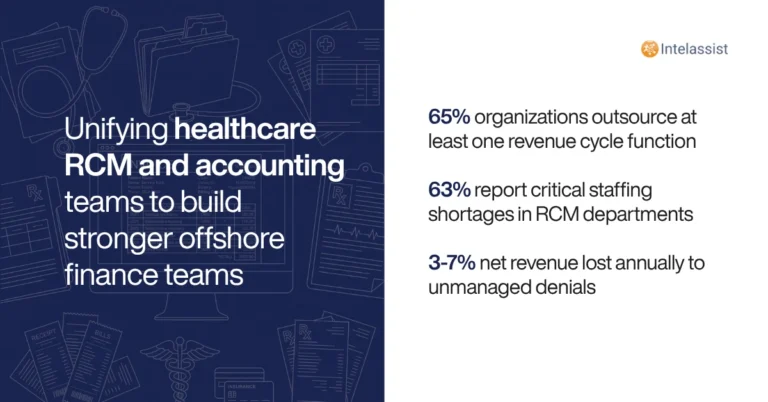
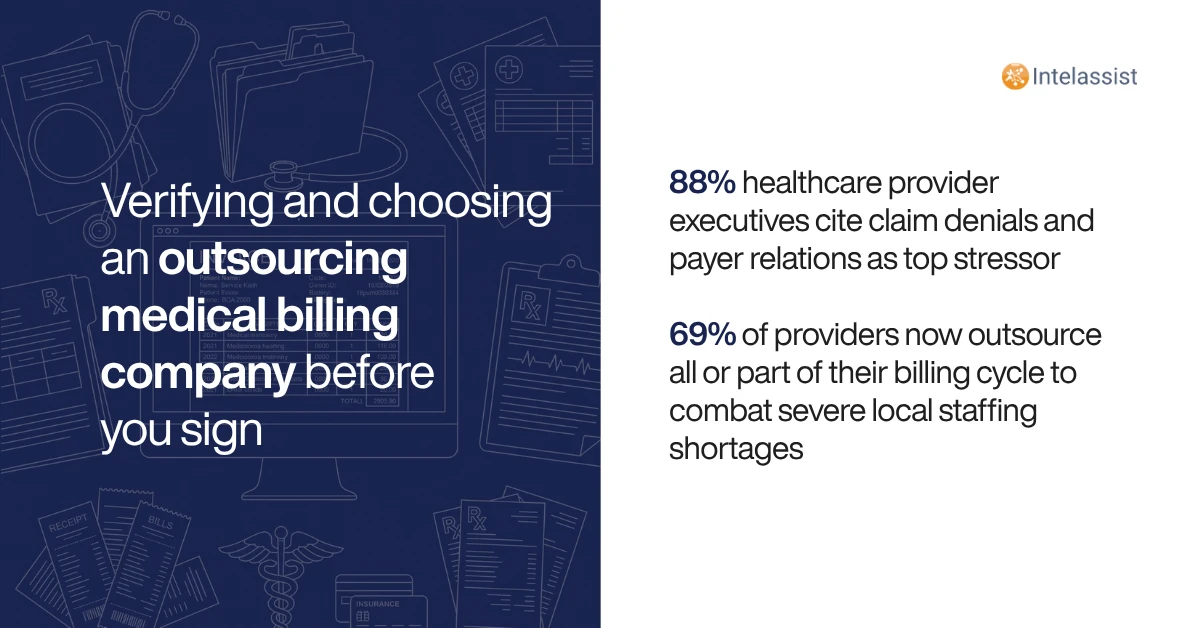
- According to Guidehouse’s 2026 RCM Report, 88% of provider executives cite payer relations and claim denials as their primary operational stressor, leading 69% to outsource all or part of their revenue cycle operations and 67% to partner with a managed services organization.
- In 2025, the average initial claim denial rate rose to 11.6%, with median final denial rates reaching 2.7%, driving more than USD 48 billion in annual hospital losses from uncollected patient balances and rejected claims.
- Payer friction directly erodes collections; Guidehouse’s 2024 survey indicated that nearly half of healthcare leaders reported a net collection yield of 93% or lower.
What Compliance Documentation Must Exist Before Turning Over PHI?
When evaluating options for outsourcing healthcare billing, regulatory compliance credentials must precede any discussion of pricing or service workflows.
A medical billing partner must provide an executed Business Associate Agreement (BAA), current audit reports, and documented role-based access control (RBAC) protocols before gaining access to Protected Health Information (PHI).
If patient data is compromised, legal and financial liability remains squarely with the covered entity. To satisfy internal IT and compliance stakeholders, verify three baseline requirements:
- Executed Business Associate Agreement (BAA): The agreement must mandate breach notification within 24 hours, define clear liability indemnification, and outline explicit PHI return or destruction protocols upon contract conclusion.
- Audit Attestation: Demands independent, annual third-party verification of security, confidentiality, and processing integrity across the vendor’s physical facilities and network operations.
- Secure Access Architecture: Verifies that remote staff access your electronic health record (EHR) through Virtual Desktop Infrastructure (VDI) with multi-factor authentication (MFA). Endpoints must enforce zero-local-storage policies, blocking local downloads, external drives, and screen captures.
Bypassing security vetting under operational pressure introduces severe exposure. Reviewing why rushed offshore RCM staffing creates compliance liabilities highlights how administrative shortcuts create lasting regulatory risk.
What Does a Medical Billing Company Do Across the RCM Cycle?
A professional medical billing company manages the administrative and technical exchange of data between healthcare providers, clearinghouses, and commercial or government payers. Their scope spans front-office patient access, middle-cycle clinical coding, and back-office claims follow-up to convert clinical encounters into collected practice revenue.
Which Specific Roles Handle Your Accounts?
Effective healthcare billing requires role-specific specialization rather than generalized administrative labor:
- Patient Access Specialists: Verify insurance eligibility, coordinate primary and secondary benefits, and obtain prior authorizations before patient encounters occur, eliminating front-end technical rejections.
- Medical Coding Specialists: Certified coders (AAPC or AHIMA accredited) assign accurate ICD-10-CM, CPT, and HCPCS modifier codes based strictly on clinical documentation and payer medical policies.
- Accounts Receivable & Denial Specialists: Monitor electronic remittance advice (ERA 835), identify zero-pay vouchers, submit timely appeals with supporting documentation, and systematically resolve aging balances.
Understanding how these distinct functions coordinate across departments is detailed in the complete guide to offshore RCM for healthcare organizations.
Defining the Boundary: Practice Ownership vs. Partner Responsibility
Successful partnerships establish explicit operational boundaries. In-house clinical teams retain complete control over patient care, clinical charting, and medical necessity determinations. The billing partner assumes responsibility for claims scrubbing, clearinghouse rejection tracking, payment posting, and payer follow-up.
Offloading administrative claims follow-up also protects clinical capacity; understanding what is driving behavioral health workforce burnout and how to fix it demonstrates how shifting billing workloads restores clinical focus.
How Should You Evaluate a Billing Partner’s Reporting and Quality Oversight?
Evaluate a billing partner by their data transparency, audit protocols, and custom Service Level Agreements (SLAs) rather than generic marketing claims. Because collection performance varies significantly by medical specialty and payer mix, direct operational visibility is essential.
Verifying Data Transparency: Raw Reports vs. Curated Summaries
Demand direct, read-only access to clearinghouse reports, raw remittance data, and unedited claim status logs inside your practice management system. Bypassing curated monthly slide decks allows your team to audit:
- Exact submission timestamps to confirm timely filing compliance.
- Unfiltered clearinghouse rejection codes prior to vendor scrubbing.
- Time elapsed between initial payer remittance posting and secondary billing.
Establishing Quality Assurance and Root-Cause Tracking
A reliable partner must maintain documented internal quality assurance (QA) workflows. Confirm that their team conducts regular two-tier audits of completed claims, maintains documented coder escalation paths for ambiguous provider notes, and systematically tracks Claim Adjustment Reason Codes (CARCs) and Remittance Advice Remark Codes (RARCs) to eliminate recurring billing errors at the source.
Dedicated Specialist, Shared Agent, or Full-Service Vendor?
The operational structure of medical billing outsourcing determines whether your practice retains operational oversight or delegates claims to an unmonitored processing pool. Embedded staffing models allow organizations to maintain quality standards without paying inflated agency overhead.
Why Pooled Outsourcing Risks Quality
Traditional BPO vendors deploy shared agents who rotate across dozens of unrelated healthcare accounts. This fragmented approach dilutes specialty-specific payer knowledge, causes complex rejections to go unworked, and obscures daily workflows.
Retaining Direct Oversight with a Dedicated Staffing Model
An embedded staffing model integrates dedicated, full-time revenue cycle professionals directly into your practice management system. These specialists follow your standard operating procedures (SOPs) and operate under your direct supervisory oversight.
While the standard BPO industry experiences annual staff turnover near 40%, Intelassist maintains a 90%+ staff retention rate. This continuity protects institutional billing knowledge and prevents cash flow disruption. Practice administrators can evaluate hiring a dedicated medical billing specialist in the Philippines without losing workflow control to structure this operational setup.
Frequently Asked Questions About Outsourcing Medical Billing
Evaluate claim denial rates against your historical specialty baseline and payer mix rather than a generic national figure. A competent billing partner analyzes past denials during onboarding, establishes transparent performance benchmarks, and provides unedited reporting to track ongoing overturn rates.
Yes. Under HIPAA regulations, any third party that creates, receives, maintains, or transmits Protected Health Information (PHI) is legally classified as a Business Associate. They must sign a binding BAA that stipulates breach notification rules, data security protocols, and liability terms before system access is granted.
Shared agents divide their time across multiple unrelated healthcare practices with varying billing rules and software platforms. Dedicated remote staff work exclusively for your practice, log directly into your EHR, follow your specific SOPs, and retain deep familiarity with your regional payer policies.
Base contracts typically encompass electronic claim generation, clearinghouse management, payment posting, and standard payer follow-up. Specialized workflows—such as prior authorization submissions, provider re-credentialing, patient phone support, and formal appeals—are typically structured as distinct service scopes or dedicated staffing roles.
Onboarding typically spans 3 to 6 weeks. This timeline accommodates secure network provisioning, EHR role-based credentialing, clearinghouse EDI/ERA enrollments, workflow documentation, and dual-review claims auditing.
Your practice retains 100% legal ownership of all clinical records, billing history, and patient data. Reputable agreements explicitly state that all records remain fully accessible in your native practice management system and cannot be withheld or subject to proprietary extraction fees upon contract termination.