Outsourcing bookkeeping should not function as a reactive measure triggered only during tax season deadlines or sudden employee turnover. For accounting firms, outsourcing bookkeeping is the operational integration of dedicated offshore bookkeepers directly into the production workflow to maintain stable, year-round client capacity.
Treating remote bookkeeping as permanent infrastructure ensures general ledgers remain balanced regularly, delivering standardized, audit-ready work product that senior accountants, controllers, and partners can review without rework.
Core Findings:
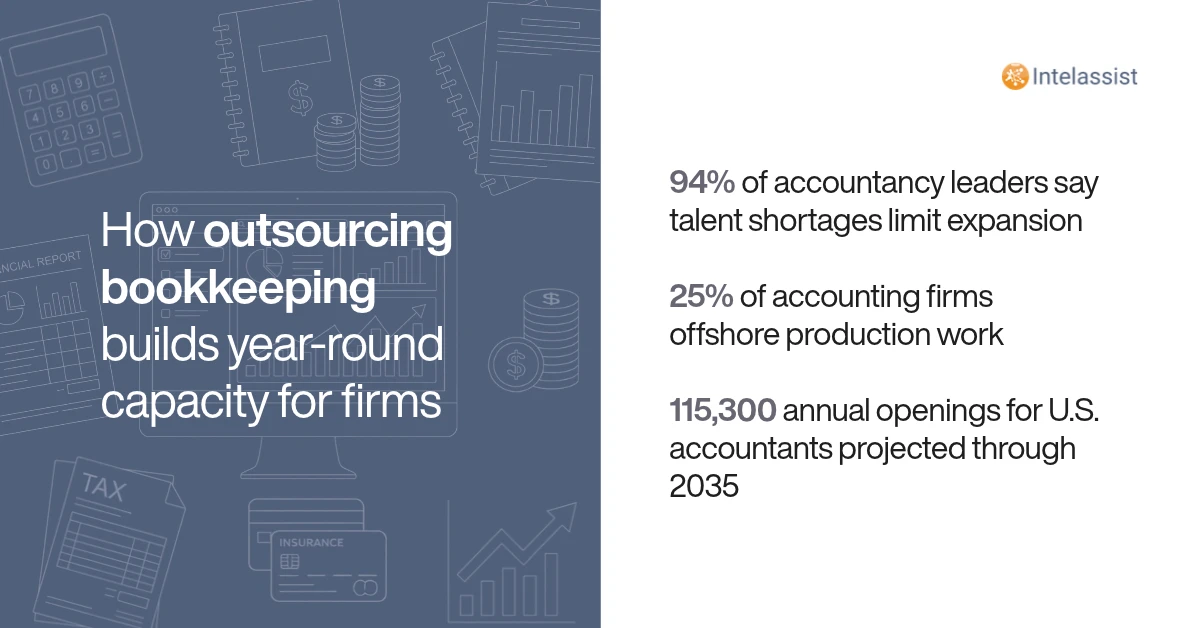
- 94% of accountancy leaders worldwide confirm that talent and recruitment challenges directly restrict their capacity for firm growth.
- According to AICPA MAP survey data across more than 1,100 accounting firms, 25% of practices offshore work, 30% outsource domestically, 14% plan to adopt domestic outsourcing, and 12% plan to begin offshoring. These operational shifts align with broader finance and accounting outsourcing trends and industry statistics reshaping firm operations.
- Technological adoption has not eliminated the need for skilled accountants: 44% of accounting firms state they will need more accountants to oversee processes and analyze results alongside automation, while another 44% require identical staffing levels.
- The U.S. Bureau of Labor Statistics projects roughly 115,300 annual openings for accountants and auditors through 2035, with net employment growing by 79,400 jobs. This persistent deficit reinforces why practice owners must build reliable remote production capacity rather than competing for an exhausted local applicant pool.
What Does It Mean for an Accounting Firm to Outsource Bookkeeping for Production Capacity?
Accounting firms that outsource bookkeeping acquire dedicated operational bandwidth to service multi-client portfolios under uniform firm standards. When a CPA firm decides to outsource accounting, the objective is not to offload client communication to a third party, but to secure review-ready production capacity that integrates directly into existing practice management workflows.
Direct Small-Business Outsourcing vs. Firm Production Capacity
Direct small-business outsourcing provides transaction entry for a single business owner who needs basic bookkeeping, invoicing, and checking account categorization. In contrast, firm production capacity requires remote bookkeepers capable of managing multi-entity general ledgers under firm standard operating procedures.
Dedicated bookkeepers operate as an internal extension of the practice, handling routine production tasks across several core operational functions:
- Standardizing client chart of accounts across diverse industries.
- Executing monthly bank, credit card, and merchant clearing reconciliations.
- Posting recurring adjusting journal entries for depreciation, prepaid expenses, and accrued liabilities.
- Preparing initial balance sheet tie-out schedules for senior review.
Why Accounting Firms Must Buy Reviewable Work Product, Not Billable Hours
Accounting practices do not need unvetted contractor hours: they need reviewable work product that passes manager review on the first pass. Buying raw hours from generic platforms can create an internal audit bottleneck, forcing partners to spend non-billable time untangling incorrect journal entries.
A reviewable work product package must satisfy four specific criteria before partner sign-off:
- Source Document Verification: Every balance sheet line item ties out directly to third-party bank statements, loan amortization schedules, or payroll summaries.
- Standardized Indexing: Workpapers follow the firm’s strict folder structures, naming conventions, and cell-referencing formats.
- Explicit Query Tracking: Ambiguous transactions are flagged with transaction IDs, dates, and preliminary categorization logic rather than left unclassified.
- Audit Trail Completeness: Reconciliations maintain unbroken digital audit trails inside the general ledger platform without manual overrides.
Why Has Traditional Finance and Accounting Outsourcing Failed Practice Owners?
Traditional finance & accounting outsourcing has failed accounting practice owners because shared-service providers prioritize ticket volume over technical consistency. Practice owners seeking to outsource bookkeeping for accountants often encounter missed month-end deadlines, sudden turnover, and poor communication that damages client trust.
Working through a Shared-Pool and Constant Re-Onboarding
Conventional business process outsourcing agencies assign work to a rotating pool of junior staff who divide attention across dozens of unrelated client accounts. When a firm owner spends four weeks training an external worker on client preferences, that worker is frequently reassigned or leaves the agency entirely.
Practice owners can study the operational mechanics of breaking the failed outsourcing cycle to understand why dedicated placement succeeds. Specifically, permanent role placement explains how dedicated offshore teams prevent constant re-onboarding by assigning specialists exclusively to one firm.
The consequences of constant re-onboarding include repeated non-billable training hours, inconsistent transaction categorization across accounting periods, lost institutional knowledge, and delayed month-end client delivery.
Realizing the Cost of Rework on Partners
When an outsourced provider delivers incomplete files, senior leadership absorbs the rework. Firm partners and controllers get pulled into late-night ledger cleanup, fixing misallocated expenses and unreconciled suspense accounts.
This rework forces partner billable time into low-value administrative cleanup, erodes client realization rates on fixed-fee engagements, causes senior accountant burnout, and caps firm revenue capacity.
How Does a Dedicated Remote Model Turn Bookkeeping Into Year-Round Firm Capacity?
A dedicated remote staffing model provides accounting firms with full-time team members who execute standard operating procedures year-round. Instead of hiring temporary seasonal contractors during tax deadlines, practices maintain balanced ledgers every month.
Smoothing Seasonal Compression Into Predictable Monthly Retainers
Seasonal work compression occurs when client books sit untouched until tax filing season begins. By deploying dedicated bookkeepers, AR/AP specialists, and financial analysts, firms maintain current ledgers every thirty days.
This continuous operational rhythm creates three distinct practice benefits:
- Converts erratic annual compliance fees into predictable monthly recurring advisory retainers.
- Eliminates the compression of fifty hours of catch-up bookkeeping per client during filing season.
- Provides clients with clean financial statements, enabling ongoing cash flow forecasting through specialized accounting and finance support solutions.
Standardizing General Ledger Workflows and Review Trails
Dedicated remote staff adopt the firm’s established review hierarchy: Preparer to Reviewer to Partner Sign-Off. Because the same bookkeeper prepares workpapers every month, they master the firm’s indexing conventions, clearing queries proactively and documenting variances inside practice management software. This consistency reduces senior manager review time from hours to minutes per client file.
How Do Accounting Firms Integrate Dedicated Offshore Bookkeepers in the Philippines?
Accounting practices evaluating options to outsource bookkeeping in the philippines access a deep labor market trained in U.S. GAAP standards, business English, and modern cloud platforms. Successful firms integrate these professionals through rigorous screening and enterprise-grade data security.
Technical Screening for Cloud Accounting Platforms and Reconciliation Logic
Effective integration requires testing practical software skills before placement. Bookkeepers must demonstrate verified proficiency in QuickBooks Online, Xero, NetSuite, Sage Intacct, Bill.com, and Karbon. Practical screening evaluates bank reconciliations, payroll entries, multi-entity mapping, and balance sheet tie-outs to ensure audit-ready work product.
Practical technical screening validates competence across key operational areas:
- Cloud Accounting Architecture: Configuring multi-currency settings, managing automated bank rules, and handling ledger integrations.
- Payroll Accounting: Booking multi-state payroll summaries, tracking payroll liabilities, and verifying tax impound accounts.
- Accounts Payable & Receivable: Processing two-way purchase order matching, managing vendor aging schedules, and generating accurate collections reports.
- Accrual Basis Adjustments: Calculating revenue recognition schedules and depreciating fixed assets per amortization tables.
Data Security, Client Confidentiality, and Access Governance
Protecting client financial records requires rigid access controls rather than informal trust. When utilizing outsourcing finance and accounting services, firms protect confidentiality through secure remote desktop environments, role-based cloud permissions, enterprise password managers, and multi-factor authentication. Local data downloading is restricted, keeping client records inside the firm’s protected cloud ecosystem.
Core security protocols for remote accounting teams include:
- Enforcing virtual desktop infrastructure (VDI) so data never resides on local hardware.
- Setting role-based user permissions inside client ledgers with zero master admin rights.
- Prohibiting USB port read/write access and disabling local print capabilities.
- Documenting comprehensive confidentiality and non-disclosure agreements that meet professional accounting standards.
How Can Accounting Firms Onboard an Offshore Bookkeeper Without Operational Disruption?
Onboarding an offshore bookkeeper succeeds when practice owners implement a phased delegation schedule rather than transferring entire client rosters at once. Following structured guidelines for building and training an offshore accounting team establishes operational consistency across three distinct stages.
The table below outlines the operational roadmap, detailing responsibilities, software access levels, and quality gates for each onboarding phase:
| Onboarding Phase | Core Production Deliverables | Software Access & Security Controls | Quality Gate & Sign-Off Metric |
|---|---|---|---|
| Phase 1: Days 1 to 15System Setup & SOP Alignment | Review chart of accounts templates; study sample closed workpapers; complete reconciliations on staging files | Practice management guest profile; sandbox accounting ledger access; password manager assignment | 100% tie-out accuracy on three test month-end client reconciliations |
| Phase 2: Days 16 to 45 Supervised Production & Parallel Review | Active bank reconciliations; vendor invoice processing; transaction tagging for 5 to 10 initial client accounts | Read/write bookkeeper role in client ledgers; direct Slack or Teams channels; zero master admin access | Senior accountant review notes cleared within 24 hours; zero uncategorized suspense entries |
| Phase 3: Days 46 to 90 Full Production Ownership | End-to-end monthly closing checklists; payroll journal entries; balance sheet tie-out schedules across full portfolio | Full standard operational access; recurring task ownership in project management or ERP software tools | Monthly books delivered for senior review within five business days of month-end |
Implementation Detail by Stage
- Phase 1: Days 1 to 15 (Setup and SOP Alignment): The firm provisions system credentials and practice management access under least-privilege permissions. The bookkeeper reviews charts of accounts, folder structures, and closed workpapers, completing test reconciliations in a sandbox environment.
- Phase 2: Days 16 to 45 (Supervised Production): The bookkeeper handles live reconciliations for an initial cohort of five to ten clients. A senior accountant conducts parallel reviews, holding brief daily check-ins to calibrate notes.
- Phase 3: Days 46 to 90 (Full Production Ownership): The bookkeeper assumes recurring monthly closing schedules and balance sheet tie-outs across the assigned portfolio, enabling senior accountants to refocus on review and advisory delivery.
Frequently Asked Questions About Bookkeeping Outsourcing for Accountants
Direct small-business outsourcing handles bookkeeping for a single business. Capacity outsourcing embeds dedicated bookkeepers into a firm’s production workflow, preparing standardized, review-ready workpapers across multi-client portfolios according to the firm’s standard operating procedures.
Dedicated bookkeepers communicate directly with firm leaders via Slack, Microsoft Teams, and practice management tools like Karbon or Canopy, documenting review notes within working files to preserve clear audit trails.
Dedicated offshore bookkeepers support major cloud accounting stacks, including QuickBooks Online, Xero, NetSuite, Sage Intacct, Bill.com, Gusto, and Karbon, matching the firm’s exact environment.
When outsourcing accounting services, firms safeguard client data using virtual desktop environments, role-based permissions, multi-factor authentication, enterprise password managers, and restricted local file downloads.
Technically vetted offshore bookkeepers can be placed within two to three weeks, followed by a structured 30-to-60-day phased integration into the firm’s review workflows.