Building High-Retention Remote Teams for Back Office Operations
The teams handling client relationships tend to get the most attention, but it’s the back office support that determines whether a business can actually deliver on what those relationships promise. Payroll, compliance, data management, administrative coordination; none of it is visible to the client, and all of it is essential.
When growing firms take a close look at their internal workflows, what usually surfaces is a clear divide: the client-facing side of the organization is expanding, while the internal infrastructure supporting it is stretched thin. Processes that were built for a nimble, small operation are being asked to carry more weight than they were designed for.
Scaling that infrastructure is one of the harder operational hurdles for mid-market leaders to clear; not because the answers are complicated, but because it requires a level of intentionality that’s easy to deprioritize when front-of-house customer demands need attention. Here’s what it takes to execute this transition well.
Core Findings
- Outsourcing back office support is fundamentally about gaining direct access to skilled global talent, adapting to evolving customer demands, and increasing overall quality of work and performance, rather than just lowering costs.
- Forward-thinking mid-market organizations rely on a Global Business Services (GBS) model: blending shared services, core internal business hubs, and dedicated offshore teams to build resilient, highly efficient business operations.
- Back-office operations such as data analytics, knowledge management, and customer experience have seen outsourcing adoption grow by nearly 50% as enterprises scale their data demands.
- Standard BPO providers face devastating attrition rates between 40% and 70%. Shifting to a people-first model yields an elite 90%+ team retention rate, preserving institutional knowledge and operational continuity.
- Automating processes before they are standardized accelerates systemic errors. True efficiency comes from mapping out human-led workflows clearly before connecting digital tools or automation platforms.
What is Back Office Support?
Back office support refers to the foundational administrative, technical, and operational functions of an organization that do not interface directly with customers but are essential for day-to-day business execution. These roles span specialized areas including finance, talent management, human resources, data operations, and compliance infrastructure.
From a mid-market perspective, outsourcing back office support is vital for business continuity and organizational resilience. Rather than maintaining a fully localized overhead, businesses utilize integrated offshore teams in the Philippines to protect themselves against local labor shortages, sudden volume spikes, and talent churn. Managing data handling, financial transaction tracking, and specialized IT management through an extended global workforce directly influences business continuity. It ensures that even during regional talent crunches or structural corporate pivots, core processing engines remain fully functional, secure, and uninterrupted.
This operational buffer changes outsourcing from a reactive cost-cutting exercise into a proactive capability play. According to Deloitte’s Global Business Services (GBS) Survey, up to 33% of global businesses explicitly prefer outsourcing because it allows their core onshore leadership to focus intensely on building in-house strategic capabilities. Meanwhile, it opens the doors for embedded remote teams to deeply understand the business and transition into high-level knowledge-driven operations over time.
Why Do Back Office Operations Matter for Mid-Market Scale?
Mid-market business growth requires specialized talent, operational agility, and infrastructure stability. Managing these functions entirely in-house often introduces significant operational friction, particularly regarding talent acquisition timelines and localized retention challenges where mid-sized firms must constantly compete for talent against massive conglomerates.
Organizations have successfully utilized the Global Business Services (GBS) model for over 10 years, combining shared services, core internal business centers, and offshore teams to efficiently run complex business operations. Moving beyond transactional fulfillment requires mid-market firms to treat back office development as a strategic capability play. Rather than treating personnel as modular, temporary units, high-performing organizations treat global team integration as a true extension of their domestic workforce. This structural alignment delivers distinct operational advantages:
- Uninterrupted Continuity: Distributing core administrative functions across secure global hubs establishes operational redundancy, ensuring business functions continue without interruption regardless of local market pressures.
- Rapid Capability Access: Mid-market organizations can bypass local talent shortages by directly embedding professionals, such as specialized accounting professionals and systems analysts, into existing business units without long recruitment cycles.
- Resource Reallocation: Relieving onshore leaders of repetitive operational friction allows them to focus entirely on high-value strategic initiatives, core product development, and regional market expansion.
What Core Functions Are Included in Strategic Back Office Support?
Modern business operations require precision across multiple distinct disciplines. A mature global team does not simply process data; it maintains the systems that inform executive decision-making and scale corporate capability. In fact, back office operations such as reporting and analytics, knowledge and content management, and customer experience saw outsourcing implementation increase by almost 50% in 2025 alone.
1. Finance and Accounting Services
Beyond basic transactional ledger entries, comprehensive back office accounting services manage complex financial ecosystems. This includes regulatory compliance tracking, accounts payable/receivable management, automated payroll administration, and continuous financial reporting.
2. Specialized Information Technology Support
Mid-market technology relies on consistent system availability. Dedicated infrastructure management encompasses proactive network monitoring, tier-1 through tier-3 helpdesk support, system deployment verification, and endpoint security management.
3. Knowledge and Content Management
Scaling organizations require a central repository for institutional data, training documentation, and standardized operating procedures (SOPs). Back office specialists organize, update, and govern this content, ensuring information is readily accessible and audit-ready across all departments.
4. Omnichannel Customer Experience (CX) Support
While front-line agents manage direct client calls, back office CX support provides the structural backbone for customer relationships. This involves processing customer requests, maintaining data accuracy across systems, resolving complex multi-tiered account issues, and ensuring compliance benchmarks are continuously met.
| Back Office Domain | Embedded Core Roles | Mid-Market Business Impact |
|---|---|---|
| Finance & Accounting | Accounts Payable/Receivable Specialists, Billing Analysts, Tax Coordinators | Reduced Day Sales Outstanding (DSO), accelerated monthly closes, and audit readiness. |
| Technology Infrastructure | Network Administrators, Helpdesk Engineers, Systems Analysts | Maximized system uptime, proactive security patching, and structured hardware/software deployment. |
| Vendor Management | Vendor Compliance Officers, Procurement Assistants, Contract Administrators | Standardized vendor onboarding, reduced contract variances, and ongoing service-level agreement (SLA) monitoring. |
| Talent Management | HR Coordinators, Recruitment Sourcers, Payroll Administrators | Accelerated talent pipelines, standardized onboarding documentation, and seamless global payroll execution. |
| Knowledge & Content Management | Documentation Specialists, Content Coordinators, Training Administrators | Institutional knowledge retention, structured SOP creation, and easily accessible corporate compliance data. |
| Customer Experience | CX Data Analysts, Tier-2 Support Specialists, Quality Assurance Auditors | Improved customer satisfaction scores, accurate resolution tracking, and minimized data entry errors. |
How Does Back Office Outsourcing Drive Talent Retention?
The primary risk associated with traditional global staffing models is high attrition. Conventional Business Process Outsourcing (BPO) operations typically experience annualized turnover rates ranging from 40% to 70%. This constant churn creates an ongoing cycle of retraining, operational friction, and lost institutional knowledge—a burden that mid-market firms with leaner HR teams are poorly equipped to absorb.
Addressing this challenge requires shifting from a transactional sourcing model to a people-first employment strategy. Intelassist maintains an average retention rate exceeding 90% by actively investing in its professionals. This performance is achieved through structured talent management strategies:
- Career Pathing: Providing continuous professional development, corporate training tracks, and specialized technical certifications ensures team members grow alongside the client companies they support.
- Cultural Alignment: Mirroring client corporate values within global delivery centers minimizes communication friction, aligns holiday schedules, and strengthens direct brand connection.
- Comprehensive Wellness Frameworks: Providing premium health benefits, professional workspaces, modern technology stacks, and regular employee engagement programs builds long-term commitment.
When a mid-market organization protects its global workforce, those professionals become deeply invested in the client’s long-term success, acting as a reliable foundational anchor for the entire business.
What Common Back Office Management Mistakes Should Mid-Market Businesses Avoid?
Developing a global workforce requires avoiding common operational pitfalls that frequently disrupt standard outsourcing implementations.
Mistake 1: Automating Broken Processes Without Prior Standardization
Deploying automation across poorly defined workflows simply accelerates inefficiencies. Mid-market organizations must document, optimize, and standardize their back office operations before implementing programmatic or AI-driven workflows.
Mistake 2: Prioritizing Direct Cost Reduction Over Cultural Integration
Selecting a partner solely based on the lowest hourly rate often leads to high turnover and poor execution. True operational efficiency stems from cultural alignment, shared communication styles, and a mutual commitment to quality.
Mistake 3: Siloing Remote Teams From the Core Business Strategy
Treating a global team as a separate, isolated entity limits performance. For mid-market firms looking to build a unified operational footprint, remote professionals should be integrated directly into the company culture, regular departmental meetings, communication channels, and strategic goals.
How to Build a Sustainable Global Back Office Strategy
Transitioning to an integrated global delivery model requires a structured deployment roadmap to ensure alignment across operations, technology, and compliance frameworks.
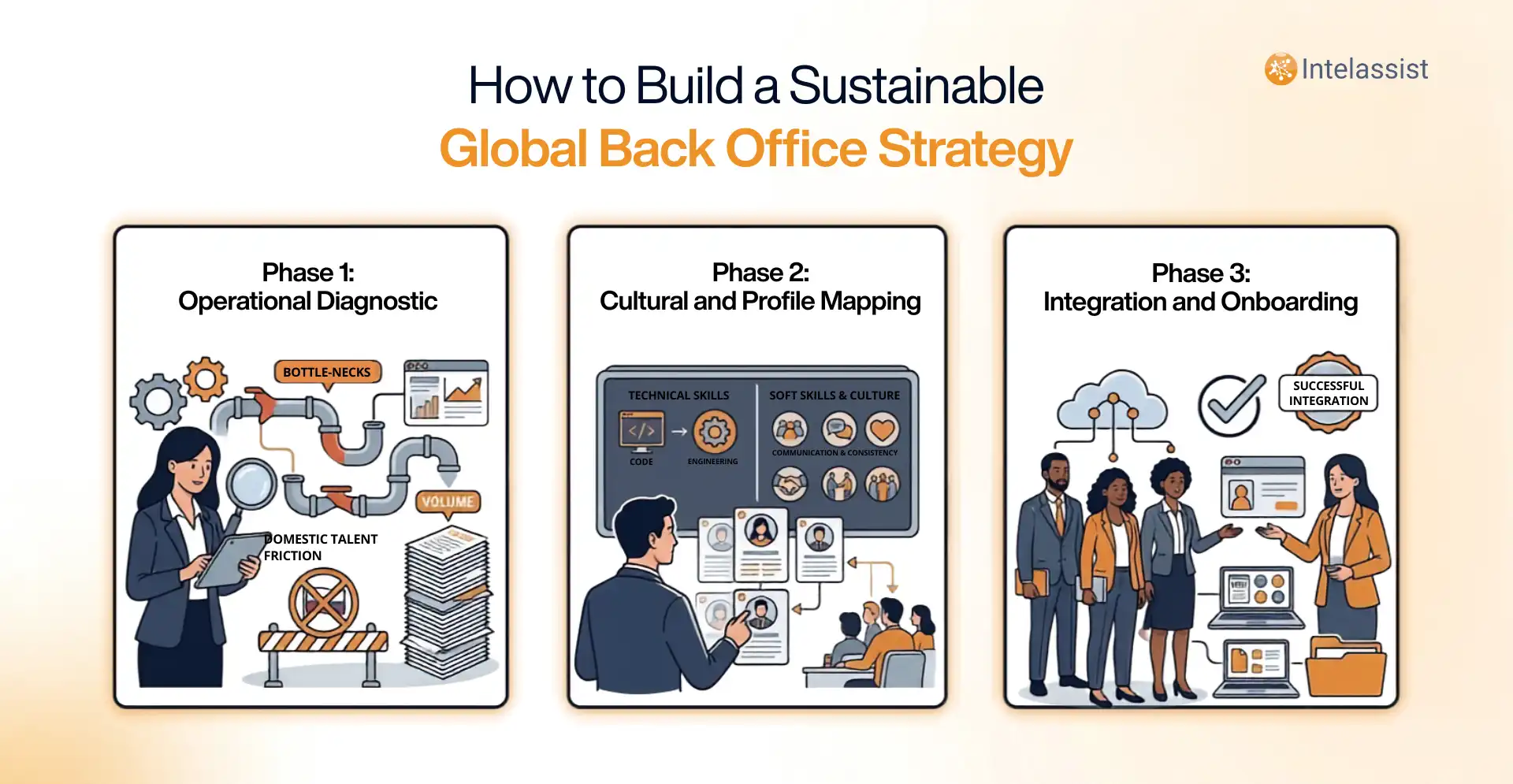
Phase 1: Operational Diagnostic
Analyze internal workflows to identify resource constraints and operational bottlenecks. Focus on processes with high volume, clear documentation requirements, and significant domestic talent-acquisition friction in the local mid-market hiring space.
Phase 2: Cultural and Profile Mapping
Define the required technical proficiencies along with the soft skills and cultural traits necessary for long-term integration. This ensures the selected candidates match your existing team dynamics perfectly.
Phase 3: Phased Integration and Onboarding
Introduce global professionals in structured cohorts. Treat their integration exactly like an onshore onboarding process, providing access to internal tools, documentation, and communication networks from day one.
Frequently Asked Questions
Back office support comprises the internal operational, technical, and administrative functions that sustain a business. For mid-market firms, these roles provide the critical infrastructure required for front-office teams to deliver customer value safely and efficiently without bloating onshore overhead.
Front office teams manage direct revenue-generating and client-facing activities, such as sales and account management. Back office teams focus on internal operations, maintaining systems, managing financial compliance, and processing data to ensure client promises are fulfilled seamlessly.
High attrition creates continuous retraining costs and degrades process accuracy, which can heavily strain lean mid-market leadership teams. A partner with high retention rates preserves institutional knowledge, ensures consistent service quality, and builds reliable long-term operational partnerships.
Yes. Modern offshore back office teams consist of highly credentialed professionals, including certified accountants and financial analysts. They manage complex corporate accounting, regulatory compliance reporting, and deep financial analytics within secure environments tailored to growing mid-sized enterprises.
Ensuring alignment requires deep pre-employment screening, immersive onboarding programs, and matching the client’s communication style. This ensures global professionals operate as true extensions of the internal corporate culture.