A Strategic Guide to Dedicated Remote Staffing
The primary advantages of outsourcing are sustained reductions in operational overhead, rapid access to highly specialized global talent pools, and increased internal focus on core business drivers. By delegating repetitive or highly technical departmental workflows to an offshore partner, organizations can scale output capacity without expanding local physical footprint.
When implemented through a dedicated remote staffing model rather than a transactional vendor, outsourcing serves as a growth engine for long-term organizational efficiency.
Core Findings:
- Approximately 74% of U.S. enterprises turn to third-party customer support models to manage inbound customer engagement and technical support functions. This widespread integration underscores outsourcing as a standard operational practice rather than an experimental strategy.
- Quantitative research into corporate efficiency indicates that a positive relationship between external staffing and operational flexibility is stronger for international outsourcing than for domestic outsourcing.
- Modern global workforce compliance has evolved to a level where sophisticated outsourcing partners maintain exact parity with local, in-house hires regarding strict regulatory frameworks, including HIPAA compliance and regional financial data protections.
- While the legacy Business Process Outsourcing (BPO) industry suffers from an unstable 40% average retention rate, specialized dedicated staffing models achieve up to 95% retention rate. This stability preserves institutional knowledge and eliminates the hidden costs of continuous retraining.
What Does Outsourcing Mean?
Outsourcing is an operational business strategy where an organization hires an external service provider to manage specific tasks, projects, or ongoing departmental roles instead of hiring internal local employees.
Modern outsourcing has evolved beyond simple cost minimization for repetitive data entry. Today, it functions as a comprehensive talent acquisition strategy that allows forward-thinking organizations to build stable, highly integrated offshore departments.
The Strategic Shift to Dedicated Remote Staff
Business Process Outsourcing (BPO) routes workflows through a shared pool of operators. This transactional setup frequently causes fragmented communication, inconsistent output quality, and a complete loss of direct operational control.
In contrast, a dedicated remote staff model provides your business with full-time professionals who work exclusively for your company. These team members use your internal software, adopt your operational workflows, and align directly with your brand guidelines and even with your company culture. This configuration ensures that critical institutional knowledge remains secure within your business.
Key Advantages of Outsourcing for Growing Enterprises
Outsourcing tends to get associated with large corporations, but it’s often the most practical move for companies that are still growing. When you’re trying to scale without overextending your budget, being able to bring in exactly the talent with the right requirements, makes a real difference. Here’s a look at the key advantages, and why they matter more than most growing companies expect.
Reductions in Labor and Infrastructure Costs
The most immediate advantage of outsourcing is the reduction of direct labor expenses and corporate overhead. Partnering with an offshore staffing provider allows businesses to secure qualified specialists at a fraction of local salary rates.
These financial savings extend to multiple operational areas:
- Zero Infrastructure Spend: Your offshore partner provides all physical office space, hardware procurement, and secure network environments.
- No Local Recruitment Fees: The external provider assumes full financial responsibility for talent sourcing, technical testing, and preliminary interviews.
- Reduced Employee Administration Overhead: Payroll processing, local labor compliance, and mandatory healthcare benefits are managed entirely by the offshore vendor’s HR team.
Scalable Access to Global Talent Pools
In a lot of markets, the talent simply isn’t there for certain specialized roles, and companies end up either stalling on critical projects or settling for candidates who aren’t quite the right fit. Outsourcing opens up a much larger pool. Instead of being limited to whoever’s available in your city or region, you can hire from places where that expertise is deep and established.
The Philippines is a good example of how well this can work. It’s become one of the premier destinations for outsourcing because the workforce is highly educated, experienced, and genuinely capable of taking on complex, specialized work. For companies that have struggled to fill key roles locally, that makes a real difference.
Maximizing Internal Bandwidth for Core Priorities
When routine administrative tasks become a burden, innovation delays consume the time of executive leadership and local managers. Delegating critical but non-core operational tasks to an offshore partner frees up your local team’s internal bandwidth.
This allows your in-house staff to focus entirely on high-impact initiatives, client relationship management, and revenue-generating activities.
Functional and Industry-Specific Benefits of Outsourcing
Different corporate departments realize distinct operational advantages when transitioning to an offshore staffing model. Below is a breakdown of how specialized roles leverage global talent pools.
Benefits of Outsourcing Accounting and Financial Management
Financial departments face intense pressure to maintain flawless accuracy while controlling operational costs. Utilizing an offshore team allows accounting firms and corporate finance departments to scale their processing capacity without adding local headcount.
| Financial Role | Primary Offshore Function | Operational Impact |
|---|---|---|
| Bookkeeper | Daily ledger updates, bank reconciliations, accounts payable/receivable. | Drives the baseline benefits of outsourcing accounting by maintaining real-time cash flow visibility. |
| Tax Specialist | Corporate tax preparation, document organization, and compliance mapping. | Accelerates filing timelines during peak seasons without requiring seasonal local hires. |
| Financial Analyst | Data compilation, monthly variance reporting, and trend analysis. | Provides executive leadership with actionable financial insights at a reduced cost. |
Advantages of Outsourcing Medical Billing and Healthcare RCM
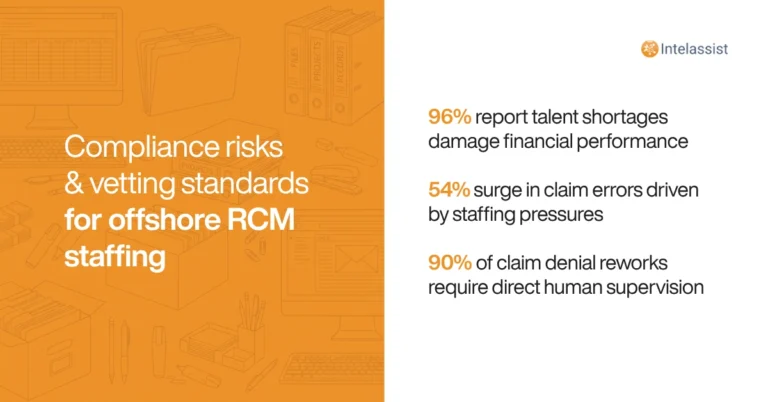
Healthcare organizations must navigate complex insurance rules and strict compliance frameworks. Managing these processes internally often distracts staff from direct patient care and leads to costly billing errors.
The benefits of outsourcing medical billing and revenue cycle management (RCM) include:
- Reduced Claim Denial Rates: Dedicated offshore RCM specialists focus exclusively on clean claim submissions, code verification, and rapid denial appeals.
- Full Regulatory Compliance: Reputable outsourcing partners possess the operational capability to match all standard in-house hires regarding HIPAA compliance and complex regulatory requirements, safeguarding sensitive patient records against security breaches.
- Accelerated Reimbursement Cycles: Continuous account monitoring ensures steady, predictable cash flow for medical practices and clinical networks. Revenue cycles are more efficient because billing and receivable system has a continuous flow.
Outsourcing IT and Technical Support Functions
Internal IT departments are frequently overwhelmed by routine troubleshooting tickets, leaving them little time to focus on core network architecture and cybersecurity initiatives.
The primary benefits of IT outsourcing include:
- Continuous Coverage: Global talent distribution allows for round-the-clock technical support and proactive system monitoring.
- Access to Elite Engineering Skillsets: Organizations can secure certified network administrators, cloud architects, and software QA testers without paying prohibitive local tech premiums.
- Rapid Incident Resolution: External tech support teams operate under strict service level agreements (SLAs), ensuring minimal operational downtime.
Benefits of Outsourcing HR Functions and Talent Acquisition
Managing internal human resources involves extensive administrative overhead, from tracking time cards to running preliminary resume screenings.
The core benefits of outsourcing HR functions include:
- Optimized Workforce Onboarding: Offshore HR assistants can handle background checks, reference verifications, and onboarding documentation.
- Streamlined Global Payroll Support: Remote specialists ensure accurate time-tracking management and data coordination for distributed workforces.
- Enhanced Retention Tracking: Dedicated tracking of employee satisfaction metrics helps identify potential turnover risks before they disrupt operations.
Benefits of Outsourcing Engineering and Design Services
Engineering and architecture firms often face erratic project pipelines, making it difficult to balance local staffing levels with fluctuating workloads. Embracing engineering services outsourcing allows firms to scale production capabilities dynamically without over-extending local overhead.
Key operational impacts include:
- Precision Drafting Support: Utilizing offshore specialists for architecture services ensures that complex schematics move forward without interruption.
- Rapid Production Cycles: Delegating labor-intensive tasks like architectural drafting allows your core local engineers to focus purely on conceptual design and client relations.
- Software Proficiency: Sourcing technical professionals fluent in AutoCAD outsourcing ensures that delivery standards match your internal design criteria precisely.
Integrating Company Culture into Outsourced Teams For Sustainable Performance
The true value of an outsourcing strategy relies on the longevity and stability of the offshore team. When professionals are deeply integrated into an organization’s operational culture, they develop a strong sense of ownership. This cultural connection protects institutional knowledge and ensures consistent output quality over time.
Why Culture Drives High-Retention Performance
When remote professionals are treated as true organizational colleagues and are supported with professional physical workspaces, fair compensation, and clear avenues for career development, engagement increases.
Intelassist sustains an industry-leading employee retention rate of over 90%, which stands in stark contrast to the traditional BPO industry average. This long-term workforce stability ensures that the experience your remote team gains stays inside your business, creating a dependable foundation for growth.
Three Actions for Seamless Team Integration
- Open Direct Lines of Communication: Include your remote team members in regular department meetings, project updates, and digital collaboration channels. Avoid filtering interactions through intermediate managers.
- Provide Unified Brand Onboarding: Deliver the same core values, brand vision, and operational documentation to your offshore team that you provide to local hires.
- Acknowledge Professional Milestones: Celebrate project successes, performance achievements, and employment anniversaries across your entire distributed workforce.
Evaluating and Selecting an Outsourcing Partner
Selecting an offshore vendor solely on the lowest hourly rate can introduce hidden operational liabilities and compliance risks. To secure a sustainable partnership, leadership must apply a rigorous evaluation framework during the vendor vetting process to ensure corporate alignment.
- Audit Executive Governance: Look for partners that provide structured management oversight and clear operational accountability, ensuring your remote team is fully supported on the ground.
- Assess Sourcing Quality: Verify if the vendor relies on generic resume databases or if they actively recruit custom talent tailored specifically to your required technical skill sets.
- Inspect Data Security Frameworks: Ensure the provider enforces enterprise-grade physical and digital security protocols, including clean-desk policies, restricted USB access, and secure, encrypted network connections.
- Strategic Evaluation Frameworks: For a complete breakdown of compliance checklists, geographic advantages, and operational steps, read our comprehensive guide on offshoring in the Philippines.
Frequently Asked Questions
Outsourcing is an operational strategy where a business hires an external partner to manage specific tasks, projects, or departmental functions. Rather than employing local staff and maintaining internal infrastructure, the company leverages the partner’s specialized talent and resources to handle those workflows.
An example of outsourcing is an architectural firm hiring a dedicated remote drafting specialist through an offshore staffing provider. The remote specialist creates technical drawings using AutoCAD, while the local architects focus on client management and project strategy.
The core concept of outsourcing is centered on operational specialization and efficiency. It dictates that companies should focus their internal time and resources on their primary competitive advantages while delegating routine, technical, or administrative workflows to specialized offshore partners who can execute them at a lower cost.
A wide variety of professional and operational roles are commonly outsourced today. Key examples include accounting and bookkeeping personnel, medical billing and revenue cycle specialists, IT support technicians, human resources assistants, and technical engineering drafters.
Outsourcing can significantly improve company culture by relieving local staff of administrative overload, reducing burnout, and boosting overall job satisfaction. However, to maintain a unified culture, businesses must avoid transactional setups and treat their offshore team as a permanent extension of their core workforce.