How Architecture Firms Are Using Offshore CAD Drafters to Stay Competitive
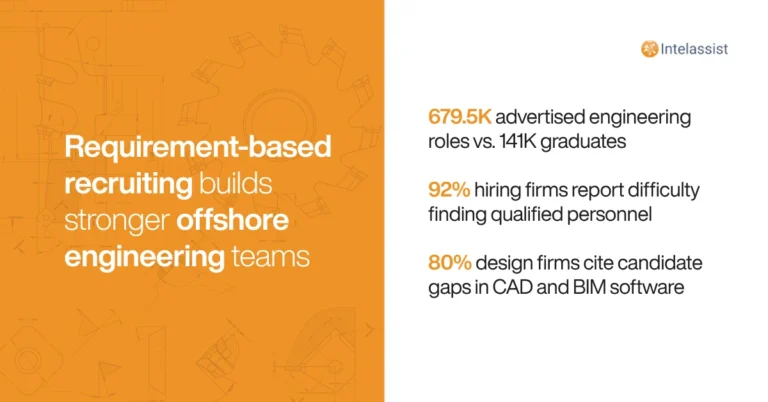
The demand for qualified CAD and Revit drafters has not let up. If anything, the gap between what firms need and what the US labor market can supply has widened. Project volume continues to climb across commercial, residential, and infrastructure sectors, while the pipeline of mid-level drafting talent capable of stepping into a production role remains stubbornly thin.
For principals and operations leads at mid-sized architecture and engineering firms, this creates a familiar bind: you have the work, you may even have the clients, but you don’t always have the production capacity to deliver without overextending your senior staff or taking on unsustainable hiring risk.
A growing number of peer firms have found a practical path through this: a deliberate staffing model built around integrated remote CAD teams that function as a genuine extension of the in-house practice.
This article explains how that model works, why it’s gaining traction, and what it looks like in practice for firms at the 50–300 employee range.
The Staffing Problem Hasn’t Changed. The Cost of Waiting Has.
AEC staffing challenges aren’t new. What has changed is the cost of waiting them out.
A few years ago, a firm might post a drafter role, get a handful of qualified applicants within a few weeks, and fill the seat within 60 days. That timeline has stretched significantly. Qualified candidates, drafters who know Revit, can work within established BIM standards, and don’t require six months of onboarding, are being recruited aggressively. Compensation expectations have moved with demand.
Meanwhile, project load doesn’t pause for hiring cycles. Deadlines don’t flex because your best production drafter left for a developer’s in-house team. The practical consequence is that principals and project managers absorb the production gap, staying late to push drawings and pulling senior staff into tasks that shouldn’t require their level of expertise.
There’s also a structural tension that makes traditional hiring harder to justify. Project volume fluctuates. A 12-month backlog today doesn’t guarantee a full team’s worth of billable work 18 months from now. Adding permanent headcount to meet a peak carries real risk when the cycle turns.
This is the context in which remote staffing, specifically dedicated offshore CAD drafting teams, has moved from a fringe consideration to a mainstream operational strategy.
What “Integrated Remote Team” Actually Means
There’s a meaningful difference between sending work to a faceless production queue and building an offshore team that operates as part of your practice.
In the model that firms are adopting, drafters are hired specifically for the firm, trained on its standards and workflows, and assigned to that firm long-term. They use the same tools (Revit, AutoCAD, Bluebeam, or whatever the practice runs) and collaborate within the same project management and communication infrastructure the in-house team uses.
Over time, these team members develop genuine institutional knowledge: your drawing standards, your project delivery preferences, your client-facing conventions. That continuity produces a fundamentally different working relationship than project-by-project task sourcing.
For a principal or operations director evaluating this model, the relevant questions are:
- • Can these team members operate within our existing workflows without a significant change-management lift?
- • How long does it take to get a new drafter productive on our projects?
- • Will there be continuity, or will we be retraining constantly?
- • What does the cost structure actually look like compared to US-based hiring?
Peer experience suggests the answers are more straightforward than most firms initially expect.
What This Looks Like in Practice
Two examples illustrate the range of contexts in which this model is delivering results.
| Architecture Firm, South Carolina A South Carolina architecture firm integrated a dedicated remote drafting team beginning in 2023. The team now comprises eight people working across Revit, AutoCAD, and Bluebeam, the same toolset the in-house team uses daily. Retention has been 100% since engagement began, staffing capacity has increased by 25%, and the cost ratio relative to equivalent US-based hiring runs approximately 1:3.Two years in, the remote team is embedded in production workflows and carries the same project accountability as any in-house drafter. |
| Precast Concrete Manufacturer, Queensland A Queensland-based precast concrete manufacturer engaged a remote drafting team in 2022 to support engineering documentation demands it could not meet with local hires. Since then, the team has expanded by 75%. Turnaround times on technical drawings have dropped, and the same 1:3 cost ratio applies relative to comparable local hiring.The primary driver was access to reliable, sustained capacity. The local market simply wasn’t supplying it. |
Neither of these is an outlier case. They reflect a consistent pattern: firms that needed reliable production capacity, found they couldn’t source it locally at the right cost or speed, and built stable remote teams that have continued to perform.
Why This Model Is Gaining Traction Now
Remote work infrastructure has matured significantly. The collaboration tools, cloud-based BIM environments, and communication platforms that make distributed teams functional are now operationally routine. Firms that were already running hybrid in-house teams during and after the pandemic have the workflows in place to absorb a remote drafter without significant retooling.
There is also a generational dimension to this. Mid-level AEC professionals who came up through the last decade of practice are accustomed to working across distributed teams. The friction that made remote collaboration feel exceptional in 2015 is largely gone.
The remaining hesitation tends to be institutional: concerns about quality control, communication reliability, and whether a remote team member can feel accountable to a project the way an in-house hire does. These are legitimate concerns and worth taking seriously.
Firms that have worked through them consistently point to the same variable: structure. A dedicated remote team member who works exclusively for your firm, learns your standards, and reports through your project management chain builds accountability the same way any long-term hire does. Accountability follows the engagement model, and geography is largely incidental to that.
What to Evaluate Before Moving Forward
If you’re a principal or operations leader considering this seriously, a few areas deserve close attention:
Staffing model specifics
Is the remote drafter dedicated exclusively to your firm, or shared across a pool of clients? Dedicated teams build institutional knowledge and accountability over time. Shared pools introduce variability that is hard to manage at the project level.
Onboarding timeline and ramp-up
Any new hire, remote or local, takes time to get up to speed on a firm’s standards. Understanding the realistic onboarding window for a remote drafter, and what support the staffing partner provides during that period, is important context for planning.
Continuity and retention
The value of a remote team member compounds over time. A drafter who has been on your team for two years understands your standards in a way a replacement won’t on day one. Asking how staffing partners structure retention, and what their actual track record looks like, is a reasonable due-diligence question.
Scalability
One of the structural advantages of a remote team model is the ability to scale capacity up or down more fluidly than a permanent hire allows. Understanding how that flexibility is structured, including notice periods, scaling timelines, and contractual constraints, matters for firms managing variable project volume.
The Competitive Lens
Your competitors are not all waiting for the local hiring market to improve.
Some firms are already running production-ready remote drafting teams. They are delivering projects with more capacity than their local headcount would suggest. They are protecting their senior staff from production overload. And they are doing it at a cost structure that lets them price more competitively or protect margins more effectively.
The AEC talent shortage is a structural condition. Firms that treat it as a temporary disruption to be weathered through conventional hiring will continue to feel its pressure. Firms that have expanded what their team can look like, geographically and structurally, have found a way to keep moving.
That is the practical reality of how a growing number of peer-sized firms are maintaining their competitive position: a deliberate decision to build production capacity in a way the market actually supports.
See How Intelassist Builds Dedicated CAD Drafting Teams for Architecture Firms
Intelassist works with AEC firms to build dedicated remote drafting teams, hired for your practice, trained on your tools and standards, and integrated into your existing workflows. If you’re evaluating whether a dedicated remote team is the right fit for your firm’s capacity needs, the AEC solutions page is a practical next step.