Vetting a CAD outsourcing partner is the systematic evaluation of an offshore technical staffing firm’s software proficiency, data security infrastructure, and operational management layer before granting access to proprietary architectural drawings or BIM models. Most CAD outsourcing failures stem from unverified software skills and the absence of a daily QA management loop rather than a lack of global technical talent.
Core Findings:
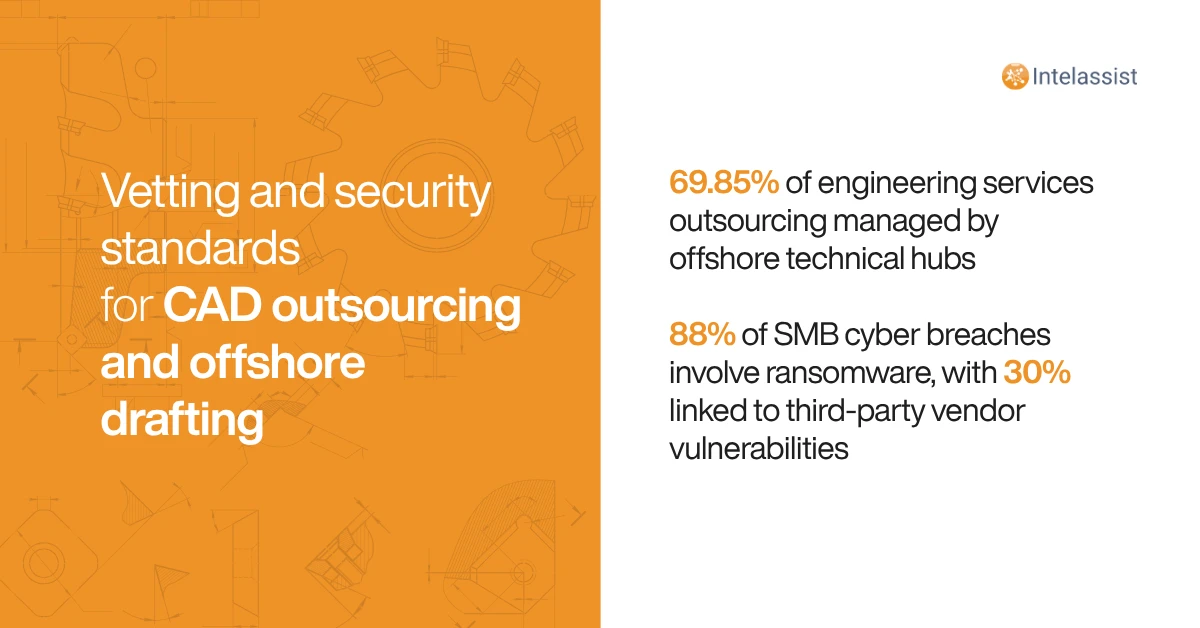
- Offshore hubs retained a 69.85% share of the engineering services outsourcing market in 2025, with Asia-Pacific holding 41.92% of global revenue—driven significantly by established technical talent bases in the Philippines.
- Upskilling efforts now blend AI-augmented finite-element analysis with traditional CAD workflows, accelerating design iteration cycles without compromising structural accuracy.
- SMBs experience up to 88% ransomware-related breaches overall, with human-element risk involved in 60% of cases and third-party software vulnerabilities accounting for 30%.
- Enforceable protection of offshore CAD drawings depends on documented reasonable measures, including confidentiality markings, physical and technological access restrictions, strict NDAs with partners, periodic access reviews, and employee training.
Moving Beyond General BPO Staffing for Offshore Technical Workflows
Offshoring engineering and architectural drafting requires replacing high-level promises with operational scrutiny. While the strategic advantages of outsourcing include expanding drafting bandwidth and lowering operational overhead, execution breaks when generalist staffing agencies treat technical CAD roles like administrative tasks.
When evaluating architecture outsourcing services, the two things worth auditing most are how your outsourcing partner screens candidates and how they manage the work once it’s live.
Production-Ready Revit and AutoCAD Execution
General BPO vendors often place drafters who possess basic software familiarity but lack production speed, parametric family creation experience, or adherence to strict CAD layer standards. When these drafters learn on your billable hours, project timelines stall and redline turnaround costs escalate. Validating technical competence requires evaluating candidates under real-world redline conditions before signing a contract.
Task-Based Handoffs vs. Dedicated Remote Staffing Ownership
Remote CAD drafters working without context often lack an understanding of regional building codes or broader project intent, leaving client operations directors to manage daily file fixes. To understand what engineering services outsourcing actually looks like in practice, firms must shift from task-based vendor tickets to embedding a dedicated drafter into internal daily workflows.
- Task-Based Vendor Model: Work is sent over a digital wall; no single offshore team member owns project continuity; redlines require repeated explanations; client bears full management burden.
- Embedded Dedicated Model: A dedicated CAD drafter attends daily standups, masters your sheet templates, learns your design standards, and owns role outcomes year-round.
The 5-Step CAD Outsourcing Partner Vetting Checklist
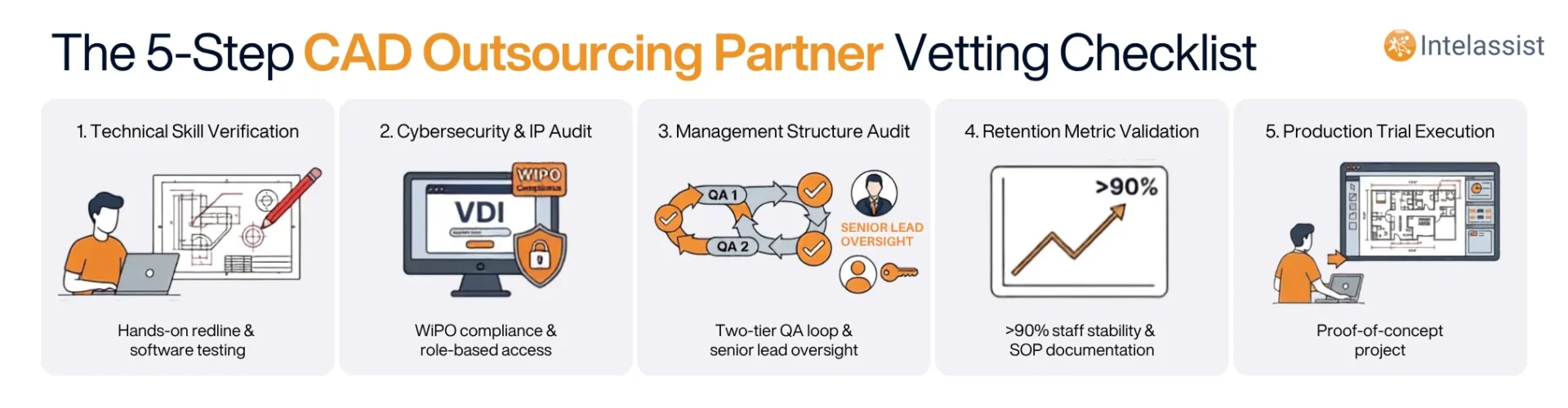
Protecting your proprietary design files and ensuring drawing accuracy requires a structured, multi-stage vetting framework. Before you grant network access, run a prospective CAD outsourcing partner through the following vetting framework:
Step 1: Enforce Tool-Specific Technical Skill Testing
Require candidates to complete a timed drafting evaluation using a sample redline package in Revit or AutoCAD. Test their ability to manage sheet layouts, organize model hierarchies, create dynamic blocks, and execute parametric modeling within your firm’s specific template structure.
Step 2: Audit Cybersecurity Infrastructure and Trade-Secret Compliance
Before sending proprietary files offshore, evaluate physical and network security standards. Ensure the partner enforces role-based access control, encrypted file transfers, and disabled local USB storage. Include strict non-disclosure agreements and periodic access reviews to protect your design IP from unauthorized exposure or third-party breaches.
Step 3: Inspect the Daily QA Management Loop
Clarify how quality assurance is managed before drawings reach your inbox. A reliable CAD drafting partner uses a two-tier oversight structure where a senior CAD/BIM coordinator reviews sheet sets against your redlines prior to submission.
Confirm who your direct point of contact is and establish daily standups to discuss active drawing sets and submittal deadlines. Exploring the specific reasons why offshore CAD teams fail shows that the absence of a structured daily QA loop is the single largest driver of client frustration.
| QA Oversight Element | General BPO Agency | Dedicated Remote Staffing Partner |
|---|---|---|
| Pre-Submission Review | None (Client acts as primary checker) | Senior CAD Coordinator checks against client redlines |
| Layer & Standard Audits | Inconsistent across file batches | Strict adherence to client CAD standards and AIA layers |
| Communication Channel | Ticketing system or generic inbox | Direct Slack/Teams integration + daily standups |
| Issue Escalation | Offshore account executive (non-technical) | Dedicated Operations Manager + Technical Team Lead |
Step 4: Verify Retention Metrics and Knowledge Protection Protocols
High turnover in traditional BPOs forces constant re-onboarding and erases production efficiency. Choose a dedicated remote staffing partner with proven retention metrics, ideally maintaining a team retention rate above 90%.
Verify that your partner documents standardized operating procedures (SOPs) for your project templates, ensuring institutional knowledge remains secure even during team transitions.
Step 5: Execute a Production-Grade Trial Project Before Scaling
Before committing to long-term architectural drafting outsourcing, run a paid, limited-scope trial project. Submit a standard redline set or elevation drawing to evaluate real-time responsiveness, file delivery speed, and redline accuracy.
A structured trial reveals the true operational cadence of your offshore CAD team before you deploy them across larger commercial or residential projects. Seeing what a dedicated offshore CAD drafting team delivers during a trial period establishes clear benchmarks for long-term production scaling.
Technical Roles and Specialized CAD Workflows
Boutique technical staffing requires matching specific discipline expertise to specialized project demands rather than assigning general engineering support. Modern AEC and infrastructure projects require dedicated specialists who possess niche tool mastery and industry-specific drafting standards.
Examining specialized deployments highlights how dedicated staffing models adapt across different infrastructure verticals:
- Telecom and Utility Infrastructure: Sourcing specialized dedicated CAD drafting teams for telecom and utility providers to manage fiber route mapping, site layout drawings, utility pole line attachments, and permit set drafting.
- Structural Steel & Fabrications: Deploying a remote project coordinator for PEMB structural steel fabrication who oversees shop drawing submittals, Tekla model coordination, material takeoffs, and fabrication schedule updates.
- Architectural & Commercial BIM: Integrating dedicated Revit drafters and BIM coordinators who manage multi-disciplinary clash detection, parametric family creation, and detailed construction documentation sets.
Key Questions to Ask a CAD Outsourcing Partner Before Signing
Before executing a service contract or transmitting proprietary design files, conduct a thorough legal and technical Q&A session with prospective staffing partners.
What should be included in an NDA before sending CAD files offshore?
An offshore NDA must explicitly state that all drawings, BIM models, and design files remain your exclusive intellectual property. It should define physical and digital access controls, restrict local data saving, establish data destruction protocols upon contract end, and outline clear legal jurisdiction for enforcement.
How do you test whether a drafter actually knows Revit or AutoCAD?
Evaluate candidates through custom redline exercises that measure drawing speed, template setup, view range adjustments, and family modification in Revit. Reviewing how a drafter handles complex wall assemblies or sheet coordinate systems provides direct proof of practical software capability.
What happens to my files and project knowledge if a drafter leaves?
Your partner should enforce a structured knowledge transfer protocol backed by documented project SOPs. Secure user access must be revoked immediately upon departure, while a cross-trained replacement is deployed within a guaranteed service-level agreement (SLA) to maintain workflow continuity.
Who is my direct point of contact if deliverable quality slips?
In an embedded staffing model, you communicate directly with your dedicated offshore CAD drafter for daily redlines and with an assigned operations manager for quality escalations. This dual-layer contact structure ensures immediate performance correction without management overhead.
Where is proprietary design data stored and who holds access?
Proprietary design data should be hosted on secure cloud servers or virtual desktop infrastructure (VDI) with multi-factor authentication. Access must be granted on a strict need-to-know basis, preventing unauthorized downloads or external file sharing.
These questions are designed to uncover hidden security vulnerabilities, clarify management accountability, and ensure contractual protection for your intellectual property. Demanding specific operational answers from your CAD outsourcing partner upfront helps make onboarding much smoother and gets your partnership off on the right foot.