Requirement-based recruiting for offshore engineering is an active hiring model where specialists are sourced, evaluated, and hired exclusively against an engineering firm’s specific software stack, drafting standards, and workflow requirements. By trading immediate placement for role-specific screening, this approach eliminates the cycle of drafting errors, senior-engineer rework, and turnover common in traditional engineering outsourcing.
Core Findings:
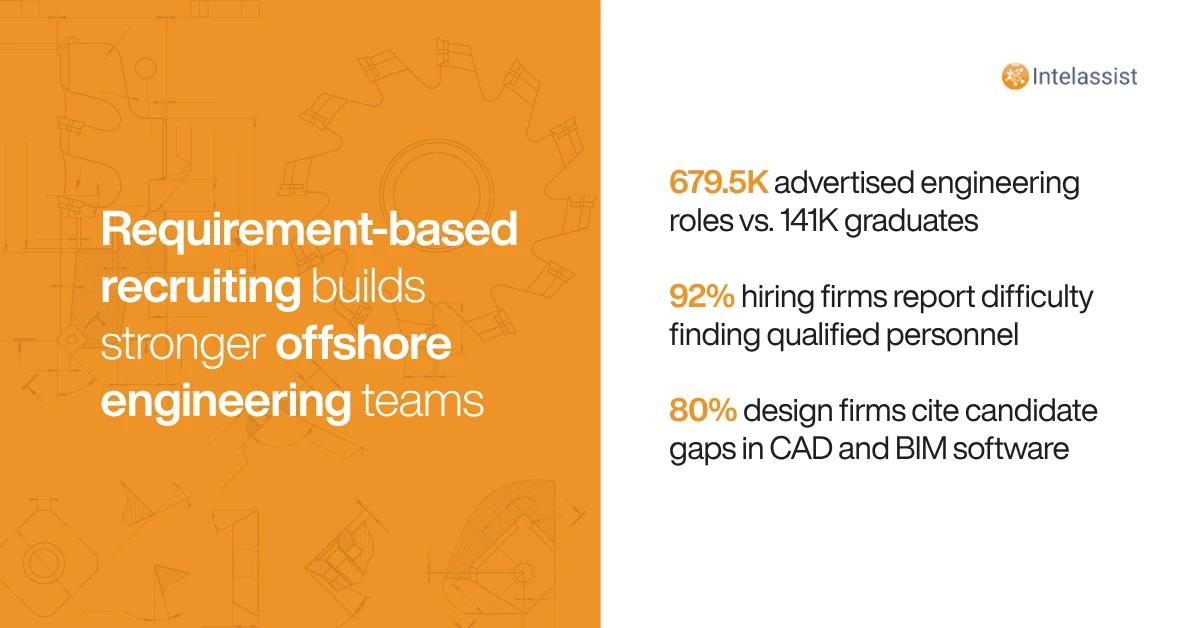
- Over 679,500 engineering positions were advertised across the United States in April 2026, while domestic universities graduate roughly 141,000 engineers annually.
- 92% of construction and engineering firms actively hiring report difficulty locating qualified craft and technical personnel.
- 58% of global design-and-make leaders identify lack of access to skilled talent as a barrier to growth, with 61% reporting that workers with the right technical skills are difficult to find.
- 35% of architecture and design employers hiring recently faced recruitment hurdles, with 80% citing skill gaps in specialized CAD and BIM software.
The Downside of Traditional Engineering Outsourcing Placements
Traditional engineering outsourcing loses effectiveness over time because generalist staffing vendors view technical production as interchangeable labor. Operations leaders face a predictable, costly cycle: a firm hires an external provider to clear backlogs, receives drawings that violate internal standards, spends senior engineering hours redlining sheets, and pulls the work back in-house. When backlogs build up again months later, the cycle repeats.
As current AEC outsourcing trends show, successful partnerships depend on software fluency. An offshore hire who claims CAD literacy but struggles with the technical specifications shifts the management burden directly onto internal engineers. When firms outsource engineering tasks without verifying exact discipline workflows, they compound overhead rather than reducing it.
Bench Staffing vs. Requirement-based Recruiting
Bench staffing assigns pre-hired generalists from an internal payroll pool to fill seats quickly, whereas requirement-based recruiting initiates an active, targeted search matching a firm’s specific technical scope. Bench models optimize vendor seat utilization; requirement-based models safeguard client production stability.
A fast placement is almost always a pre-matched placement. When a staffing firm promises an offshore engineer in 48 hours, that candidate was chosen before anyone looked at your standards or your actual requirements. And a candidate selected without that context rarely survives contact with your production environment.
A dedicated offshore team built through requirement-based recruiting functions as an integrated extension of your studio, working exclusively within your project directories and under your operational oversight.
What Must an Engineering Requirement Brief Contain Before Recruiting Starts?
An engineering requirement brief must articulate exact production standards, software environments, and deliverable handoffs before candidate sourcing begins. Precision in the brief eliminates unqualified candidates before screening starts.
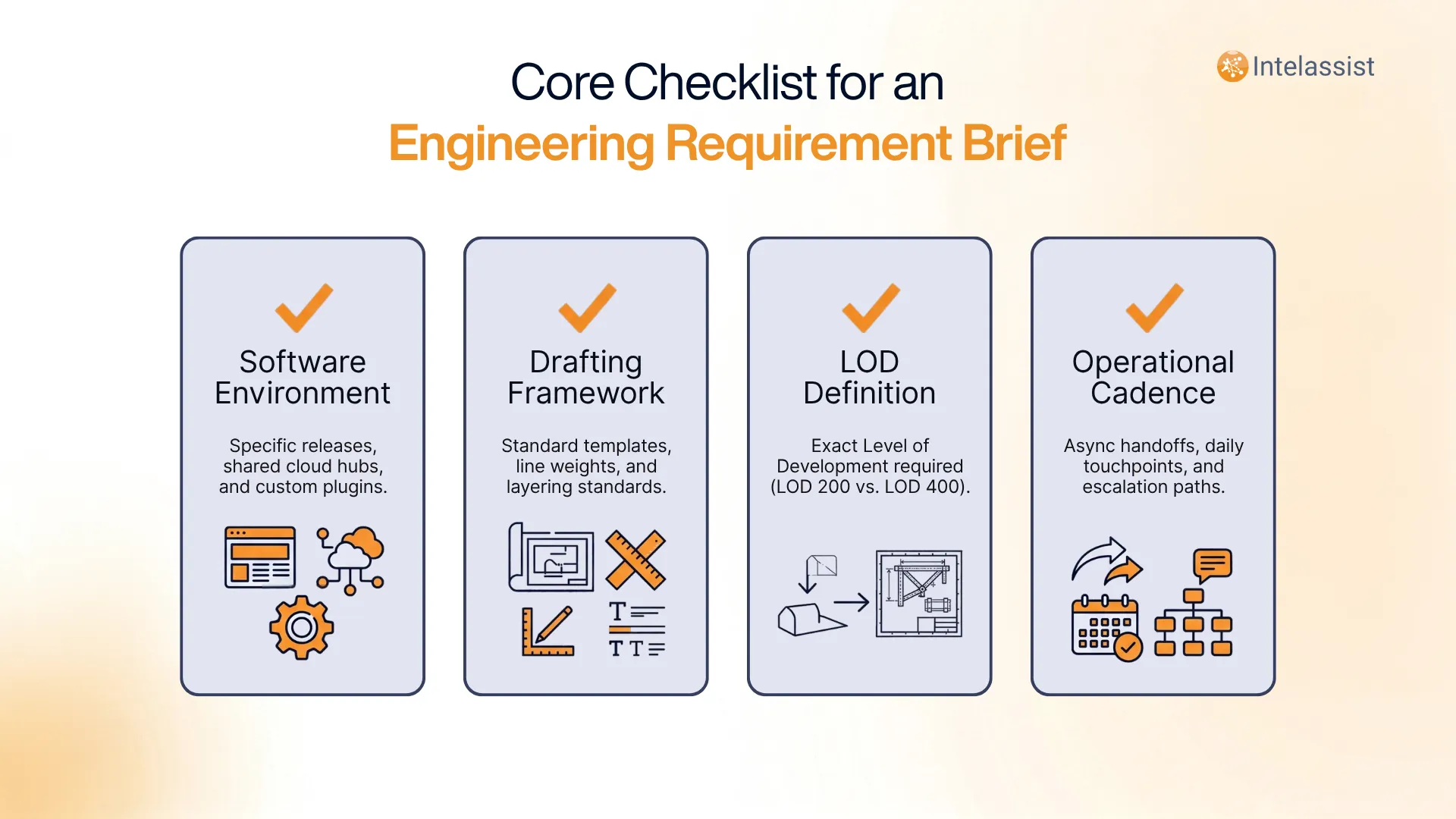
When scoping outsourced engineering services, operations leaders must define four technical pillars:
- Software Versioning and Plugins: Document exact release versions, maintenance updates, and required extensions (such as Revit in Autodesk Construction Cloud versus standalone AutoCAD).
- Drafting Conventions and CAD Standards: Specify layer guidelines, line weights, title blocks, and sheet set configurations.
- Level of Development (LOD) Deliverables: Define whether tasks require LOD 200 schematic geometry, LOD 300 coordinated design elements, or LOD 400 fabrication detailing.
- Communication and Handoff Protocols: Establish daily check-in rhythms, asynchronous markup tools, and review sign-offs.
Custom Technical Screening for Specific Platforms and Software Tools
Standardized tests often assess broad knowledge or basic interface navigation, failing to capture how candidate engineers handle project-specific standards, complex layering conventions, or software-specific cases.
By tailoring evaluation tasks to the exact tools and workflows required for a given role, engineering teams can accurately measure practical competence before candidate onboarding. This ensures new placements integrate seamlessly into existing production pipelines without requiring extensive remedial technical training.
Screening Criteria by Engineering Discipline
AEC and Civil Infrastructure Workflows
Firms evaluating options for outsourcing civil engineering services require disciplined platform assessments rather than general CAD evaluations. When planning to outsource civil engineering services across regional infrastructure projects, technical screening must verify specific competencies:
- Autodesk Civil 3D Execution: Dynamic corridor modeling, cut-and-fill surface volume calculations, and pipe network layout with automated annotation and profile generation.
- Transportation & Infrastructure Platforms: Workspace and level library compliance within MicroStation or OpenRoads Designer aligned with state standards.
- Survey & Coordinate Precision: Managing coordinate geometry points and surface databases accurately to prevent site alignment errors before work moves to the field.
Rigorous civil engineering outsourcing requires testing these application-specific workflows on actual project templates rather than relying on claims of general drafting familiarity.
Mechanical and Structural Workflows
In mechanical engineering outsourcing, technical screening must isolate parametric modeling integrity and fabrication drawing precision. Candidates must demonstrate practical mastery across specific production disciplines:
- Parametric Software Environments: Advanced modeling, assembly constraints, and part configurations in SolidWorks, Autodesk Inventor, or Tekla Structures.
- Manufacturing & Detailing Standards: Generation of fabrication-ready shop drawings, accurate sheet metal flat patterns, and weldment callouts.
- Tolerance & Connection Verification: Execution of tolerance stack-up analyses and resolving complex structural steel connections to eliminate clash risks prior to shop fabrication.
How Should Engineering Firms Test Tool Competence During Screening?
Firms must evaluate tool competence through practical, timed modeling assessments rather than portfolio reviews. Static portfolios often conceal individual gaps, as rendered presentation sheets can mask messy layer hierarchies, detached xrefs, or team-generated geometry.
To verify technical ability:
- Administer a Redline Markup Test: Provide an unedited drawing file and a marked-up PDF redline set. Require the candidate to complete revisions within a strict two-hour window.
- Audit Model Hygiene: Inspect completed files for clean layer standards, parametric constraints, and accurate dimensioning.
- Verify Data Governance: Prioritize providers with documented security protocols. Review how to vet a CAD outsourcing partner before sending proprietary designs to safeguard intellectual property.
How Long Does Requirement-based Recruiting Take (And Why is it the Right Trade)?
Requirement-based recruiting takes three to six weeks from brief intake to final placement, representing an intentional operational trade-off that secures long-term retention.
Ramp-up timelines follow the complexity of the role. Technical drafters generally need three to six months to internalize a studio’s production standards fully; construction estimators and comparably specialized roles tend to reach full productivity in closer to a month. Knowing this going in allows the onboarding process to be structured instead of reactive.
Successful integration also requires acknowledging the internal onboarding lift. Month one creates real internal work: standardizing operating procedures and turning internal shorthand notes into clear production guides. To keep the process from stalling, designate a single internal owner who has the authority to answer questions and adjust workflows without needing committee sign-off on every decision.
Frequently Asked Questions
Requirement-based recruiting is a tailored staffing model where offshore engineers and drafters are sourced, tested, and hired exclusively against an engineering firm’s explicit software versions, drawing standards, and project workflows, rather than pulled from a pre-hired bench pool.
High turnover occurs because generalist BPOs place candidates based on resume keywords rather than practical tool testing. When drafters struggle with specialized software workflows, rework escalates, and candidates burn out.
Practical testing replaces static portfolio reviews with timed, real-world drafting exercises. Candidates receive standard redline markups and templates, executing revisions to prove layer discipline, modeling speed, and adherence to drafting standards under project constraints.
Firms must document their software environments, provide template drawing sets, and designate a single internal engineering lead with authority to resolve technical questions and approve workflow adjustments without committee delays.
Sourcing, technical vetting, and client interviews typically require three to six weeks. Candidates then transition into structured production pathways, achieving full operational independence between one and six months depending on role complexity.
Yes, provided each position is recruited against its specific technical platform. Civil 3D modelers possess distinct software skill sets and must be hired through separate requirement briefs rather than bundled into a single generalist role.