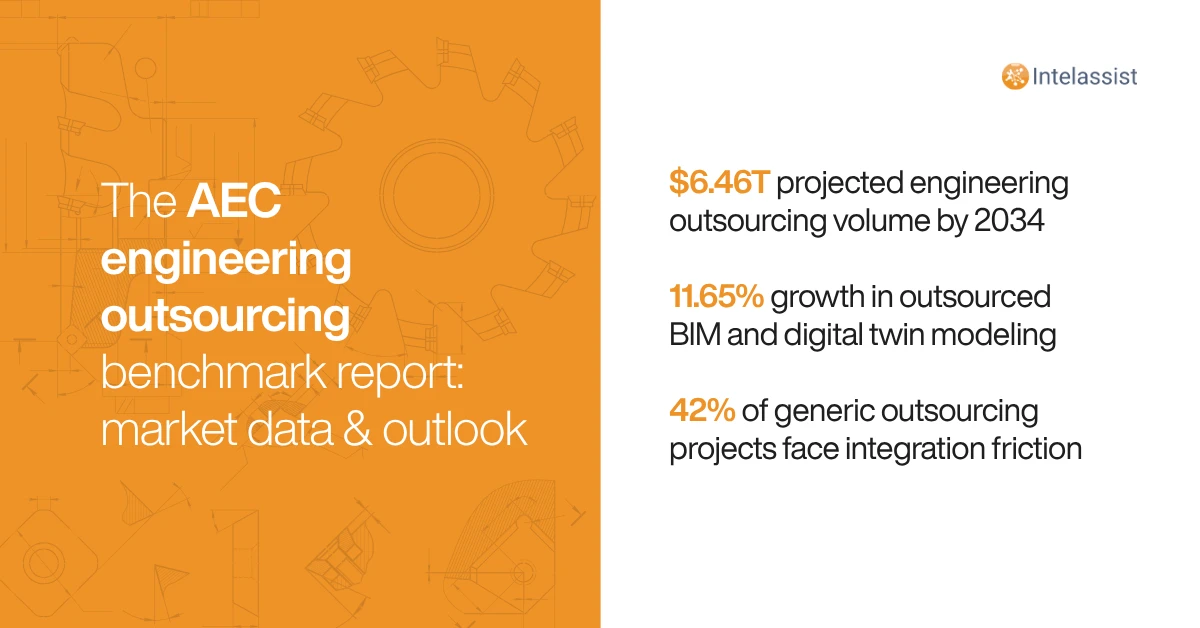
Architecture, engineering, and construction outsourcing trends show that the industry has expanded into the world’s largest professional services category by annual revenue, reaching $1.92 trillion in 2025 and projected to reach $6.46 trillion by 2034 at a 14.42% CAGR.
Rather than treating offshore staffing as a temporary fix for basic drafting backlogs, A/E/C leaders are structurally integrating specialized remote engineers and BIM specialists directly into their core project delivery workflows. In 2026, these trends reflect a fundamental shift from simply augmenting onshore teams toward outcome-based contracts where external technical teams manage complete, permit-ready design packages.
What Is Driving the Rapid Expansion of AEC Outsourcing in 2026?
The rapid adoption of construction and engineering outsourcing services is driven by compounding market pressures: surging global infrastructure demand, tight profit margins, and domestic talent shortages across technical disciplines.
Global Construction Expansion and Infrastructure Mandates
According to Deloitte’s Global Powers of Construction Report, the global construction sector is expanding from $11.39 trillion in 2024 to $16.11 trillion by 2030. Large-scale urban development, renewable energy projects, and public infrastructure modernization programs generate unprecedented project pipelines. However, because top construction firms face razor-thin margins, implementing off-site planning and digital modeling workflows has become essential for maintaining operational profitability.
Finding Offshore Talent and Managing Costs
Domestic engineering firms in North America and Europe face escalating wage inflation and persistent shortages of experienced CAD technicians and civil engineers. In response, enterprises now leverage global engineering talent pipelines.
Civil engineering and architectural labor costs in primary offshore hubs like the Philippines and India remain 60% to 75% lower than equivalent positions in the US, UK, and Germany. This cost differential allows firms to scale production capacity, handle workload spikes, and protect profit margins without expanding permanent domestic overhead.
| Growth Driver | Operational Impact on A/E/C Firms | Data Insights |
|---|---|---|
| Global Construction Scale | Requires rapid scaling of drafting and design capacity to capture project volume. | Market expanding to $16.11 Trillion by 2030. |
| Labor Cost Arbitrage | Reduces technical payroll overhead while maintaining high output quality. | 60%–75% cost reduction in offshore hubs. |
| Software R&D Shift | Accelerates adoption of AI-driven simulations and 3D modeling workflows. | 68% of industrial firms outsource engineering. |
Key Market Benchmarks: Global Engineering & Construction Outsourcing Growth
Understanding current market valuations provides A/E/C executives with clear operational benchmarks for strategic planning.
- Research from Deloitte highlights that the world’s 100 largest construction firms generated $1.978 trillion in revenue in 2024, driving widespread demand for digital design integration.
- Data from IMARC Group confirms that engineering services outsourcing is the fastest-growing professional services market globally by absolute revenue addition.
- The global BIM outsourcing market is growing from $4.6 billion in 2025 to $9.8 billion by 2032 at an 11.5% CAGR, driven by public sector BIM mandates, scan-to-BIM projects, and integrated 4D/5D time-cost modeling.
- The civil engineering outsourcing segment will grow from $726.18 million in 2026 to $1.18 billion by 2036 at a 5.0% CAGR. Trade data shows that drafting and 3D modeling account for 28% of total ESO market share.
- Outsourcing in the AEC vertical is no longer limited to overflow drafting. Over 58% of ESO providers now integrate AI-driven simulations, cloud coordination, and digital twin technology directly into client workflows.
What Specialized Technical Roles Are AEC Firms Outsourcing Most?
AEC firms are moving away from multi-purpose virtual assistants in favor of role-specific technical specialists who possess deep proficiency in industry-standard software suites.
Core AEC Outsourced Technical Specialties
| CAD & Documentation | BIM & Civil 3D | Operations & Admin |
|---|---|---|
| AutoCAD Drafting | Revit Architecture/MEP | Client Intake |
| Permit Drawing Sets | Civil 3D Site Layouts | Project Scheduling |
| As-Built Drawings | 4D/5D BIM Modeling | Submittal Logs |
CAD Drafting and Architectural Documentation
Outsourcing architectural drafting and CAD drafting allows firms to streamline the production of construction documentation, detailing, and permit sets. Handing off production drawing cycles to dedicated offshore technicians allows internal project managers and licensed architects to concentrate on client relations, concept design, and construction administration. Remote drafters deliver standardized AutoCAD and Revit output aligned with local code requirements.
Building Information Modeling (BIM) and Civil 3D Engineering
Rising project complexity requires advanced BIM coordination across architectural, structural, and MEP disciplines. Offshore civil and structural engineers develop parametric Revit families, execute 3D clash detection in Navisworks, and construct detailed grading and utility models in Civil 3D. Industry analysis highlights that full design package outsourcing—where providers deliver complete, permit-ready BIM models and stamped documentation sets—has increased average contract values from $50,000–$200,000 for task-level work to $500,000–$2,000,000 per engagement.
How A/E/C Leaders Build Operational Resiliency and Workflow Integration
Unlocking the full value of engineering services outsourcing requires operational structure, quality control protocols, and data security measures.
Evolving from Task-Based Drafting to Outcome-Driven Staff Integration
Research shows a clear market movement away from transactional labor arbitrage toward outcome-based contracts. Furthermore, market data indicates that nearly 42% of outsourcing initiatives face friction due to process inconsistency or intellectual property management concerns. Enterprises overcome these challenges by embedding dedicated, pre-screened technical professionals directly into their internal communication channels (Slack, Teams) and software ecosystems (Autodesk Construction Cloud, Revit, Civil 3D). Direct operational oversight ensures remote drafters follow your firm’s CAD standards, sheet setups, and QA/QC checklists from day one.
Safeguarding Intellectual Property and Establishing Quality Controls
Protecting proprietary design files and client privacy is essential when managing remote teams. Firms enforce security protocols by deploying secure cloud access environments, single sign-on (SSO) authentication, and strict non-disclosure agreements. Additionally, establishing standardized template libraries across AutoCAD, Revit, and Civil 3D ensures remote team members execute work to exact firm specifications from day one.
Scale Your AEC Operations with Dedicated Technical Talent
Managing heavy project backlogs without inflating domestic overhead requires a reliable, scalable talent strategy. Intelassist supplies pre-screened Revit drafters, Civil 3D engineers, and BIM specialists who embed directly into your operational workflows to protect project timelines and profit margins.
Discover how Intelassist can expand your firm’s drafting and engineering capacity. →