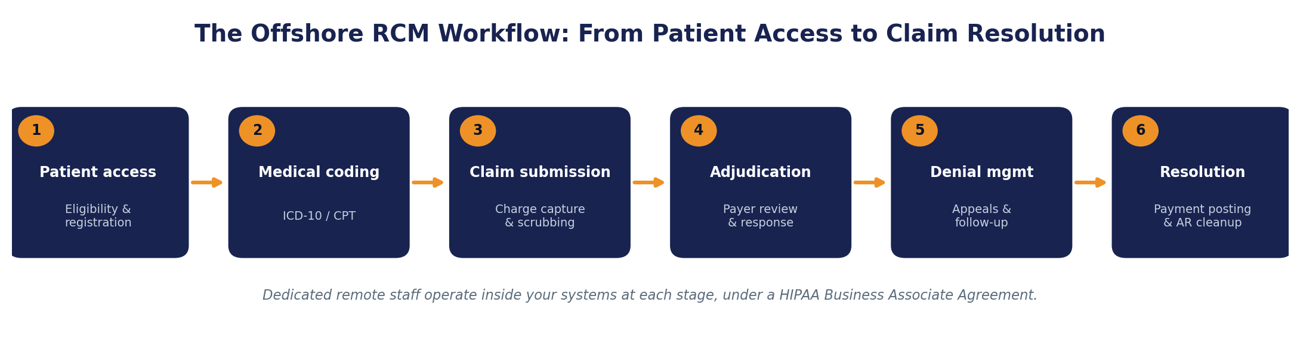
Offshore revenue cycle management (RCM) is the practice of running the administrative side of the revenue cycle, eligibility, coding, claim submission, denial management, and accounts receivable follow-up, with a dedicated remote staff who works only for your organization, under a HIPAA Business Associate Agreement.
Done well, it clears billing backlogs and lowers AR days. Otherwise, it creates compliance exposure. This guide covers how it works, whether it is HIPAA compliant, and what to evaluate before you choose a partner.
Core Findings
- Backlogs are getting worse in healthcare organizations. Initial denial rates rose to 11.8 percent in 2024 and true AR days increased 5.2 percent year over year, across more than 2,100 hospitals (Kodiak Solutions).
- Compliance is a structural requirement. Under HIPAA, any vendor that handles protected health information is a business associate, must operate under a signed agreement, and is directly liable for safeguarding it (HHS).
- The Philippines is a mature destination for this work. Its broader IT and business process sector closed 2025 near $40 billion with about 1.9 million workers, and the US and Canada make up an estimated 75 to 80 percent of its healthcare information management client base (PEZA).
- Staffing pressure is what forces the decision. 53 percent of healthcare organizations expect their revenue cycle performance to decline in 2025 without change, with labor and skills shortages among the top barriers cited (Becker’s Healthcare / Savista 2025 RCM Benchmark Survey).
- A dedicated remote team is now standard practice across the sector. 97 percent of healthcare organizations outsource at least one revenue cycle function, averaging 2.2 functions each (Becker’s Healthcare / Savista 2025 RCM Benchmark Survey).
What Is Offshore RCM, and What Does It Cover?
Offshore RCM is a defined set of administrative revenue cycle tasks handled by a dedicated remote team that works only for your organization. The first question most leaders ask is which of those tasks can safely move and which should stay in-house.
Which revenue cycle functions can a remote team actually run?
The tasks of a dedicated offshore team cover the administrative, rules-driven stages of the revenue cycle. A dedicated remote team can own eligibility and benefit verification, medical coding, charge entry and claim submission, denial management and appeals, and AR follow-up and payment posting. Clinical judgment and final accountability stay with your organization.
The dividing line is the same one that applies in any function: offload the repetitive, standards-driven work, and keep the decisions that require professional judgment, clinical context, or legal accountability.
| Tasks to unload to offshore team | Tasks that stay in-house |
|---|---|
| Eligibility and benefits verification | Compliance program ownership and policy |
| Medical coding (ICD-10 / CPT) | Final sign-off on complex or high-risk coding |
| Charge entry and claim submission | Write-off, adjustment, and pricing decisions |
| Denial management and appeals | Payer contract strategy and escalations |
| AR follow-up and payment posting | Clinical documentation decisions |
How Does Offshore RCM Cut AR Days and Clear Backlogs?
Smart outsourcing for healthcare organizations comes down to consistent, trained staff dedicated to working on claims every day. Here is how an offshore team turns that steady effort into lower AR days and fewer write-offs.
Why does a dedicated team move the numbers that matter?
Backlogs and rising AR days usually trace to a staffing and consistency gap. Denials pile up because no one has time to work them, and aging claims slip past timely-filing windows. A dedicated remote team takes that work off your plate, working denials and AR systematically rather than reactively.
That matters because the money is recoverable. More than half of denied claims are eventually overturned, but only after multiple, costly rounds of appeals that understaffed teams rarely have time to pursue. Consistent follow-up on denials and aging AR is exactly the repeatable, high-volume work a dedicated team is built for, which is how organizations bring AR days down and stop writing off recoverable revenue.
Is Offshore RCM HIPAA Compliant?
Yes, when it is structured correctly. HIPAA does not prohibit offshore handling of protected health information. It requires that any business associate that creates, receives, maintains, or transmits PHI operate under a written agreement and comply directly with the Privacy and Security Rules, and that obligation flows down to subcontractors. Compliance therefore depends on how the partner operates, wherever they sit.
Use the following as a baseline when you evaluate any offshore RCM partner. If a partner hesitates on any of these, treat it as a stop sign.
| Requirement | What to request from your offshoring partner |
|---|---|
| Business Associate Agreement | A signed BAA before any PHI is shared, with subcontractors bound to the same terms. |
| Security certifications | Recognized frameworks such as HITRUST CSF, ISO 27001, and/or SOC 2 Type II. |
| Access controls | Role-based access, multi-factor authentication, and secured-desktop handling that prevents local downloads of PHI. |
| Audit trails | Logged, reviewable access to every record, with named accountability. |
| Breach reporting | Defined notification timelines consistent with the HIPAA Breach Notification Rule. |
| Data residency | Confirmation of any state Medicaid or contractual restrictions on offshore handling of specific data. |
Best Practices for Standing Up an Offshore RCM Team
- Sign the BAA and confirm certifications first. Nothing involving PHI begins until the agreement is in place and the security posture is verified.
- Start with a defined scope. Begin with a contained workflow, such as denial follow-up or AR cleanup, then expand as results and trust build.
- Onboard against your systems and payers. Train the team on your EHR, your clearinghouse, and your top payers’ rules, the same way you would a local hire.
- Measure what matters. Track AR days, clean-claim rate, denial overturn rate, and cost to collect, not just volume.
- Protect retention. Coding and denial expertise compounds. A partner built for long tenure keeps that knowledge on your account.
The Future of Revenue Cycle Work
Automation and AI are reshaping the revenue cycle, scrubbing claims, predicting denials, and drafting appeals. What they do not replace is the judgment to handle exceptions, the accountability to protect PHI, and the persistence to work a complex appeal to resolution. The durable model pairs trained people with the right tools, under the right compliance controls.
Healthcare organizations that build dedicated remote RCM teams now, on a compliant foundation, are positioned to absorb those tools as they mature, rather than scrambling to rebuild the team later.
Frequently Asked Questions
Running administrative revenue cycle functions, eligibility, coding, claim submission, denial management, and AR follow-up, with dedicated remote staff who work inside your systems under a HIPAA Business Associate Agreement.
Most backlogs come down to staffing. A dedicated team works with denials and aging AR systematically, which is how organizations recover revenue that would otherwise be written off and bring AR days down.
Clinical documentation decisions, final sign-off on complex coding, write-off and pricing policy, payer contract strategy, and ownership of your compliance program.
Look for recognized frameworks such as HITRUST CSF, ISO 27001, and SOC 2 Type II, alongside a signed BAA and documented access controls and audit trails.
Some state Medicaid programs and specific contracts restrict offshore handling of certain data. Confirm your obligations with compliance counsel before scoping the work.
Plan for a structured onboarding window on your EHR, clearinghouse, and payer rules, similar to ramping a local hire, then expand scope as results build.