Building Dedicated Remote Drafting, BIM, and Documentation Teams That Stay
Engineering services outsourcing is the practice of extending a architecture, engineering, or construction (AEC) firm’s production capacity with dedicated remote staff: trained professionals who work only for your firm, on your tools and standards, and stay with your team across projects. Unlike a transactional vendor who completes a deliverable offsite and hands it back, dedicated remote AEC staff integrate directly into your workflows while keeping your firm in full control of scope, schedule, and quality.
When firms treat that capacity as a commodity, ordering drawings the way they would order printing, quality drifts, rework climbs, and the experiment quietly winds down within a quarter or two. The model is rarely the problem. The setup is.
To scale production without sacrificing quality of work, AEC leaders are moving away from project-by-project vendors and toward dedicated remote teams that operate as an extension of the in-house framework.
Core Findings
- Around 16,200 drafting positions open up every year in the U.S. — mostly because experienced workers are retiring or moving into different roles, and there simply aren’t enough people coming in to replace them.
- That gap creates real instability in project volume. A full backlog today doesn’t mean a full team’s worth of work 18 months from now, and firms are feeling that uncertainty.
- Construction planning backlogs have already slipped to 8.1 months, with the planning and pre-construction stages taking the hardest hit.
- Retention is the multiplier. Intelassist’s dedicated remote staff average more than five years of tenure, which protects the institutional knowledge a trained drafter or modeler builds about your firm.
Defining Engineering Services Outsourcing Beyond Transactional Drafting
When building offshore production, firms frequently collapse distinct arrangements into the single word “outsourcing.” The structural difference between a vendor relationship and dedicated staffing determines almost everything that follows.
What is the difference between project-based outsourcing and dedicated remote staff?
Project-based outsourcing assigns a discrete deliverable to an outside vendor who completes it offsite and returns it. Dedicated remote staffing assigns trained professionals who work only for your firm, on your standards, and remain on your team across projects.
- Project-based vendor: Optimized for throughput and price. Work is handed off and returned, with no one on your side owning the relationship. It suits one-off overflow, and struggles with anything that depends on continuity or house standards.
- Dedicated remote staff: Optimized for continuity. The same professionals learn your CAD standards, title blocks, and review cycle once, then apply them consistently for years. They attend your kickoffs and behave like the team members they are.
For AEC work, the second model is the one that holds up, because Revit and AutoCAD drafting, BIM modeling, redlines, estimating takeoffs, and project documentation are repeatable and standards driven. They reward people who learn about your conventions once, not a rotating cast who relearn them on every job.
Why AEC Firms Face a Capacity and Talent Gap
How severe is the AEC talent shortage?
In the 2025 AGC/NCCER Workforce Survey, 92 percent of firms with openings reported difficulty filling them, and worker shortages were named the leading cause of project delays.
The gap reaches the exact roles AEC firms rely on for production. Among salaried positions, estimating personnel were among the hardest to fill, reported as difficult by more than three-quarters of firms with those openings. When local hiring for drafting, BIM, and estimating support cannot keep pace, dedicated remote staff close the gap for structured production work while in-house teams concentrate on design judgment and client relationships.
What Engineering Work to Offload, and What to Keep In-House
Dedicated remote support works best for structured, repeatable, documentation-heavy tasks. Judgment-dependent and client-facing work generally stays in-house. The table below is a practical starting point for that decision.
| Strong candidates to offload | Better kept in-house |
| CAD drafting and detailing | Conceptual and schematic design |
| BIM modeling and coordination | Design decisions and code interpretation |
| Redlines, markups, and revisions | Stamping and professional sign-off |
| Estimating takeoffs and quantity surveys | Client-facing presentations and negotiation |
| Submittal logs and project documentation | Final quality assurance and approvals |
Use this as a guide, not a rule. The dividing line is whether a task depends on professional judgment and client context, or on disciplined execution against a defined standard.
Why Most Offshore Drafting Experiments Fail
Most first attempts fail for one of three reasons, and all three are setup problems rather than talent problems.
1. Treating dedicated staff like a transactional vendor
A drafter who works only for your firm needs your standards, kickoffs, and feedback. Ship work offsite with no owner on your side and quality drifts, then the firm concludes that offshore work “does not meet our standards.” Managing a remote team member the same way you manage a new local hire is what produces in-house quality.
2. Under-investing in the first 90 days
Firms give a senior local hire 30 to 60 days to ramp, then expect flawless week-one output from a remote one. A remote AEC professional typically needs a structured onboarding window before running independently. Build that runway in and you get a productive long-term contributor.
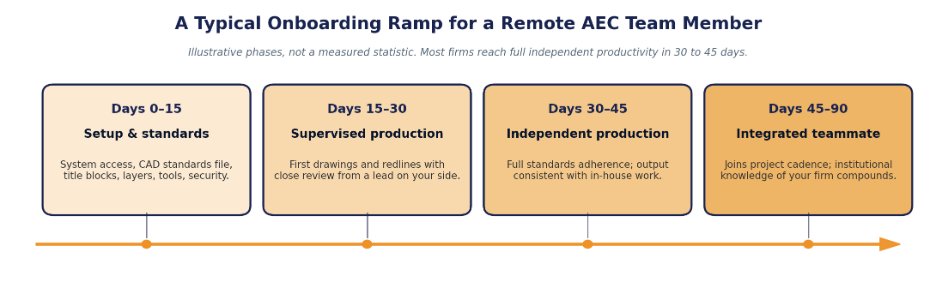
Figure 1. A typical onboarding ramp for a remote AEC team member (illustrative phases).
3. Ignoring retention until it is too late
Training a new drafter then losing them in six months becomes a cost rather than a saving. Retention is mostly a function of how the staffing partner operates: compensation set above market, real career progression, and a workplace people do not want to leave. Ask any prospective partner for their average tenure before you sign.
Differentiating and Evaluating Engineering Services Vendors
Procurement and operations leaders need verifiable markers over promotional language. The table below contrasts a standard transactional model with a dedicated remote framework across the criteria that matter most to AEC firms.
| Criterion | Transactional vendor | Dedicated remote framework |
| Talent allocation | Shared or pooled staff rotating across multiple unrelated clients. | Professionals assigned exclusively to your firm. |
| Hiring and screening | Bulk placement based on seat availability. | Direct collaboration; your firm interviews and approves each member. |
| Standards and integration | Generic output; little knowledge of your CAD standards. | Trained on your standards, templates, and review cycle. |
| Continuity and tenure | High rotation; institutional knowledge resets. | Long tenure; knowledge of your firm compounds over years. |
| Operational control | Limited visibility into daily work. | Full visibility; managed in your tools and workflows. |
| Data security | Variable; often unclear. | Formal controls and recognized compliance frameworks. |
Best Practices for Integrating a Remote AEC Team
Getting value from a remote AEC team is less about finding good people and more about setting them up to succeed from day one. Four practices do most of the work.
- Onboard with your standards file from day one. Give access to your CAD standards, title blocks, layers, and templates before the first drawing, so consistency is built in rather than corrected later.
- Assign an in-house reviewer for the first projects. A lead who reviews early output and gives the same feedback they would give a new local hire is the fastest path to in-house quality.
- Set an overlap in working hours and communication norms. Agree on overlap and channels up front. Time zone difference is manageable; an undefined process is not.
- Treat them as teammates to protect retention. Include remote staff in project cadence and give them a path to grow. People who can see a future with your firm build the knowledge that is hardest to replace.
Maintaining AEC Production Amidst Hiring Shortages
As automation absorbs routine drafting tasks, what remains for people is the work that needs judgment: interpreting intent, catching errors before they propagate, and holding the line on standards. Standards discipline, communication, and continuity become the decisive skills.
Firms that build dedicated remote teams now are positioned for that shift. When the same professionals have worked your projects long enough to know them cold, they do not just produce drawings. They protect quality and timelines at a scale local hiring alone cannot reach.
Frequently Asked Questions
1. What engineering tasks are the best candidates to offload?
Structured, repeatable, documentation-heavy work: CAD drafting, BIM modeling, redlines and markups, estimating takeoffs, submittals, and project documentation. Design judgment and client-facing decisions usually stay in-house.
2. Will offshore drafting meet our quality standards?
Quality is determined by how the team is trained and managed, not by location. Professionals trained on your standards, templates, and review process, and kept on your team long-term, produce work consistent with your in-house output.
3, How long until a remote team member is fully productive?
Plan for a structured onboarding window, often 30 to 45 days, similar to the ramp you would give a local hire learning your systems.
4. How do time zones affect collaboration?
Most remote AEC teams work partial or full overlap with their client’s hours, with heavier alignment during onboarding and active project phases. Overlap and structure matter more than the raw time difference.
5. How is our project data protected?
Reputable partners apply formal security controls and recognized compliance frameworks to protect proprietary designs, models, and documentation. Ask any partner to walk you through their specific safeguards before sharing files.
6. Can the team use our software and standards?
Yes. Dedicated remote staff operate inside your existing environment, your CAD and BIM software, your file structure, and your security and access controls, rather than a separate vendor system.
7. How do we keep a trained team member from leaving once we have invested in them?
Choose a partner whose model is built for retention through above-market pay, career progression, and a strong culture. Ask for average tenure as a direct proxy for how stable your team will be.