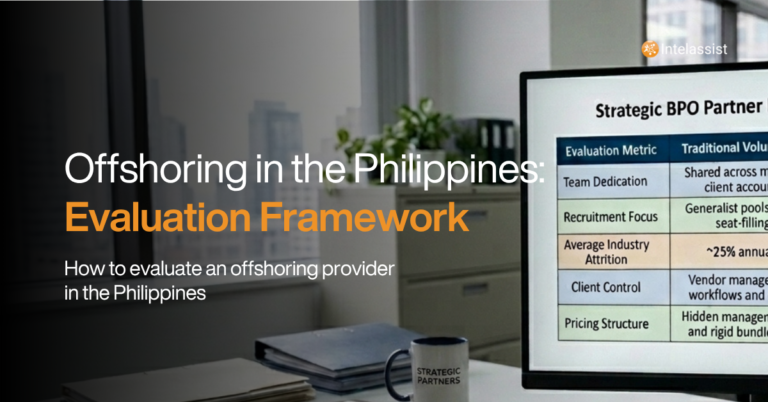
High-Retention Customer Support Outsourcing
An offshore customer care team is a dedicated extension of an enterprise’s domestic support system, integrated into the company’s core culture to manage client interactions across multiple digital and voice channels. Unlike traditional business process outsourcing (BPO), these teams are staffed by permanent, full-time remote professionals selected specifically for cultural fit, brand alignment, and long-term operational continuity.
When customer care operations are handled by revolving-door commodity agencies, customer satisfaction drops, onboarding costs climb, and internal human resource teams face constant training fatigue.
To scale successfully, global enterprises are shifting away from rigid call centers toward custom-built, dedicated remote staff who operate natively within the parent organization’s culture.
Core Findings:
- Approximately 35% of global businesses are prioritizing customer experience over the next three years to deliver differentiated outcomes and build strong brands, making the architecture of your customer care infrastructure a primary corporate differentiator.
- Traditional transactional BPOs suffer from an annual turnover rate of around 40%, whereas dedicated remote staffing models achieve up to 95% workforce stability, protecting institutional knowledge and lowering long-term onboarding costs.
- Incorporating offshore talent injects cognitive diversity into your customer operations. Research demonstrates that teams with balanced cognitive divergence achieve higher levels of creative problem-solving (46%) compared to teams with lower divergence (37%).
- Customer care goes beyond basic transactional ticket resolution to build intentional, emotional connections with users, directly driving customer lifetime value (LTV) and brand advocacy.
Defining Dedicated Customer Care Beyond Transactional BPO
When establishing global support footprints, enterprises frequently collapse distinct operational functions into the generic category of “outsourcing.” To build a scalable customer support ecosystem, leaders must clearly define the structural boundaries between reactive troubleshooting and proactive relationship management.
What is the difference between customer service, technical support, and true customer care?
Customer service focuses on resolving transactional billing or account tickets, while technical support diagnoses specific software errors. In contrast, true customer care centers on building an intentional, empathetic relationship with the end consumer over their entire lifecycle.
Understanding these operational differences allows enterprise HR leaders to align talent acquisition with actual consumer expectations:
- Customer Service: This function is fundamentally reactive and tactical. Representatives handle discrete, short-term tasks—such as processing a return, updating an billing address, or confirming a shipping window. Success is measured strictly via velocity metrics like Average Handle Time (AHT) and ticket volume.
- Customer Care: This discipline represents the qualitative touchpoints that protect client lifetime value (LTV). It moves beyond solving immediate problems to prioritize user sentiment, proactive outreach, and active empathy. Customer care professionals operate as brand stewards, ensuring that clients feel valued, heard, and structurally supported throughout their entire corporate lifecycle.
- Other Support Roles:
- Technical Support: This division requires specific technical skills and role expertise to resolve functional product issues. Technicians troubleshoot software glitches, guide users through hardware installations, or handle system integrations. The core focus is functional problem resolution rather than relationship management.
- Billing and Finance Support: This helps manage complex transactional operations, including invoicing discrepancies, subscription management, payment processing, and accounts reconciliation. Professionals in this role bridge accounting accuracy with customer communication, making sure accounts receivable collections proceed smoothly.
| THE CUSTOMER EXPERIENCE (CX) The holistic journey across every touchpoint | |
| CUSTOMER SERVICE Reactive, ticket-based “Fix the issue” | CUSTOMER CARE Proactive, relation-led “Protect brand sentiment” |
When you hire dedicated remote staff to manage these touchpoints, they cannot operate in an isolated silo. They require deep integration into your product workflows, communications tools (such as Slack, Microsoft Teams, or custom CRMs), and brand tone guidelines.
Traditional BPOs aren’t built for that. Their agents typically handle several different client accounts in a single day, which makes deep brand knowledge nearly impossible. And when demand spikes, the typical response is to hire fast, bringing in large groups of people who are still finding their footing. The result is a team that’s technically present but never fully up to speed. That’s the gap a dedicated model is designed to close.
Overcoming Attrition in Enterprise Staffing
One of the highest hidden costs in customer experience scaling is not salary or technology infrastructure; it is employee attrition.
The international BPO industry faces an average annual attrition rate of 25%. For an enterprise leader, this level of volatility introduces operational risks such as:
- constant drain on internal management resources for continuous offboarding and onboarding,
- inconsistent customer experiences as unseasoned agents rotate onto complex workflows, and
- loss of institutional knowledge regarding complex product lines or client histories.
How does workforce stability impact customer care metrics?
High operational stability directly correlates with lower customer churn, shorter customer resolution times, and optimized onboarding costs.
Intelassist addresses this baseline vulnerability by restructuring the employment relationship. Instead of treating personnel as temporary digital processing units, we position your dedicated offshore team as permanent corporate peers. By providing premium local healthcare benefits, continuous professional education pathways, and workplaces tailored for long-term career growth, our annual client retention rate consistently exceeds 90%.
Cognitive Diversity for Complex Problem-Solving
A significant limitation of traditional call center models is the reliance on rigid scripts that restrict critical thinking and creative problem-solving. When offshore customer care teams are treated as mere execution layers, they are unable to handle the complex, ambiguous issues that frequently arise in enterprise environments.
Data from the Stanford Graduate School of Business show that cognitive diversity in offshore teams leads to higher success, with creative problem-solving in 46% of cases compared to just 37% for teams with lower divergence.
Embracing this cognitive diversity introduces fresh perspectives to your customer experience strategy. Representatives from diverse professional and cultural backgrounds analyze problems differently, identifying systemic product or process flaws that uniform internal teams might overlook.
When you build your remote customer care team with that in mind and give them the freedom to actually think through problems rather than just execute steps, they become capable of resolving difficult, non-standard issues on the first interaction. That’s a meaningful upgrade from a script-reader.
Differentiating and Evaluating Offshore Team Vendors
Enterprise procurement teams require verifiable performance markers over promotional taglines. The table below outlines how standard transactional outsourcing models compare to Intelassist’s dedicated offshore framework across core enterprise criteria:
| Operational Criterion | Traditional Transactional BPOs | Dedicated Offshore Framework |
|---|---|---|
| Talent Allocation | Shared or pooled agents managing 3 to 5 unrelated brands concurrently. | 100% exclusive, dedicated remote staff assigned solely to your brand. |
| Hiring & Screening | Automated, bulk placement based on immediate seat availability. | Direct HR collaboration; client interviews and approves every team member. |
| Culture Matching | Minimal; scripts are generalized to suit broad, multi-industry profiles. | In-depth alignment on native brand values, local communication styles, and operational nuances. |
| Average Attrition Rate | 40% – 50% annually (Industry baseline). | Less than 10% annually (90%+ long-term retention proof). |
| Operational Control | Black-box reporting with zero visibility into daily individual performance. | Full operational visibility; direct management via your internal platforms and workflows. |
Best Practices for Integrating Offshore Customer Care Teams
Getting the most out of an offshore customer care team isn’t just about finding good people; it’s about setting them up to succeed from day one. Here’s what that looks like in practice.
1. Build a Unified Communication Infrastructure
Do not separate your global staff from your domestic workforce. Implement an omnichannel communication layer where your offshore customer care teams have direct, authenticated access to your internal communication platforms.
When remote professionals communicate daily with domestic product leads, engineers, and tier-2 support staff, they develop a thorough understanding of the brand’s ecosystem, accelerating complex problem-solving.
2. Move from Scripted Automation to Guided Empathy
While standard automated tools and chatbots are efficient for basic tier-1 triage, complex enterprise customer journeys demand human touch.
Train your dedicated offshore customer care team to prioritize customer sentiment alongside ticket resolution speed. Move away from hard Average Handle Time targets to comprehensive customer satisfaction and customer effort scores.
3. Establish Shared Professional Milestones
To protect your retention metrics over a multi-year decision cycle, treat your offshore team members as true components of your corporate hierarchy. Include them in company-wide town halls, match their local operational hours to critical domestic time zones, and establish clear professional advancement paths within the account.
People who can see a future with your company are the ones who build the kind of institutional knowledge that’s genuinely hard to replace.
The Future of High-Touch Customer Care
As automation takes over basic customer interactions, what’s left for human agents are the high-stakes, emotionally sensitive conversations that require real judgment. That’s where product knowledge and cultural understanding become decisive.
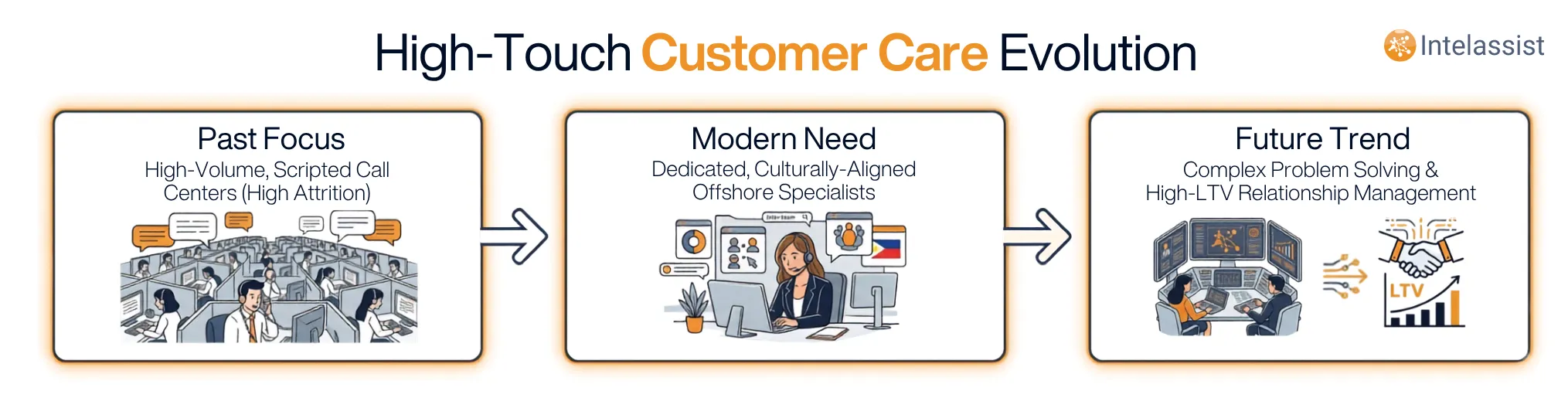
Companies that invest in dedicated offshore teams now are positioning themselves well for this shift. When your customer care professionals have been with your brand long enough to truly know it, they don’t just resolve issues; they protect relationships. And at scale, that’s the difference between holding onto your best clients and watching them quietly leave.
Frequently Asked Questions
We source and recruit professionals specifically for your organization based on your explicit cultural values, corporate communication standards, and operational background preferences. You maintain final interview and selection authority over every team member.
Intelassist reduces turnover by treating remote professionals as premier long-term assets. We offer highly competitive compensation packages, comprehensive local healthcare plans, modern workplace environments, and clear career paths.
Yes. Your dedicated offshore team operates entirely within your existing enterprise technology ecosystem (such as Salesforce, Zendesk, HubSpot, Slack, or Microsoft Teams) and complies fully with your organization’s security guidelines and access controls.
Traditional BPOs route your customers to a pool of shared agents who handle multiple corporate accounts simultaneously.
Intelassist provides 100% exclusive, dedicated remote staff who work solely for your enterprise, ensuring deep product knowledge and consistent brand representation
Our staffing framework supports highly regulated, detail-oriented enterprise verticals, including Architecture/Engineering/Construction (A/E/C), Healthcare Administration, Financial Services, and corporate IT operations.