A role backfill through a staffing partner is the structured operational sequence of sourcing, technically evaluating, and onboarding a replacement professional when a dedicated remote team member departs or transitions off an account. Rather than treating personnel as interchangeable headcount, an effective backfill relies on codified standard operating procedures (SOPs), technical benchmarking, and structured knowledge transfer so production schedules absorb minimal disruption.
Core Findings:
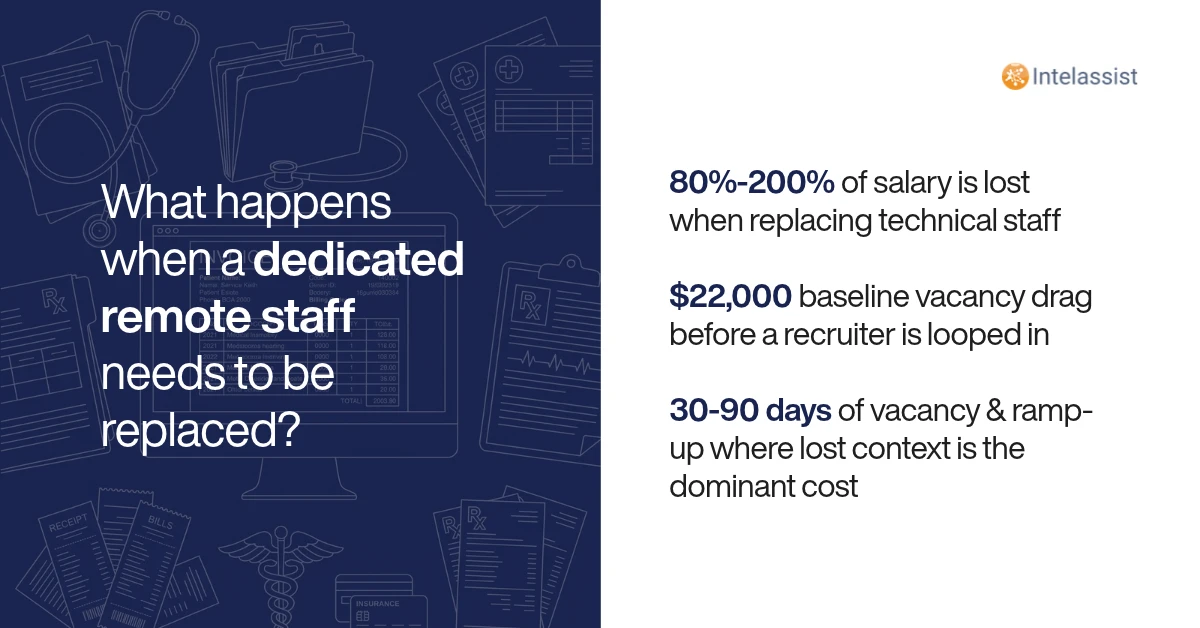
- Replacing frontline personnel costs roughly 40% of their annual salary, specialized technical staff cost 80%, and managers or operational leaders cost up to 200% when factoring in lost output and organizational friction.
- An empty professional desk can cost up to $22,000 in lost productivity and operational drag before accounting for recruiter fees, job board postings, or background screening costs.
- Vacancy combined with onboarding for specialized technical disciplines often stretches across 30 to 90 days. During that window, the primary expense is rarely the administrative search itself; it is the loss of account-specific context, delivery velocity, and project continuity.
- Dedicated staffing engagements replace reactive recruitment with active pipeline planning, applying a structured 90-day onboarding and integration framework to stabilize workflow transitions and compress the timeline to full productivity.
Why Does Remote Staff Turnover Matter When Choosing a Staffing Partner?
Every staffing vendor promises a quick replacement when someone leaves. Few operations directors or HR leaders believe that promise, because they have already experienced what happens when a generalist vendor tries to fulfill it: a three-week delay followed by a stack of unvetted resumes, leaving the internal team to absorb the work.
When an offshore engagement breaks down, the failure rarely occurs during steady-state operations. It occurs during a personnel change. In transactional business process outsourcing (BPO) arrangements, annual attrition rates often exceed 40%. These providers operate on high-volume labor arbitrage, treating staff as interchangeable units. When an employee departs, the client is forced to start over with someone new who has zero familiarity with the firm’s standards. This constant turnover explains why many companies choose to break the outsourcing cycle with dedicated teams that offer long-term stability and integrate well into daily operations.
At Intelassist, maintaining an employee retention rate above 90% is the operational result of direct employment, above-market compensation, comprehensive private health coverage (HMO), clear technical career paths, and hands-on management in our Manila facilities. When a partner invests in its workforce, professionals remain with their accounts, protecting institutional knowledge.
What Causes Turnover in Dedicated Remote Teams?
Departures happen in any organization. In a dedicated remote staffing model, personnel changes fall into three operational categories, and the earlier a departure is identified, the less friction it causes.
1. Planned Career Evolution and Role Scaling
Dedicated team members develop specialized domain expertise over time. A production drafter may advance into BIM coordination; an accounts receivable clerk may demonstrate the capacity to manage complex ledger audits.
Proactive staffing partners track employee performance through structured 1-on-1s and regular reviews. When a team member approaches their ceiling on a specific task list, the partner should flag this to the client early, allowing for an orderly promotion or transition plan rather than losing the employee to the external market.
2. Early Execution and Skill Mismatches
Occasionally, an individual’s technical pacing or communication cadence does not align with a firm’s production environment. These issues usually appear within the initial 90-day integration timeline.
When early performance benchmarks are missed, the partner addresses the gap immediately through targeted skill training or initiates an orderly reassignment before project schedules fall behind.
3. Unplanned Resignations
Life events, relocations, and external opportunities still occur. In the Philippines, standard professional labor practice mandates a 30-day formal notice period. In a managed dedicated model, local operations managers work alongside the departing employee throughout that window, supervising knowledge capture, organizing working directories, and preparing documentation for their successor.
What Is the Process to Backfill a Role Through a Staffing Partner?
A reliable backfill follows a strict, repeatable operational sequence rather than an ad-hoc resume scramble. While exact candidate presentation timelines depend on role complexity and market availability, the sequence itself must remain uncompromised.
Phase 1: Operational and Technical Scope Audit
The backfill begins with an audit of the current production queue: what tools does this seat use today, which systems do they access, and what daily outputs are expected?
Phase 2: Targeted Sourcing and Practical Competency Benchmarking
Resume screening may be insufficient for specialized roles. Candidates need to undergo practical, tool-specific competency evaluations:
- A/E/C Technical Drafting: Auditing actual sample drawing files for correct layering, lineweights, sheet setups, and parametric modeling accuracy rather than relying on self-reported software ratings.
- Accounting & Finance: Administering practical multi-entity ledger reconciliations and error-spotting exercises.
- Healthcare Billing & RCM: Testing coding accuracy, modifier usage, and prior authorization workflow navigation.
Phase 3: Client Stakeholder Evaluation
The client interviews pre-vetted candidates who have already demonstrated foundational competency. The focus shifts to operational alignment: communication style, problem-solving approach, and working rhythm. The client makes the final hiring decision.
Phase 4: Governed Environment Provisioning and Onboarding
Once selected, the partner provisions company-managed hardware, establishes secure VPN tunnels, implements role-based access permissions, and integrates the professional into project communication tools. The new team member begins onboarding against documented operating standards.
How Do You Transfer Knowledge When an Offshore Team Member Leaves?
When an employee departs, individual familiarity with unspoken team preferences takes an inevitable hit. Any vendor claiming that replacements cause zero lost context is not being candid. The real operational question is: how much context is preserved in living documentation, and how much leaves with the individual?
If project standards exist only in an individual’s memory, the client absorbs the entire cost of turnover. If those standards are codified into institutional operating systems, the incoming hire steps into an established framework.
Case Study: Establishing a 60-Person Offshore CAD Drafting Team
An enterprise engineering partner was able to preserve production consistency across a large offshore group by maintaining:
- Centralized SOP Ecosystems: Standardized drawing rules, layering standards, and quality-control checklists hosted in an accessible repository rather than stored on local machines.
- Technical Terminology Glossaries: Detailed reference libraries defining firm-specific acronyms, abbreviations, and notation protocols.
- Structured Training Pathways: Documented progression roadmaps that define how specialized skills are taught and measured.
Specialized competencies require dedicated ramp runways, such as one month for construction estimators or three to six months for technical drafters to master bespoke client drawing standards from scratch. When a backfill is executed within an established dedicated team, the new hire does not start from zero; they work from the firm’s established SOP library and receive daily guidance from tenured peers.
Who Covers the Production Gap While the New Person Ramps?
When an internal team member departs, the remaining in-house team usually bears the brunt of the overtime. In a managed dedicated model, the staffing partner structures coverage to balance the workload across available operational layers.
- Peer Pod Support: In multi-person dedicated teams, adjacent team members absorb critical project queues using shared standard templates and workflows.
- Account Lead QA Oversight: Local technical team leads provide direct quality control, reviewing outbound deliverables to ensure that draft work meets client quality thresholds before delivery.
- Internal Priority Triage: The client and staffing partner identify core deliverables that must stay on schedule, temporarily deprioritizing non-urgent administrative tasks during the transition.
What to Get in Writing Before You Sign a Staffing Agreement
Never assess a partner’s replacement policy after a team member gives notice. The contractual framework must define backfill terms even before work begins.
✔ Candidate Presentation SLAs: Require measurable service-level commitments specifying the timeframe within which the partner must present verified, tested candidates following an account departure notice.
✔ Knowledge Transfer and Handover Terms: Confirm how overlapping days are handled. If the departing staff member works their full notice period, the contract should outline how shadowing and peer-to-peer training are scheduled.
✔ Intellectual Property and SOP Ownership: Contracts must explicitly establish that all standard operating procedures, documentation libraries, process flowcharts, and deliverables created during the engagement remain 100% client property.
Frequently Asked Questions
A role backfill through a staffing partner is the full-lifecycle sourcing, technical screening, and onboarding process managed by a staffing provider to replace a dedicated remote professional who departs or transitions off an account.
Backfill timelines vary based on role specialization, technical prerequisites, and talent pool depth. Specialized positions such as Revit drafters, Civil 3D technicians, or medical coders require hands-on technical testing rather than rapid matching. Dedicated partners outline specific candidate delivery SLAs directly within their service agreements.
Knowledge loss is prevented by embedding SOP documentation into daily operations. Maintaining centralized drafting manuals, tool settings, and QA rubrics ensures that project standards belong to the firm rather than an individual’s personal desktop, allowing incoming professionals to ramp up against documented standards.
The staffing partner tests and validates foundational tool competency (such as AutoCAD, Civil 3D, Revit, or financial ledgers) prior to client presentation. The client only needs to orient the incoming professional to firm-specific project templates and active project files.