The engineering talent shortage caps design firm growth by creating an operational bottleneck in technical production: a shortage of qualified CAD drafters, BIM modelers, and trade coordinators forces senior licensed engineers to absorb routine redlines, reducing billable project intake and limiting client expansion.
Rather than a lack of market demand, firms seemingly face a revenue ceiling because their leaders spend low-margin hours executing mechanical drawing corrections, sheet setups, and basic clash reviews.
Core Findings:
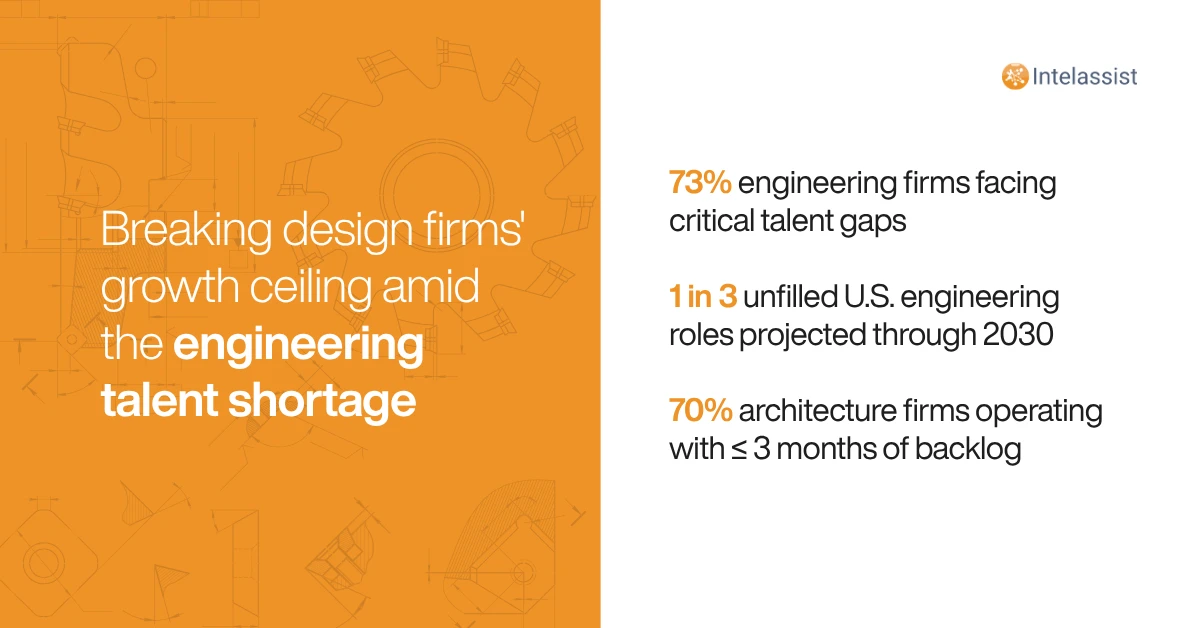
- 73% of engineering and R&D-focused companies report critical talent gaps across core technical functions.
- Nearly one in three U.S. engineering roles is expected to go unfilled annually through at least 2030.
- Backlog buffers are tightening rapidly across the sector: in 2025, nearly half of architecture firms maintained four or more months of backlog, but by 2026, more than 70% had dropped to three months or less, with over a third operating with less than one month of secured work.
- Firms face surging demand for professionals skilled in advanced digital delivery, complex project coordination, climate resilience, and simulation—capabilities that are changing faster than traditional education and internal training pipelines.
How Are Firms Currently Responding to the Deficit (and Why Traditional Tactics Fail)?
Most design practices respond to technical staffing gaps through reactive adjustments. When project deadlines tighten and drafting queues stall, leadership teams typically cycle through four tactics that introduce operational friction and compress firm margins:
- Attempting to outbid regional competitors for intermediate CAD operators and Revit modelers inflates fixed payroll. Paying enterprise compensation packages for mid-level production support narrows project gross margins without expanding the firm’s overall delivery capacity.
- When internal capacity operates at or above 100% billable utilization, partners often decline complex requests for proposal (RFPs) or pace project delivery schedules artificially. Turning away viable client work protects staff from immediate collapse, but it damages client retention and cedes market share to aggressive competitors.
- In many practices, the immediate default is relying on senior project managers and licensed Professional Engineers (PEs) to work late nights and weekends running sheet corrections, cleaning up line weights, and organizing submittals. This misallocation burns out the firm’s most valuable assets and triggers costly turnovers.
- Turning to on-demand freelancer platforms or shared-pool business process outsourcing (BPO) arrangements often compounds the problem. Generalist offshore agencies operate ticket-based, shared queues where the staff assigned lack hands-on experience in drafting standards, building codes, and specialized software. Senior staff end up spending more hours debugging bad drawings and re-onboarding rotating freelance staff than the arrangement was meant to save.
Building a Dedicated Remote Team as a Technical Extension
Sustainable firms avoid interim measures by establishing a dedicated remote technical extension. In this model, an offshore professional is not a remote ticket worker who picks up ad-hoc redlines from an anonymous queue; they are full-time team members dedicated solely to one firm.
Dedicated remote staff integrate directly into the firm’s communication channels, folder directories, and design standards. They provide steady, year-round production bandwidth that stabilizes delivery between major project cycles, protecting in-house teams from burnout while allowing leadership to pursue high-margin contracts with confidence.
Why Is Specialist Engineering Capacity Stalling Mid-Sized Firms?
Project delivery requirements have grown increasingly complex while the local supply of qualified mid-level production staff has contracted. Mid-sized firms are caught in an engineering talent shortage where project specifications demand high digital precision, yet local recruitment cycles routinely stretch past 90 to 120 days for a single qualified BIM or CAD specialist.
PEs Trapped in Redlines Causing Senior Talent Misallocation
In a balanced production model, licensed Professional Engineers and Senior Architects focus on client consultation, conceptual engineering design, structural calculations, and final code reviews.
Without adequate mid-tier production support, senior personnel spend an estimated 30% to 40% of their billable hours performing manual drafting corrections, setting up sheet sets, and checking routine fabrication submittals. This dynamic creates the following operational hurdles:
- Billing a client a senior engineering rate for routine CAD drafting inflates project costs and compromises billing realization rates, or forces the firm to write off unbillable internal hours.
- Every hour a senior leader spends fixing text alignments or cleaning up Revit projects is an hour diverted from business development, client management, and mentorship of junior engineers.
- Senior professionals join design practices to solve complex engineering challenges, not to handle administrative document formatting. Chronic friction drives high-performing talent out of the organization.
The Technical Skills Deficit Beyond Entry-Level CAD
The engineering talent shortage is compounded by an evolving technology baseline. Modern engineering delivery rarely relies on basic 2D CAD drafting; it demands deep proficiency in multidimensional Building Information Modeling (BIM), parameter-driven component design, dynamic clash resolution, and automated sheet generation.
Educational institutions continue to graduate engineers versed in theoretical mechanics, but few leave with practical fluency in production-grade software like Civil 3D corridor modeling, complex Revit MEP families, or Tekla structural detailing.
Finding local candidates who possess both foundational engineering knowledge and immediate software fluency requires months of recruitment and steep salary premiums. This skills disconnect forces firms to seek alternative operational avenues to secure specialized technical capacity.
Which Work Can Remote Technical Teams Absorb vs. What Stays In-House?
A successful capacity strategy establishes an uncompromising operational governance rule: retain design authority, engineering judgment, local site reviews, and legal stamping in-house; delegate structured, repetitive, and template-driven modeling and coordination to dedicated remote specialists.
Adopting this model requires a clear understanding of how engineering services outsourcing works in practice across daily project sprints. When functional boundaries are clearly drawn, in-house engineers regain control of their schedules, while remote specialists deliver steady production throughput.
Core Functions Retained by the In-House Engineering Team
| Design Intent and Concept Definition | Client and Regulatory Engagement | Code Interpretation and Legal Responsibility | On-Site Field Verification |
|---|---|---|---|
| Establishing initial architectural design briefs, load paths, structural frameworks, and system sizing based on client objectives and site constraints. | Leading stakeholder design presentations, participating in city planning hearings, and coordinating directly with owners and general contractors. | Evaluating local building codes, life-safety requirements, and structural calculations, culminating in final plan approvals. | Physical site visits, constructability reviews, structural inspections, and in-person construction administration meetings. |
Production and Detailing Work Absorbed by Dedicated Remote Specialists
| Construction Documentation (CD) Packages | CAD Drafting and Redline Execution | BIM Modeling and Clash Matrix Management | Shop Drawing and Submittal Review Support |
|---|---|---|---|
| Translating conceptual sketches and design iterations into permit-ready drawing sets, detailing elevations, wall sections, and structural framing plans. | Handling routine redline revisions in AutoCAD and Civil 3D, standardizing title blocks, layer naming conventions, and dimensioning standards. | Maintaining 3D models in Revit and Navisworks, running spatial interference checks across architectural, structural, and mechanical models, and generating actionable clash resolution logs. | Cross-referencing trade submittals, steel fabrication details, and equipment cut sheets against master contract drawings, preparing structured review summaries for senior engineering sign-off. |
What Should Operations Leaders Verify Before Placing Remote Technical Staff?
For operations leaders who have experienced architecture and construction outsourcing failures in the past, skepticism is natural. Traditional outsourcing frequently falls short because vendors overpromise technical capabilities, rotate staff across multiple clients, and provide zero transparency into daily workflows.
To safeguard firm credibility and ensure a seamless operational fit, leadership should evaluate prospective staffing partners against five non-negotiable verification criteria:
- Practical Software Stack Verification: Never rely on candidate resumes or self-reported proficiency. Require prospective partners to conduct timed, practical software tests using real-world design files. A candidate claiming Revit or Civil 3D capability must demonstrate mastery of family parameters, layer conventions, view templates, dynamic blocks, and surface modeling before placement.
- Typology-Specific Project Experience: Confirm that the candidate has executed production work within your firm’s specific building sectors—whether structural steel, pre-engineered metal buildings, linear utility infrastructure, or multi-family residential. Review previous sample drafting sheets and project portfolios to verify drawing clarity, annotation discipline, and detailing logic.
- Enterprise Data Security and Intellectual Property Protection: Ensure the provider implements strict IT governance to protect client intellectual property and sensitive project data. Verify the use of secure Virtual Desktop Infrastructure (VDI), localized access controls, encrypted data transfers, and strict non-disclosure agreements (NDAs).
- Historical Staff Retention Metrics: Ask for verified employee retention data. Industry-standard BPOs suffer from annual turnover rates around 40%, forcing clients into exhausting, recurring onboarding cycles. Look for specialized partners that maintain 90%+ staff retention rates, ensuring that the time invested in training your remote specialist builds long-term institutional knowledge that stays with your firm.
- Operational Integration and Communication Cadence: Establish clear protocols for daily collaboration from day one. Your remote specialist should participate in 15-minute daily standups via Microsoft Teams or Slack, track deliverable milestones inside your project management software, and receive markup feedback through standardized workflows.
| Partner Evaluation Quick-Check: Before signing an agreement with an engineering staffing partner, confirm these baseline operational criteria: • Can they provide a technical portfolio demonstrating completed work on your exact CAD/BIM version? • Is the specialist assigned 100% exclusively to your firm, or are they shared across other accounts? • What is their verified employee retention rate over the past 24 months? • Does the provider manage local payroll, equipment provisioning, and HR compliance directly? |
Frequently Asked Questions About the Engineering Talent Shortage
Remote drafting support delegates time-intensive production tasks such as 2D detailing, 3D modeling, sheet revisions, and submittal tracking to dedicated technical specialists. By shifting these technical tasks to qualified remote drafters, senior domestic engineers reclaim 30% to 40% of their billable capacity to focus on client relationships, engineering calculations, code compliance, and high-value project delivery.
No. In a dedicated remote staffing model, drafters work exclusively for your firm and integrate directly into your internal workflows, communication channels, and design templates. Unlike shared-pool BPO models or freelancing platforms that require constant ticket management and oversight, a dedicated specialist quickly adopts your internal drafting standards, functioning as an integrated team member who requires minimal oversight after initial onboarding.
Design firms maintain rigorous quality control by applying standardized operating procedures (SOPs) and structured review cycles. In-house engineering teams use Bluebeam Studio for digital markups, conduct daily 15-minute coordination standups, and establish formal quality check gates at 30%, 60%, and 90% drawing set milestones. All final design decisions, code evaluations, and professional engineering stamps remain with the licensed in-house team.
Because candidates undergo technical testing for software proficiency before hiring, operational onboarding varies between one to two weeks and a maximum of 90 days. During this period, the remote specialist reviews the firm’s drafting standards, template libraries, sheet setups, and file naming conventions. Most remote drafters begin delivering billable production work within their first ten days.