Dedicated offshore RCM specialists succeed because they focus on a single task within your Electronic Health Record (EHR). Prior authorization requires deep payer policy knowledge, clinical record assembly, and continuous portal tracking—administrative tasks that directly conflict with front-line clinical care.
By removing authorization bottlenecks from clinic personnel, practices secure pre-service determinations, eliminate scheduling delays, and reduce claim write-offs.
Core Findings:
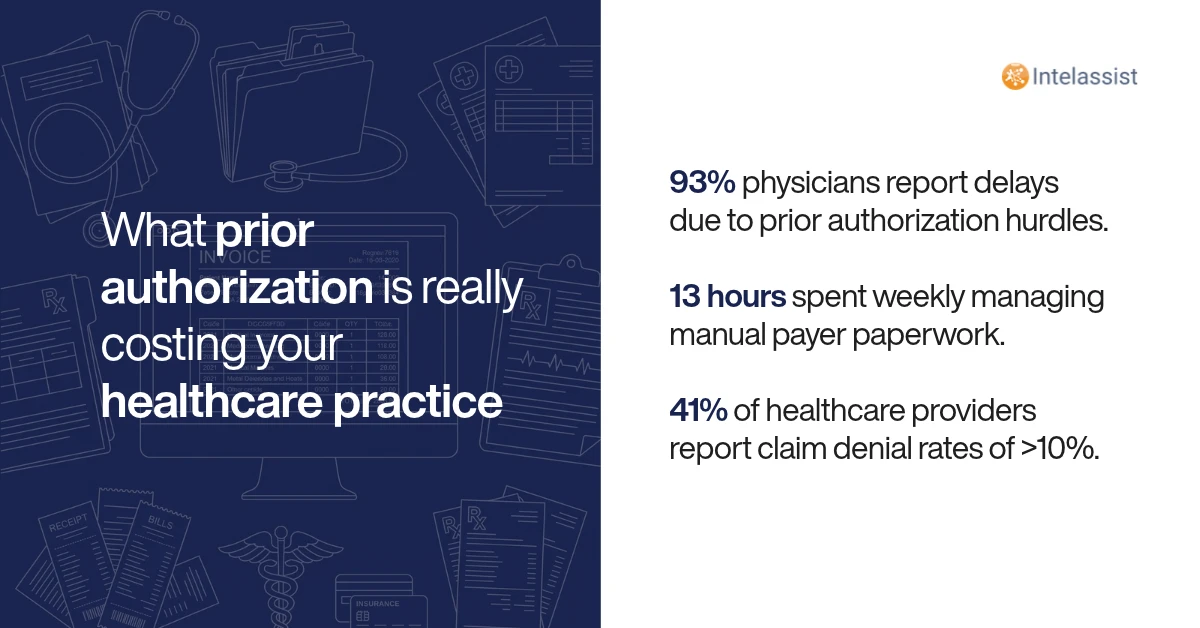
- 93% of physicians report care delays tied to prior authorization, while 82% report patients abandon treatment due to payer barriers.
- Practices complete 39 prior authorizations per physician weekly, consuming 13 staff hours per week.
- 88% of physicians state that prior authorization protocols inflate overall healthcare resource utilization.
- 41% of providers report overall claim denial rates of 10% or higher, driven largely by front-end authorization failures.
Where Do Prior Authorization Denials Actually Originate?
Prior authorization denials rarely stem from unresolvable clinical disputes; they originate from administrative expirations, missed submission deadlines, and untracked service limits.
Why Reauthorization Is a Revenue Problem, Not an Administrative Task
Treating reauthorizations as incidental paperwork obscures serious balance sheet erosion. Rendering care under an expired authorization leads directly to uncompensated clinician hours, uncollectible facility fees, and payer clawbacks that are expensive to resolve.
For practice administrators evaluating RCM and finance staffing, reauthorization belongs in the financial conversation, not the administrative one.
How Often Does Therapy Require Reauthorization?
High-frequency therapeutic specialties operate under strict, recurring reauthorization intervals:
- Physical and Occupational Therapy: Payers typically authorize care in blocks of 6 to 12 visits or require clinical progress re-evaluations every 30 to 60 days.
- Behavioral Health and ABA: Insurers mandate updated treatment plans and concurrent reviews every 90 to 180 days.
- Infusion Therapy: Biologic regimens require re-credentialing whenever dosages change or annual benefit periods reset.
Providers managing visit cap tracking while actively treating patients means forcing them to do two jobs at once. It’s one of the more avoidable causes behind the administrative fatigue driving burnout in behavioral health, and one that shows up consistently across practices that haven’t made that separation yet.
Should Practices Retask Medical Assistants, Deploy AI, or Hire Dedicated Offshore RCM Specialists?
Practices address authorization backlogs through three routes: tasking in-house Medical Assistants (MAs), adopting automated AI tools, or embedding dedicated offshore RCM staff.
Why Task-Switching Medical Assistants Burn Out
Splitting an MA’s day between patient triage and 45-minute payer phone holds causes constant cognitive fragmentation. Incomplete chart notes get submitted to portals, generating predictable rejections. The resulting stress drives rapid clinical staff turnover.
When clinic staff are pulled into back-office administrative disputes:
- Patient check-in and rooming cycle times increase.
- Providers wait on delayed vitals, throwing the daily clinic schedule off balance.
- High clinical turnover forces constant re-hiring and repetitive onboarding cycles.
Where Prior Authorization With AI Falls Short
AI software extracts form data and checks portal statuses, but it cannot navigate ambiguous payer medical policies, collect subjective chart documentation, or coordinate peer-to-peer physician appeals.
Payer environments present real-world obstacles that AI automation cannot resolve:
- Payer policies often require clinical judgment that keyword scrapers miss.
- Payer portals frequently update interfaces and implement security checks that break API connectors.
- AI simply cannot walk into a provider’s office to discuss missing chart notes or coordinate urgent peer-to-peer appeals.
How Dedicated Offshore RCM Staff Stabilize Practice Operations
A dedicated revenue cycle specialist provides continuous, queue-based management. Working alongside offshore patient support specialists who handle inbound scheduling, embedded offshore specialists manage daily worklists, monitor expiring approvals, assemble clinical packets, and follow up directly with payers.
Strategic healthcare outsourcing allows clinics to deploy experienced RCM staff who understand US payer rules. Practices can leverage Intelassist’s dedicated healthcare support solutions to secure specialists trained directly in their practice management software.
| Operational Metric | In-House MAs (Split Role) | Pure AI Automation | Dedicated Offshore RCM Specialist |
|---|---|---|---|
| Primary Daily Focus | Divided between clinical floor triage and phone hold queues | Algorithmic data extraction and portal form pre-population | 100% dedicated to prior authorization and reauthorization queues |
| Impact on Patient Care | Delays rooming cycles, increases clinic wait times, and elevates clinician frustration | Zero direct clinical disruption, but pushes exception queues back to staff | Protects clinical focus; patients arrive with verified, pre-service approvals |
| Complex Case Resolution | Slow; submissions wait for clinical downtime or end-of-shift hours | Fails on nuanced medical policies and non-standard guidelines | Fast; proactive daily portal follow-ups conducted during US business hours |
| Appeals & Peer-to-Peer Prep | Rushed; providers receive incomplete clinical binders and denial notes | Incapable of assembling physician peer-to-peer packets or rationale | Assembles policy criteria, denial rationale, chart notes, and schedules calls |
| Data Security & Footprint | Standard on-site physical workstation and local network access | Third-party vendor cloud API access requiring broad data transfers | Zero-footprint Virtual Desktop (VDI) inside your practice firewall |
How Can Practices Ensure HIPAA Compliance with Offshore RCM Providers?
Ensuring HIPAA and HITECH compliance with an offshore partner requires technical controls, binding legal frameworks, and rigorous quality assurance.
Zero-Footprint Virtual Desktop Infrastructure (VDI) vs. Local Caching
Secure offshore RCM staffing relies on zero-footprint architecture. Specialists access practice systems via encrypted virtual desktops (VDI via Citrix, Azure, or AWS WorkSpaces) requiring multi-factor authentication (MFA).
Protected Health Information (PHI) never leaves your cloud servers; local downloads, clipboard transfers, and printing are blocked at the OS level.
Business Associate Agreements (BAAs) and Audit Defense
Any offshore partner must execute a binding BAA assuming direct liability under federal privacy rules. Verify certifications, role-based access controls (RBAC), and audit logs.
Quality Assurance Protocols to Prevent Claim Denials
Dedicated specialists follow multi-tier QA checklists, validating diagnosis codes, prior conservative treatment records, and payer policies before submission to ensure submission accuracy above 98%.
How Does an Offshore Prior Authorization Specialist Integrate into Daily Clinic Workflows?
A dedicated remote specialist integrates into daily clinic operations through a five-step pipeline:
- Pre-Service Queue Audit: Daily audits of schedules identify required prior authorizations 5 to 10 days ahead, while tracking lists catch therapy reauthorizations before visit limits lapse.
- Clinical Packet Assembly: Specialists extract clinical notes, imaging, and lab results, cross-referencing documentation against payer guidelines.
- Portal Submission and Tracking: Packets are submitted directly through payer portals (Availity, CoverMyMeds) with complete records attached on day one.
- Active Expiration and Determination Tracking: Daily portal checks ensure determinations are secured pre-service, with approval numbers logged into the EHR.
- Peer-to-Peer and Appeal Coordination: When payers deny coverage, specialists assemble clinical denial criteria and schedule peer-to-peer reviews on the physician’s calendar.
Frequently Asked Questions About Offshore Prior Authorization Staffing
They provide uninterrupted, single-task administrative focus. Dedicated specialists spend their full shifts verifying payer policies, compiling clinical documentation, and tracking portal determinations, securing timely approvals without disrupting clinic workflows.
Yes. Dedicated offshore specialists use US-based VoIP systems and dedicated portal credentials to communicate with commercial insurers, Medicare Administrative Contractors (MACs), and Medicaid plans during standard US business hours.
Physical and occupational therapies typically require reauthorization every 30 to 60 days or after 6 to 12 visits. Behavioral health programs require re-evaluation every 90 to 180 days, while infusion regimens require updates when dosing or policy terms adjust.
Specialists access EHR systems via encrypted, zero-footprint Virtual Desktop Infrastructure (VDI). PHI remains entirely within your secure servers; remote devices cannot download, copy, or print patient records.