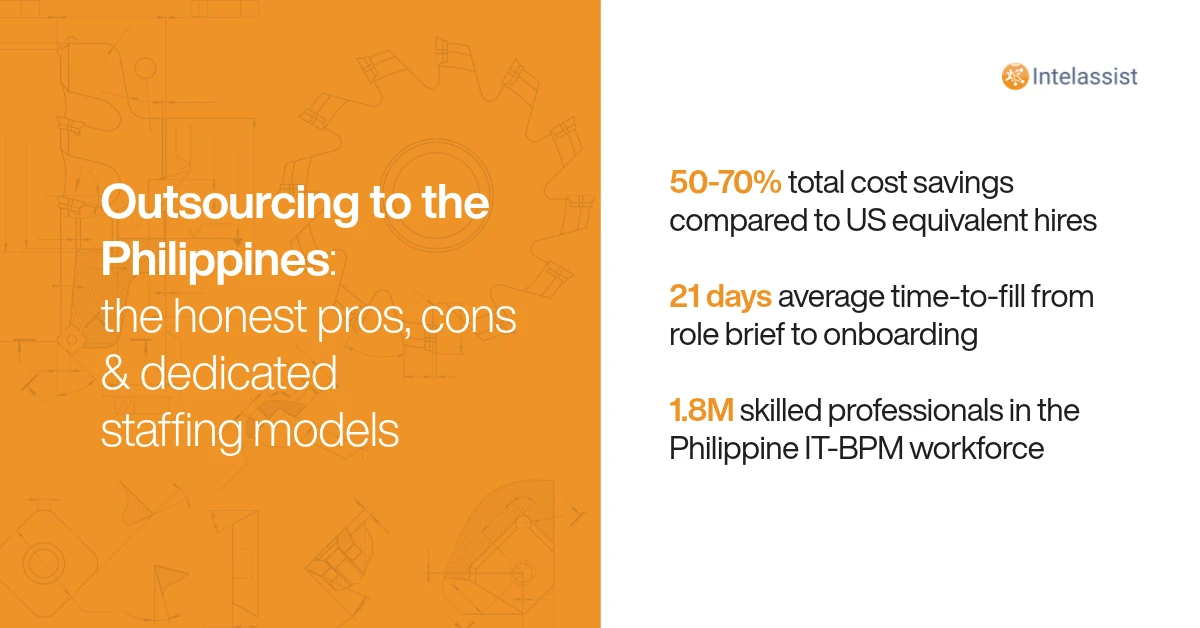
Outsourcing to the Philippines means delegating recurring operations such as bookkeeping, IT support, customer care, or back-office administration to full-time remote professionals or providers in the Philippines. For small and mid-sized companies, it typically cuts total labor costs by 50% to 70%, though poorly structured engagements fail due to vendor turnover, weak vetting, and rework.
If you tried outsourcing before and walked away frustrated, your skepticism is earned. Many founders hire through low-cost freelance boards or legacy call centers, only to spend months re-explaining their business to rotating staff or paying onshore leads to fix sloppy work.
Why Do US Companies Outsource to the Philippines?
US companies outsource to the Philippines to lower payroll overhead without sacrificing English fluency, technical competence, or customer reliability. According to the IT & Business Process Association of the Philippines (IBPAP), the country’s IT-BPM workforce exceeds 1.9 million professionals supporting North American companies.
How Much Money Do Businesses Actually Save?
Hiring dedicated remote staff in the Philippines reduces total employment costs by 50% to 70% versus US hires.
Based on U.S. Bureau of Labor Statistics (BLS) benchmarks, a full-time US bookkeeper, Tier 1–2 IT support technician, or customer operations specialist costs $55,000 to $80,000+ annually with payroll taxes, health insurance, and overhead. Through a managed staffing partner in Manila, a dedicated specialist in those functions runs $2,200 to $3,800 monthly all-in: covering salary, statutory benefits, private healthcare (HMO), hardware, and HR oversight.
Why Is English Fluency and Cultural Alignment Stronger?
The Philippines ranks among Asia’s top English-proficient nations on the EF English Proficiency Index because English is an official language of business, law, and higher education. Filipino professionals study US accounting and technical frameworks and work within Western corporate norms, reducing friction with internal managers and customers.
Which Specialized Roles Are Easiest to Fill?
Growing companies see the fastest return when outsourcing jobs to the Philippines in repeatable, process-driven roles:
- Finance and Accounting: Businesses that outsource bookkeeping in the Philippines quickly fill accounts payable/receivable, bank reconciliation, and month-end close roles from a deep pool of accounting graduates experienced in QuickBooks, Xero, and NetSuite.
- IT and Technical Support: Experienced offshoring companies in the Philippines supply Tier 1 and Tier 2 helpdesk technicians trained in ticket triage, endpoint troubleshooting, Active Directory, and Microsoft 365 or Google Workspace administration.
- Customer Service and Back-Office Operations: Dedicated specialists manage inbound support, order processing, scheduling, and CRM hygiene without pulling senior leads away from growth work.
What Are the Real Disadvantages (And How Do You Reduce Them)?
The genuine disadvantages of outsourcing in the Philippines are high industry-wide turnover, inconsistent quality, internal onboarding strain, and time zone gaps. You can resolve these drawbacks by changing how you vet, structure, and manage your hire.
1. Why Is Employee Turnover So High in Traditional BPOs?
Legacy call centers average roughly 40% annual retention (60% attrition) because they mostly acquire entry-level workers, run rigid shifts without support, and treat staff as interchangeable seats. Cycling through three people in a year erodes institutional knowledge and forces constant retraining.
What reduces it: Collaborate with a specialized remote staffing provider that sources precise talent for your needs, provides comprehensive private healthcare (HMO) on day one, dedicates staff to a single client, and offers local HR management. This approach drives over 90% annual retention at Intelassist, allowing your team to retain skilled professionals for the long run.
2. What Causes Poor Work Quality and Expensive Project Rebuilds?
The biggest fear for any buyer is paying twice: once for cheap offshore labor, and again for an onshore manager to fix misclassified ledgers, unresolved tickets, or angry customer threads. When low-cost vendors split one worker across four accounts or hire off unverified resumes, quality collapses and engagements get scaled back.
What reduces it: Require role-specific practical testing before interviewing any candidate. Bookkeepers should pass a live double-entry reconciliation test; IT technicians should troubleshoot realistic ticket scenarios; support specialists should complete written communication assessments. Pair that screening with 100% single-client allocation so your hire works exclusively inside your systems.
3. How Much Onboarding and Training Time Lands on Your Internal Team?
Even a capable remote hire stalls if dropped into an undocumented workflow and expected to guess your preferences. Business leaders expecting “hands-off delegation on day one” often hit a bottleneck during week two when questions pile up.
What reduces it: Recruit candidates with hands-on experience in your exact software stack and pair your workflow training with vendor-side supervisory oversight. While you own business processes, a US-managed staffing partner reinforces daily attendance, KPI tracking, and standard operating procedure (SOP) compliance.
4. How Does the US–Philippines Time Difference Work in Practice?
Manila (Philippine Standard Time, UTC+8) is 12 to 15 hours ahead of US time zones, depending on Daylight Saving Time. If your team relies on ad-hoc chat messages without a set schedule, a question sent at 4:00 PM EST sits unanswered until the next morning.
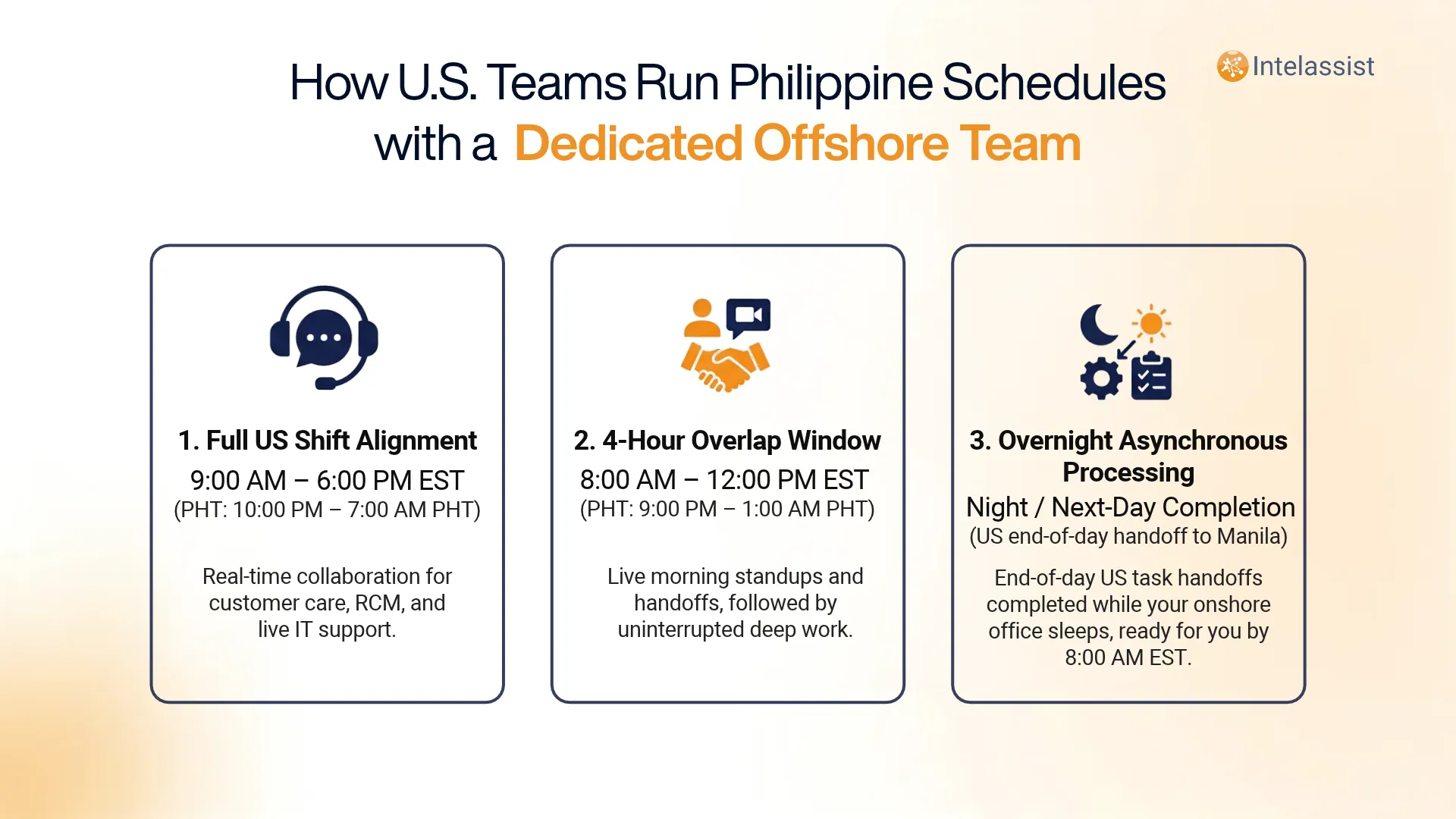
What reduces it: Define your schedule model before hiring. Customer-facing and live IT roles routinely work full US business hours (EST, CST, or PST), whereas bookkeeping and back-office roles thrive on a 4-hour daily overlap or overnight processing.
Which Work Should You Outsource, and What Should Stay In-House?
Offshoring in the Philippines delivers the highest return when dedicated remote staff supplement your core US team on repeatable, rules-based execution rather than replacing strategic leadership. Remote professionals perform best as an integrated extension of your onshore staff: clearing daily bottlenecks so you and your senior leads focus on revenue, product direction, and key client relationships.
- Keep in-house: Product roadmap decisions, enterprise sales negotiations, complex financial forecasting, final tax or legal sign-offs, and company culture leadership.
- Delegate to dedicated offshore staff: Daily transaction categorization, accounts payable/receivable, bank reconciliations, Tier 1–2 IT helpdesk tickets, inbound customer support, order administration, and CRM updates.
What Are the Hidden Payroll and Compliance Risks of Hiring Directly?
Some founders try to sidestep staffing firms by hiring overseas workers directly as independent contractors. Paying a flat wire transfer looks simple until you examine the compliance exposure.
Managing multi-state payroll, tax withholdings, and workers’ compensation across US states is already an administrative burden. Adding foreign labor laws, mandatory Philippine statutory contributions (SSS, PhilHealth, Pag-IBIG), 13th-month pay rules, and worker misclassification liability puts unnecessary legal weight on your plate. Working with an established staffing provider transfers local employer-of-record payroll, statutory benefits, hardware provisioning, and labor compliance off your desk entirely.
How Does Hiring Dedicated Remote Staff Differ From General Outsourcing?
When you hire dedicated remote staff, you get a full-time professional working exclusively inside your systems, attending your standups, and reporting to you daily. This is simply one of the main differences from general outsourcing, which routes tasks through a shared, rotating ticket pool.
| Evaluation Factor | DIY Freelance Marketplaces | Traditional Shared BPOs | Dedicated Remote Staffing (Intelassist) |
|---|---|---|---|
| Staff Allocation | Part-time; split across 3–5 clients | Rotating pool of shared agents | 100% full-time, dedicated to your company |
| Annual Retention Rate | Unpredictable; high project churn | ~40% industry average | 90%+ long-term annual retention |
| Quality & Rework Risk | High (self-reported resumes) | Moderate-to-high (scripted queues) | Low (role-tested & SOP-aligned) |
| Payroll, HMO & Compliance | Client carries misclassification risk | Handled by vendor | Full local employer, HMO & HR included |
| Data & Cyber Security | Personal laptops / home Wi-Fi | Shared call center floor | Managed hardware, HIPAA & IASME certified |
| Time-to-Fill & Pricing | Days; variable hourly billing | Weeks; opaque enterprise quotes | ~21 days average; transparent monthly rate |
How Can Buyers Tell Reliable Offshoring Companies Apart?
Before signing with any offshoring companies in the Philippines, ask four direct questions on your first call to separate transparent staffing partners from high-churn vendors:
- What are your 6-month and 12-month employee retention rates—and how do you calculate them? Ask for documented figures rather than vague assurances. Anything near the 40% BPO average means constant retraining.
- Will this specialist work exclusively on my account, or split time across clients? Confirm in writing that your hire is 100% dedicated to your business and works inside your tools.
- What practical skills assessments do candidates pass before I interview them? Require role-specific technical or accounting tests—never accept unvetted resume forwarding.
- What is the exact all-in monthly rate, and what happens if a hire is not a fit? Look for upfront monthly pricing with zero hidden setup fees and a clear 30-to-60-day replacement guarantee.
Frequently Asked Questions About Outsourcing to the Philippines
Traditional Philippine BPO call centers average roughly 40% annual retention (60% annual turnover). Dedicated staffing firms providing competitive compensation, HMO benefits, and single-client roles sustain 90% or higher annual retention.
Partnering with a full-service Philippine staffing firm rather than hiring contractors directly makes the provider the legal local employer. As such, they will be responsible for handling payroll taxes, statutory contributions, 13th-month pay, HMO benefits, and labor compliance.
Most companies complete candidate sourcing, practical testing, interviews, and onboarding within 2 to 4 weeks (averaging ~21 days at Intelassist). Having SOPs and logins ready before day one lets new hires contribute in week one.
Established providers enforce company-issued workstations, encrypted VPNs, role-based access controls, and independently audited compliance frameworks, including HIPAA.
Yes, starting with one or two well-defined roles (bookkeeping, Tier 1–2 IT support, or customer care) through a dedicated staffing partner rather than a shared queue lets you verify quality and retention before scaling.