From Distributed Infrastructure Design to Permit-Ready Drawings
A dedicated CAD drafting team is a group of technical drafters and BIM coordinators who operate as an exclusive extension of an engineering firm’s in-house staff. Unlike shared-resource outsourcing, these teams work full-time within the client’s software environments, standard operating procedures, and quality standards to produce permit-ready drawing sets and process survey data.
Core Findings:
- Offshore delivery models hold nearly 62% of the global engineering services outsourcing (ESO) market, driven by cost optimization, access to large technical talent pools, and scalable delivery.
- The Asia-Pacific region accounts for nearly 31% of the ESO market share, making it one of the fastest-expanding hubs for high-volume engineering support.
- 52% of telecom companies outsource network optimization, infrastructure design, and software development, directly linked to the rapid global rollout of 5G networks.
- In 2025, green engineering outsourcing accounted for ~18% of total global ESO spending—a figure projected to double by 2034 due to tightening regulatory demands on carbon footprints and environmental permitting across North America and Europe.
Why Does Traditional Offshore CAD Drafting Fail for Infrastructure Projects?
While engineering firms turn to global talent to manage expanding workloads, traditional offshore drafting models frequently stumble when applied to complex infrastructure projects. Analyzing the key reasons why offshore CAD teams fail shows that the breakdown rarely stems from software skill, but rather from structural high turnover and context loss.
How High Turnover Destroys Context in Telecom and Utility Engineering
High turnover in traditional BPOs degrades work quality because infrastructure drafting relies heavily on unwritten institutional knowledge and localized context.
When offshore staffing providers shuffle drafters between accounts, incoming drafters lack familiarity with your firm’s specific layer standards, clearance rules, and submittal guidelines:
- Inconsistent layer naming and line weights corrupt background files and title blocks.
- Drafters unfamiliar with regional guidelines misinterpret buffer distances around existing assets.
- Missing local submittal details causes immediate rejections at municipal plan checks.
- Senior onshore engineers spend hours re-explaining project basics instead of focusing on high-level design.
What Is the True Operational Cost of Context-Free Drafting?
Context-free drafting creates problems long before a drawing reaches final review. When drafters make design decisions without a clear understanding of site constraints, utility conflicts, permitting requirements, or construction sequencing, plan sets can move forward with foundational errors that require full redraws.
The hidden cost is not only the correction itself. It is the senior engineering time redirected to rework, the delay in permit submittals, and the loss of momentum across the project schedule.
- Engineers spend time reviewing, correcting, and redrawing faulty plan sets instead of advancing design decisions or supporting higher-value technical work.
- Plan check comments, rejections, and resubmittals push back construction start dates and create avoidable pressure on client relationships.
- Any savings from lower-cost drafting labor can disappear once senior billable hours are spent correcting work that should have been right the first time.
How Dedicated CAD Drafting Teams Turn Distributed Designs into Approvals
Examining what a dedicated offshore CAD drafting team delivers reveals how external drafters translate preliminary engineering concepts into precise, compliant drawing sets. By standardizing production workflows, firms can maintain throughput and meet tight project schedules without burdening local engineering staff.
Accelerating 5G and Utility Rollouts Through Dedicated Capacity
Dedicated CAD drafting teams enable telecom and utility providers to scale their submittal volume without expanding local overhead. With 52% of telecom companies outsourcing network optimization and infrastructure design, engineering firms face immense pressure to deliver permit-ready sets for rapid network expansion.
Core Telecom & Utility Submittal Packages:
- 5G Small Cell Sites: Pole attachment elevations, radio equipment mounting, and power feed layouts.
- FTTH (Fiber-to-the-Home) Routes: Strand mapping, underground conduit routing, and vault placements.
- Joint-Use Pole Attachments: Pole loading profiles, clearance diagrams, and span distance sheets.
A dedicated drafting team absorbs this repetitive volume, ensuring consistent layout standards across hundreds of municipal jurisdictions.
How Dedicated Drafters Translate Infrastructure Markups into Permit Submittals
Dedicated production drafters convert preliminary field engineering markups, GIS route data, and redlines into approvable construction packages using a structured, 4-step workflow:
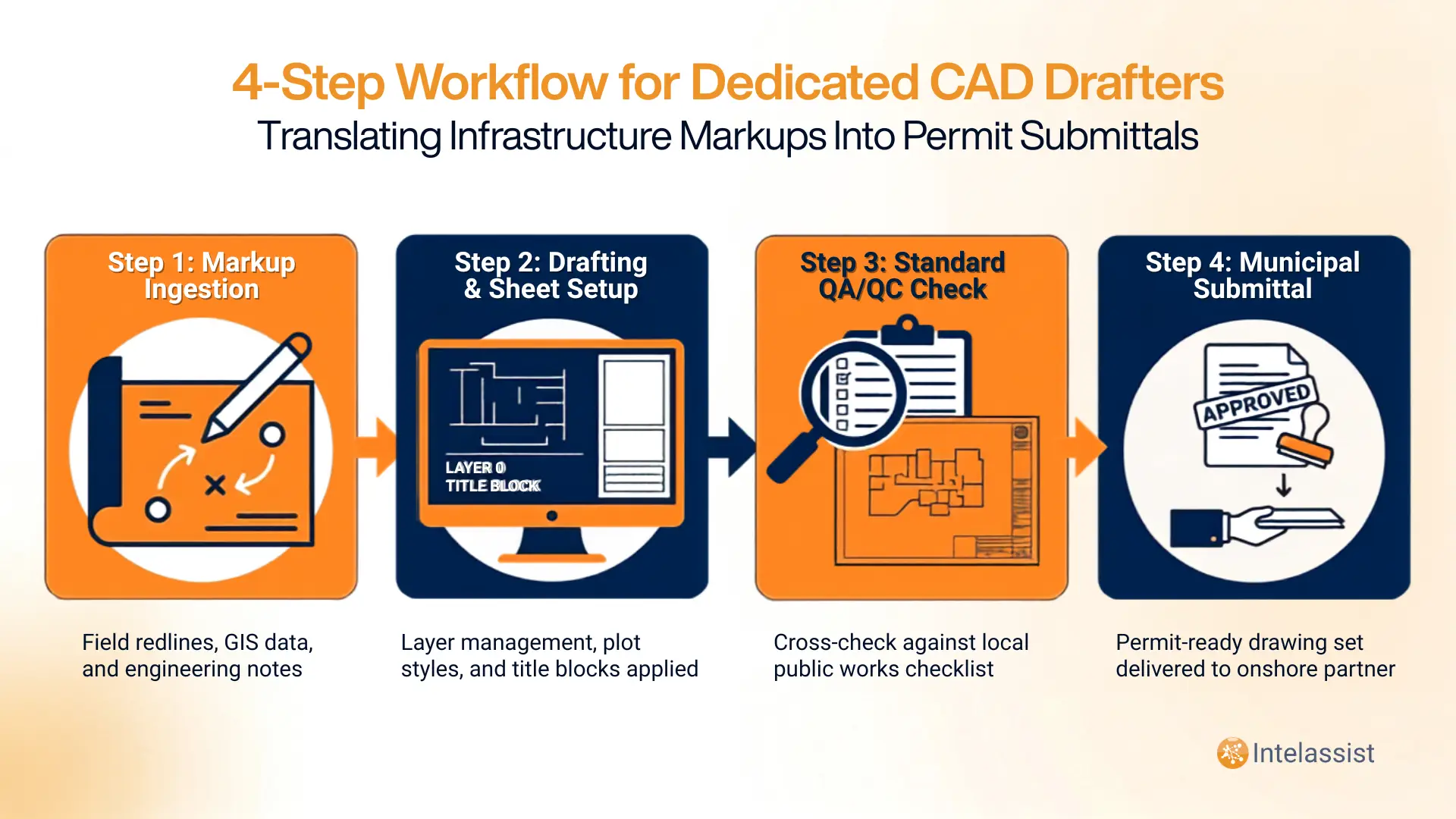
- Markup Ingestion: Extracting field survey notes, redline PDFs, and spatial GIS alignments into working drawing backgrounds.
- Sheet Setup & Layout: Applying standardized title blocks, plot styles, scaling, and CAD layer hierarchies.
- Internal Pod Review: Senior pod drafters cross-reference drawings against local agency checklists (e.g., DOT, local public works).
- Final Delivery: Delivering fully compliant, permit-ready PDF and DWG packages to the onshore engineering team.
What Role-Specific Software Expertise Is Required for Telecom and Utility Drafting?
Infrastructure drafting requires specialized software proficiency rather than general drafting knowledge:
| Discipline / Tool | Primary Technical Applications | Key Deliverables Produced |
|---|---|---|
| Civil 3D Specialists | Utility alignment profiles, pipe networks, digital terrain modeling, grading. | Corridor profiles, trenching plan sheets, surface models. |
| AutoCAD Technicians | 2D site layouts, utility encroachment details, schematic diagrams. | ROW permit drawings, pole line details, traffic control plans. |
| Revit / BIM Drafters | 3D structural modeling for vaults, substations, and equipment enclosures. | Structural BIM models, section views, vault assembly sheets. |
How Offshore CAD Teams Work Within Global Engineering Licensure Frameworks
A primary question engineering leaders ask when evaluating remote staffing is how offshore teams operate legally on licensed, permittable infrastructure work. In North America, professional engineering governance requires a licensed Engineer of Record (PE in the US, P.Eng in Canada) to retain legal responsibility for stamped deliverables. Understanding how an offshore drafting pod integrates into this regulatory framework clarifies how permittable work gets executed efficiently and in full compliance with municipal regulations.
Production Support vs. Engineer of Record (EOR) Sign-Off
The dedicated remote staffing model aligns directly with the professional licensing frameworks governing engineering practice across the US and Canada. Offshore staff handle production workflows, while local engineers maintain design authority.
- Offshore Staff Scope: Drafting, BIM modeling, structural detailing, preliminary design calculations, document preparation, and CAD coordination.
- Onshore EOR Scope: Setting design criteria, reviewing completed drawing packages, verifying engineering calculations, making final engineering determinations, and applying their official PE or P.Eng seal.
- Regulatory Compliance: Because the licensed Engineer of Record at the client firm conducts the ultimate evaluation and signs the final submittal, offshore team members do not need US or Canadian licensure to execute their daily scope.
Qualifications of Philippine Technical Talent and Compliance Integration
Offshore team members in the Philippines are highly credentialed technical professionals. Intelassist routinely hires candidates who hold formal degrees in Civil, Mechanical, Electrical, or Structural Engineering—and in many cases, hold Philippine Professional Engineer licenses.
- Academic & Practical Grounding: Drafters understand engineering fundamentals, load path logic, and spatial coordination beyond basic software operation.
- Environmental & Regulatory Adaptability: As green engineering demands account for over 18% of global ESO spending, Philippine engineers adapt quickly to incorporating environmental impact overlays, carbon footprint metrics, and local regulatory boundaries into base sheet sets.
- Standard Operating Practice: This division of labor represents the standard operating model across the global A/E/C remote staffing industry, enabling firms to scale technical output safely.
Delegating production mechanics to a dedicated offshore pod protects your in-house senior engineering capacity. When local PEs spend half of their day setting up CAD sheet borders or redrawing markups, their high-value engineering capacity is wasted. Offloading production support allows onshore teams to focus on high-level design decisions, client consultations, site inspections, and final quality sign-offs.
Resolve the Turnover Bottleneck with Dedicated CAD Drafting Teams
To eliminate the revolving-door dynamic that plagues traditional vendors, forward-thinking engineering leaders are re-evaluating how technical staffing is delivered. Understanding what engineering services outsourcing actually looks like in practice requires shifting to dedicated CAD drafters who act as an exclusive extension of your internal team, protecting institutional knowledge and ensuring long-term operational stability.
How Direct Workflow Integration Eliminates Management Overhead
Direct workflow integration removes the management barrier typical of generic outsourcing providers. Drafters connect directly into your cloud environments—such as Autodesk Construction Cloud (ACC), BIM 360, Microsoft Teams, and Asana—working inside your existing project structures.
Instead of submitting tasks to an anonymous ticket queue, your project managers assign work directly to specific drafters, participate in daily standups, and review redlines in real time. Practical hands-on technical vetting during candidate selection ensures that drafters demonstrate real Civil 3D, Revit, or AutoCAD capabilities before joining your pod.
Protecting Standard Operating Procedures (SOPs) and Institutional Knowledge
In traditional BPO settings where turnover averages ~40%, process documentation constantly declines as new hires attempt to interpret client standards. Intelassist’s dedicated model pairs high retention with client-specific SOP documentation built by senior pod members.
When scaling up, existing team members train new drafters, eliminating the burden on internal leadership.
Frequently Asked Questions About Dedicated CAD Drafting Teams
Candidates undergo hands-on technical evaluation using real-world engineering redlines before client presentation. Testing verifies tool proficiency, CAD layer organization, and drafting speed rather than relying on resume claims.
Intelassist maintains detailed SOPs for your account so new team members can be onboarded quickly. Shadow training and a cross-training model within your pod minimize project disruption during personnel transitions.
Drafters follow municipal permit checklists and client CAD standards provided during onboarding. As your team redlines drawings, drafters log local municipal feedback into a project knowledge base to prevent repeating mistakes.
The process takes 2 to 4 weeks from candidate selection to active workflow integration. This includes technical screening, video interviews, equipment deployment, and initial workflow orientation.