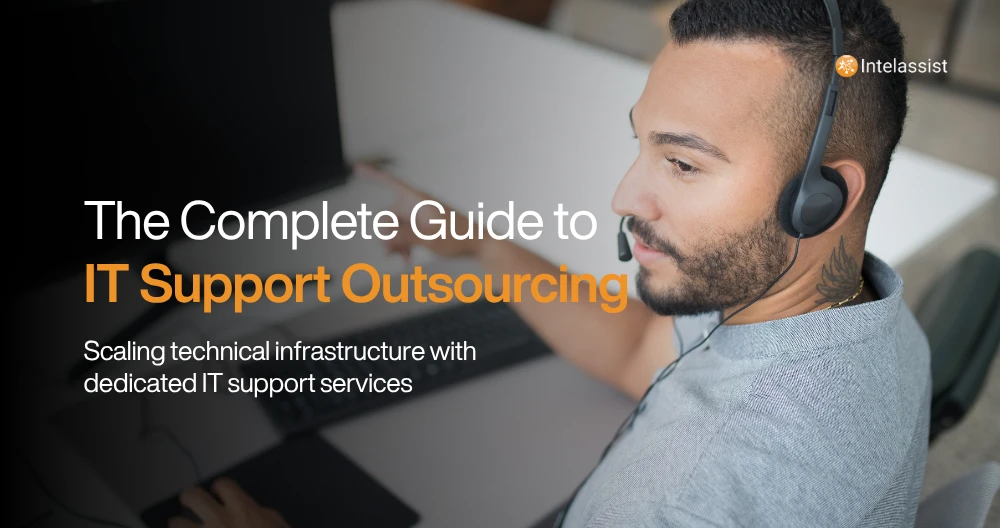
Scaling Technical Infrastructure with Dedicated IT Support Services
IT support outsourcing is a strategic approach in which a growing business delegates its technical help desk, network administration, and systems engineering to an external service provider. By moving to dedicated remote IT support services, small-to-medium businesses (SMBs) access certified tech talent without the prohibitive local payroll taxes, equipment overhead, and friction of traditional in-house hiring.
Core Findings:
- Partnering with an expert offshore IT outsourcing company yields a demonstrable 27.2% return on investment from cost savings alone, thereby systematically reducing local payroll strain.
- Shifting to dedicated remote IT support services and specialized tech talent can slash software and infrastructure deployment timelines by up to 40%, enabling platforms to launch months ahead of schedule.
- Replacing a local tech professional carry a hidden onboarding and recruiting penalty of 20% to 30% of their annual salary—an expense eliminated by using stable remote teams.
- Transitioning from volatile shared BPO help desks to a dedicated staffing infrastructure secures a 90%+ employee retention rate, preserving institutional system knowledge.
Why Traditional IT Support Outsourcing Fails (And What Makes a Dedicated Team Different?)
The typical experience most businesses have involves partnering with a large business process outsourcing (BPO) vendor, only to face fragmented communication, missed SLAs, and a revolving door of personnel. When a shared help desk agent quits every few months, your internal management team spends valuable hours constantly retraining new staff on your proprietary workflows, applications, and customer nuances.
This isn’t bad luck; it’s just simply how shared BPO models operate. In a standard BPO setting, a technical support agent handles multiple client accounts simultaneously. These workers juggle completely separate ticketing platforms, lack deep context regarding your specific infrastructure rules, and then suffer from severe burnout. This systemic stress causes a dismal industry-wide staff retention rate that hovers around 40%.
Under a dedicated remote staffing architecture, your remote IT support specialists work exclusively for your company. They log directly into your native tools (such as Slack, Jira, Zendesk, or ConnectWise), adhere strictly to your internal standard operating procedures (SOPs), and operate as a seamless extension of your corporate culture. By treating your offshore resources as true team members, this framework protects institutional knowledge and drives a much higher staff retention rate, resolving the turnover crisis that is inherent in generic outsourcing firms.
What Are the Key Types of IT Support Outsourcing Services?
One of the more overlooked parts of IT outsourcing is just how much the structure can vary. You might need a single senior specialist, a tiered support team, or something in between. The answer depends on your environment, your gaps, and your growth plans.
Selecting the correct service model prevents operational bottlenecks and ensures your end-users receive rapid, accurate technical resolutions.
Tier 1, Tier 2, and Tier 3 Remote IT Support Architectures
To build a functional, scalable help desk, you must segregate your incoming technical ticket volume by complexity. Blurring the lines between basic user assistance and high-level systems administration can overwhelm your team, exhaust your senior talent, and create massive ticket backlogs.
The following structured matrix delineates the technical boundaries, core certifications, and responsibilities required across a modern, outsourced three-tiered help desk:
| Support Level | Core Technical Focus | Target Tasks & Daily Scope | Required Certifications & Skill Sets | Ideal Escalation Path |
|---|---|---|---|---|
| Tier 0 (AI & Self-Service) | Automated Ingestion & Self-Service Resolution | Automated password resets via SMS, knowledge base article delivery, conversational AI diagnostic screening, system status notifications, and self-log service requests. | Machine learning training algorithms, structured natural language processing (NLP) scripts, API webhooks, and exhaustive FAQ tree design. | Automatically generates a ticket and escalates to Tier 1 if the user indicates the resolution was unsuccessful or requests a live human agent. |
| Tier 1 (L1 Support) | Primary Incident Intake, Triage, & Basic Troubleshooting | Handling user authentication anomalies, standard password resets requiring human validation, hardware peripheral connectivity, basic software navigation issues, and initial ticket logging/categorization. | CompTIA A+, Microsoft 365 Certified Fundamentals, Google IT Support Certificate. Requires exceptional active listening and detailed documentation skills. | Routes to Tier 2 if the incident requires deeper operating system modifications or takes longer than 15 minutes to resolve. |
| Tier 2 (L2 Support) | Advanced Troubleshooting, Diagnostics, & Configuration | Deep-dive operating system failures, software installation conflicts, local area network (LAN) routing drops, corporate VPN configuration, active directory group policy adjustments, and data recovery attempts. | CompTIA Network+, Security+, Microsoft Certified: Azure Administrator, Cisco Certified Support Technician (CCST). Requires advanced system diagnostics and command-line familiarity. | Routes to Tier 3 if the issue stems from core infrastructure architecture defects, database corruption, or requires code-level debugging. |
| Tier 3 (L3 Support) | Enterprise Infrastructure Engineering & Advanced Escalation | Resolving critical server crashes, database corruption issues, cloud architecture failures (AWS/Azure environment crashes), network-wide security breaches, and complex software bug resolution. | Cisco CCNA/CCNP, AWS Certified Solutions Architect, Certified Information Systems Security Professional (CISSP), Microsoft Certified: DevOps Engineer Expert. Requires mastery of infrastructure design. | Represents the final internal escalation point. Technicians collaborate with external software vendors or hardware manufacturers if a root-code patch is required. |
Managed IT Support Outsourcing Services
Rather than merely reacting to individual technical support tickets after systems break, managed IT support outsourcing services focus on proactive infrastructure maintenance. This strategy involves continuous, round-the-clock network monitoring, automated patch deployment, regular data backup verifications, and real-time endpoint security monitoring.
The focus is centered on network health, endpoint security, patch levels, and backup integrity, so that vulnerabilities, software conflicts, and the kind of slow-building memory issues that tend to cause outages are caught and resolved before anyone notices them.
Hybrid and On-Site Escalation Architectures
For businesses maintaining physical corporate offices, production facilities, or medical clinics, a hybrid approach combines the cost efficiency of offshore IT support with local, on-demand physical intervention.
Remote teams handle 80% to 90% of all software, cloud database, and access-management tickets. If a physical hardware component experiences an absolute failure, such as a blown server motherboard, a dead power supply unit, or a severed physical Ethernet run, the remote team isolates the break, orders the precise replacement component, and coordinates with an on-site field contractor to execute the physical repair.
Comparing Shared Help Desks vs. Dedicated Remote IT Staff
To make an objective decision for your organization, you must evaluate how a dedicated offshore team compares against alternative staffing structures across primary operational vectors:
| Operational Vector | Shared BPO Model | Local In-House Hire | Intelassist Dedicated Staff |
|---|---|---|---|
| Resource Allocation | Shared among multiple accounts; split focus. | 100% dedicated to your business. | 100% dedicated to your business. |
| Average Staff Retention | ~40% turnover, constant retraining. | Variable; highly susceptible to local poaching. | 90%+ retention rate for reliable continuity. |
| Software & Tools Integration | Uses vendor’s proprietary, generic platform. | Uses your internal tech stack directly. | Directly embedded into your native tech stack. |
| Financial ROI | Low cost per ticket, but high hidden management friction. | Prohibitive salary overhead, benefits, and local taxes. | Up to 60% cost savings relative to local payroll. |
| Cultural Alignment | Minimal; disconnected from your core mission. | High; physically present. | Highly rigorous screening for long-term cultural fit. |
How Does an Outsourced IT Support Process Actually Work?
A high-performing IT support outsourcing strategy operates like a finely tuned machine, utilizing the Information Technology Infrastructure Library (ITIL) framework to standardize delivery. A typical ticket resolution lifecycle moves through five distinct, transparent phases:
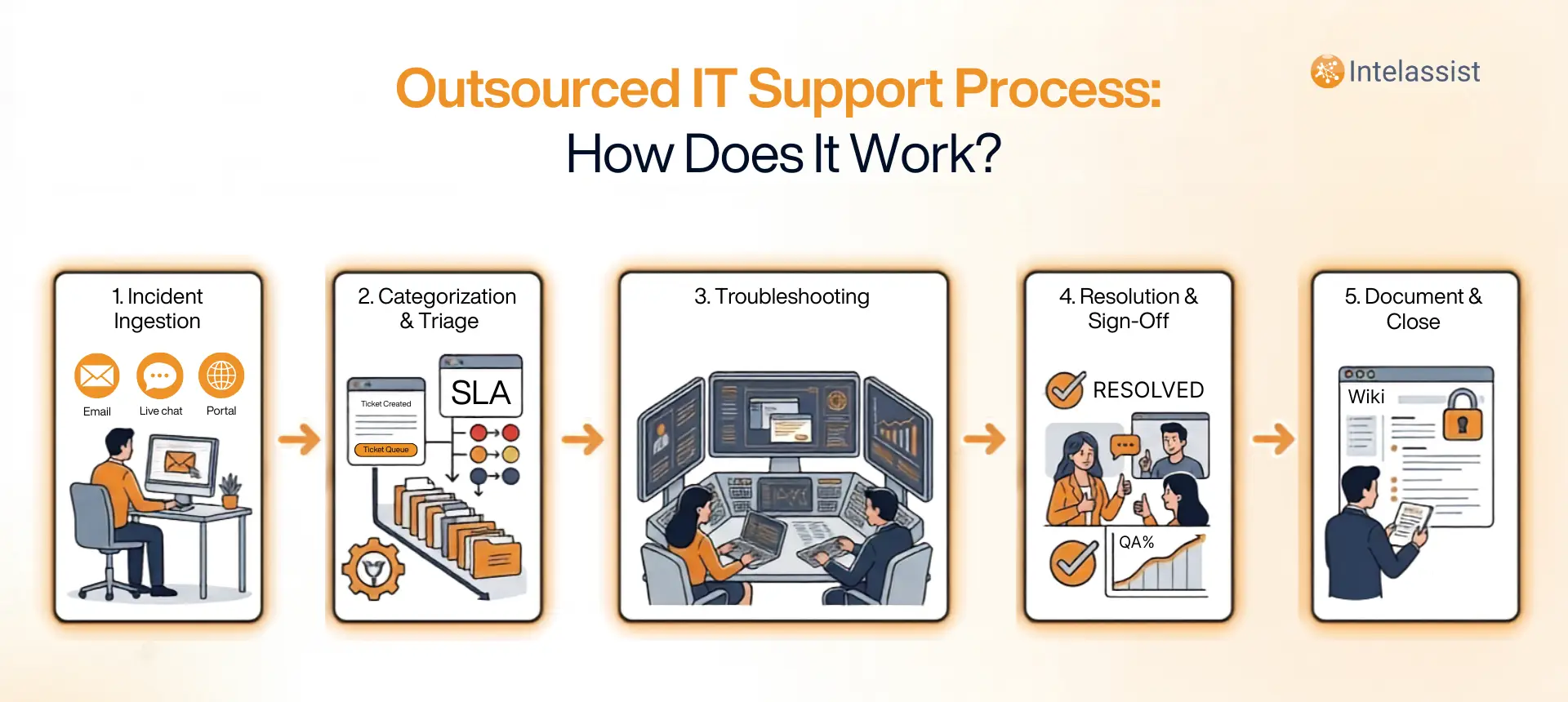
- Incident Ingestion: An end-user experiences a technical error and submits a request via email, live chat, or your client portal. The remote IT support specialist acknowledges the request instantly, maintaining operational visibility.
- Categorization and Triage: The ticket is automatically routed based on severity levels defined in your Service Level Agreement (SLA). Critical system failures are escalated immediately to Tier 2 or Tier 3 specialists, while low-priority configuration questions are queued sequentially.
- Active Troubleshooting: The dedicated technician accesses the user’s workstation securely via encrypted remote desktop protocols (RDP) or cloud management consoles to diagnose the underlying root cause.
- Resolution and Sign-off: The technical fix is applied, validated alongside the user, and cross-referenced against response-time metrics to ensure compliance with strict internal performance benchmarks.
- Documentation and Knowledge Base Update: The technician documents the exact resolution steps within your internal wiki or knowledge base. This eliminates skill gaps across the team and builds a highly structured repository of technical answers that prevent future troubleshooting delays.
Overcoming the 3 Biggest Risks in Offshore IT Support
It is entirely natural for leaders to feel hesitant about sending critical IT support functions offshore. Protecting your data security, brand reputation, and operational velocity requires mitigating three distinct risk categories:
1. Communication and Time Zone Gap
A primary frustration with low-tier outsourcing providers is the communication barrier: delayed email responses, misaligned shift schedules, and language styles that frustrate internal teams.
Intelassist eliminates this by recruiting technical professionals who have spent years supporting Western corporate clients. Furthermore, because your remote staff members operate in your native time zone, there are no handoff gaps or delayed cycles. They are online, in your internal Slack or Teams channels, exactly when your business is operational.
2. Enterprise-Grade Data Security and Compliance
Handing remote administrative access to an offshore IT support outsourcing company requires absolute, uncompromised security protocols. You cannot afford compliance lapses that compromise sensitive customer data.
To ensure safety, your dedicated remote staff operates within a highly controlled security perimeter. This includes enforcing multi-factor authentication (MFA) across all endpoints, utilizing encrypted Virtual Private Networks (VPNs) with strict access control lists (ACLs), and deploying continuous session monitoring. Technicians operate under strict policies and compliance parameters aligned with industry standards such as SOC 2, HIPAA, or PCI-DSS, depending on your vertical requirements.
3. Eliminating the Constant Retraining Cycle
When you use a standard BPO agency, you constantly train new agents because their staff members quit continuously. Intelassist prevents this by focusing on high employee engagement, competitive compensation, and transparent management practices. Because our technical professionals stay with us long-term, they develop deep expertise in your software ecosystem, meaning you only have to train your team once.
How to Transition to an Offshore IT Support Outsourcing Model
Transitioning your technical support infrastructure to an offshore model does not have to disrupt daily operations. By executing a phased roadmap, you can de-risk the deployment and ensure a smooth operational handoff.
Phase 1: The Internal Infrastructure Audit
Before hiring a single remote specialist, map out your entire internal IT ecosystem. Document every application, software-as-a-service (SaaS) platform, network switch, cloud database, and active user directory currently in use. Identify your average monthly ticket volumes, peak support hours, and the specific technical skill sets required to manage your environment.
Phase 2: Role Profiling and Sourcing
With your audit complete, define the precise technical roles you need to deploy. Are you looking for a Tier 1 Help Desk Specialist proficient in Microsoft 365 administration, or do you require a Tier 2 Network Administrator capable of managing complex AWS cloud environments?
Intelassist uses these exact technical profiles to source, vet, and present pre-screened professionals who possess the precise certifications (such as CompTIA A+, Network+, or Cisco CCNA) for your business demands.
Phase 3: The Shadowing and Graduation Period
Once your dedicated remote staff is onboard, avoid throwing them directly into a live queue on day one. Implement a structured two-week onboarding cadence:
- Week 1 (Shadowing): The remote specialist shadows your internal technical leads, observing workflows, ticketing style nuances, and communication protocols.
- Week 2 (Reverse Shadowing): The remote staff member takes the lead on incoming service tickets while your internal leads monitor their performance in real-time, providing immediate course corrections.
- Week 3 (Graduation): The remote team assumes full ownership of the designated IT support queue, operating independently under established SLA guidelines.
Moving Forward with Dedicated Technical Support
Choosing the right approach to technical infrastructure management determines how fast an engineering or operations department can scale. Traditional shared help desks introduce friction through constant agent turnover and broken communication channels, leaving your internal management team stuck in a loop of retraining. Shifting to dedicated remote IT support services removes this operational bottleneck by embedding certified tech talent directly into your internal systems.
Partnering with a dedicated offshore IT outsourcing company like Intelassist provides the exact operational visibility, data security, and high talent retention needed to convert IT support into a scalable corporate asset.
Frequently Asked Questions About IT Support Outsourcing
In a shared BPO model, agents divide their working hours across multiple unrelated client accounts, resulting in generic support and high agent turnover. A dedicated remote IT support team from Intelassist operates exclusively as an extension of your company. They utilize your internal tools, learn your processes deeply, and work exclusively for you, ensuring consistent quality and an exceptional 90%+ staff retention rate.
All administrative access is provisioned securely through identity management platforms and privileged access management (PAM) tools like LastPass, 1Password, or Okta. Remote technicians are granted the minimum level of access necessary to perform their specific tasks. Security protocols require multi-factor authentication (MFA), and access privileges can be revoked instantly from your internal control console at any time.
No. By sourcing highly proficient, technically certified professionals who are fluent in English and accustomed to supporting Western corporate environments, communication barriers are removed. Because your dedicated team works directly inside your native communication channels (like Slack or Teams) on your local time zone, they respond seamlessly as internal team members.
While a remote technician cannot physically swap out a defective hardware drive or hardwire a router, they handle the vast majority of IT service requests, which are entirely software, cloud, or network configuration based. For physical hardware failures, your remote staff diagnoses the issue, identifies the exact replacement parts required, and schedules a local on-site field contractor to perform the physical swap seamlessly.
Because Intelassist maintains an active pipeline of pre-screened technical talent, scaling your team is an efficient process. Whether you need to add another tier level of support specialists to handle seasonal ticket spikes or expand your help desk coverage to 24/7/365 availability, we can scale your infrastructure without the friction, advertising costs, or long lead times associated with traditional local hiring methods.