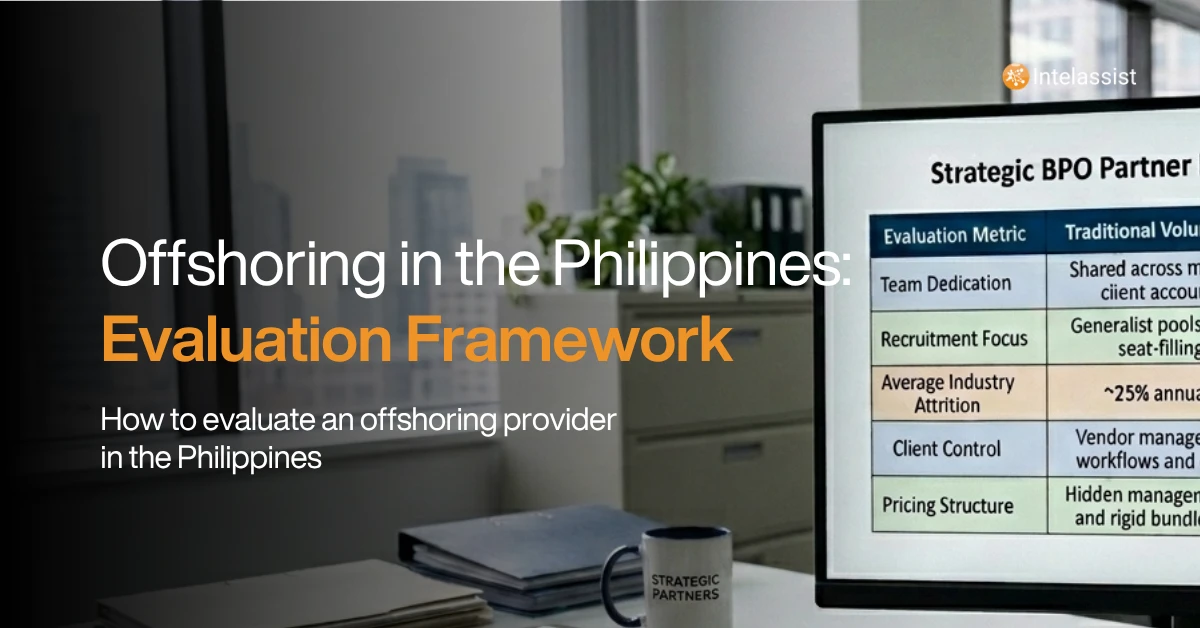
Offshore outsourcing in the Philippines in 2026 has transitioned from transaction-based call centers to a strategic model centered on dedicated remote staff who integrate directly into an organization’s core workflows. Instead of shared, multi-account task pools, modern offshoring focuses on building permanent, highly specialized extensions of your domestic team. For many founders, turning to an offshore provider in the Philippines is the logical next step to reclaim time and resources.
However, the outsourcing landscape has grown crowded and highly transactional. If you have previously been burned by poor agency communication or unexpected staff turnover, the decision to outsource again requires more than generic promises. It requires a strict framework to filter out low-cost staffing agencies and identify true operational partners.
Why Traditional BPO Models Fail Growing SMBs
Traditional Business Process Outsourcing (BPO) models are fundamentally built on volume. They maximize profit by placing as many seats as possible under generic account managers, treating human capital as an interchangeable commodity. Because of this structure, securing a truly dedicated offshore team seems impossible due to high turnover rates and the lack of cultural or operational integration that local teams naturally possess.
The Hidden Costs of High-Attrition Staffing Agencies
Every time an offshore team member leaves, your operations stall, your domestic leadership spends hours retraining new personnel, and project deadlines slip.
Generic staffing agencies experience a high average annual permanent employee turnover rate of ~25%. This revolving door occurs because employees are often treated as temporary billing units rather than career professionals. When evaluating an offshore staff provider in the Philippines, a low hourly rate ceases to be a saving if you must replace and retrain that position every six months. True cost efficiency is found in stability, not just lower hourly wages.
Critical Risks to Evaluate Before Choosing an Offshoring Provider in the Philippines
A successful offshore expansion depends heavily on the physical and operational infrastructure backing up your team. A distributed workforce is only as strong as the security and stability of the vendor’s local operating hubs.
Infrastructure and Power Redundancy
While remote work is standard, complete reliance on an offshore staff member’s home internet and local power grid introduces severe operational risks. Power interruptions and local connectivity dropouts can abruptly take your team offline.
A reliable offshoring provider in the Philippines mitigates this risk by maintaining fully equipped physical corporate offices in primary business districts such as Eastwood City in Quezon City. These hubs feature enterprise-grade security, dedicated fiber-optic internet lines, and industrial backup generators. Your partner must guarantee that if a remote team member suffers a localized outage, they have immediate access to a secure, fully functional corporate workstation to keep your operations running without interruption.
Wage Inflation vs. Talent Quality
The market for skilled technical professionals in Southeast Asia is highly competitive. In the technical and IT sector alone, 53% of competing firms face recurring difficulties in finding qualified professionals. Vendors bidding at unsustainably low-price points are forced to hire underqualified talent or cut corners on employee benefits, leading to poor execution and rapid attrition.
Evaluating a partner requires examining whether their compensation models attract top-tier professionals. If a vendor’s pricing seems too good to be true, they are likely sacrificing talent quality or account transparency to protect their own margins.
BPO Standards vs. Dedicated Offshore Staffing
To protect your business from transactional agencies, you must understand how a dedicated staffing partner differs from a standard volume-based BPO provider:
| Evaluation Metric | Traditional Volume BPO | Dedicated Offshore Staffing |
|---|---|---|
| Team Dedication | Shared across multiple client accounts | 100% exclusive to your company |
| Recruitment Focus | Generalist pools, rapid seat-filling | Specialized matching for technical roles |
| Average Industry Attrition | ~25% annually | Under 10% (Boutique partner standard) |
| Client Control | Vendor manages daily workflows and output | You direct tasks and integrate staff into your culture |
| Pricing Structure | Hidden management fees and rigid bundled costs | Transparent flat fee or line-item pricing |
The 3-Point Transparency Audit for CEOs
Before signing an agreement with an offshoring provider in the Philippines, run through this direct 3-point audit to verify their operational integrity:
1. Request Historical Attrition Rates
Demand clear, audited data on their staff retention over the past 24 months. A partner that maintains a retention rate above 90% demonstrates that they invest heavily in employee engagement, competitive compensation, and a healthy workplace culture. High retention translates directly to long-term institutional knowledge for your business.
2. Audit the Recruitment Pipeline
Ask the vendor to walk you through their vetting process. You need to ensure they are not just pulling resumes from public job boards when you sign a contract. A transparent provider allows you to interview and personally approve candidates, ensuring that your offshore team matches your specific technical and cultural requirements.
3. Review the Pricing Architecture
Ask for a full breakdown of costs. A reliable vendor clearly separates the direct employee compensation from their operational management fees. If a provider hides behind bundled, opaque pricing, it becomes incredibly difficult to verify if your team is being compensated fairly enough to stay motivated and loyal to your brand.
Frequently Asked Questions About Offshoring in the Philippines
A traditional BPO utilizes shared staff to handle repetitive, low-complexity tasks for multiple clients simultaneously under rigid vendor management. A dedicated offshore team consists of permanent, full-time professionals selected exclusively for your business, working directly under your operational guidelines and software tools.
A transparent staffing partner provides complete visibility into the hiring process. This includes customized technical testing, thorough background verifications, and direct client video interviews, allowing you to thoroughly evaluate a candidate’s communication skills and technical competence before making a hiring decision.
Your provider must comply fully with the Philippine Data Privacy Act of 2012, which closely aligns with international standards such as the GDPR. Furthermore, their infrastructure should include secure endpoint management, encrypted virtual private networks (VPNs), and physical data security protocols at their operations centers.
Most professional offshore staff in the Philippines are highly accustomed to working night shifts to directly align with US Eastern or Pacific standard business hours. This allows for real-time collaboration, immediate communication, and seamless daily handovers between your onshore and offshore teams.
Hidden costs in generic contracts typically surface as unlisted software licensing fees, sudden termination penalties, infrastructure upgrade costs, or unannounced management service charges. Working with a boutique provider that delivers clear, line-item pricing ensures your monthly expenditures remain completely predictable.
Key Takeaways
Building a high-performing offshore team requires moving past promotional pitches and auditing actual operational realities. Your choice of vendor determines whether your expansion becomes a source of friction or a driver of growth.
For long-term success, you must prioritize stability over low hourly savings, as high employee turnover can quickly cause a strain on your domestic leadership. Demand technical safeguards by ensuring your vendor backs up remote workers with physical infrastructure and enterprise-level redundancy to prevent costly downtime. Finally, enforce operational transparency by retaining control over candidate selection and insisting on transparent pricing structures so that your remote staff operates as a true, highly motivated extension of your company.