Time-to-treatment has become one of the most consequential performance indicators for modern infusion centers. As biologics expand across specialties, payer requirements intensify, and patient volumes rise, delays in starting therapy affect both clinical outcomes and operational performance. While infusion leaders have traditionally focused on chair capacity, pharmacy readiness, and nursing coverage, a growing body of evidence points to a different constraint: administrative throughput.
Payer complexity, prior authorization requirements, eligibility verification, documentation readiness, and scheduling coordination now shape how quickly patients begin therapy. In response, many infusion centers are reexamining how administrative work is structured. One operational model gaining attention is the use of integrated remote teams embedded into core workflows. When designed and governed effectively, these teams can reduce administrative friction, accelerate treatment initiation, and improve organizational resilience without compromising oversight or compliance.
This article examines how remote administrative support contributes to improved time-to-treatment, why the model is expanding across infusion care, and what healthcare leaders should consider when evaluating administrative redesign.
Administrative Pressure Reshaping Infusion Operations
Infusion centers operate at the intersection of high-acuity clinical care and increasingly complex reimbursement systems. Over the past several years, non-clinical barriers have emerged as leading contributors to delayed treatment starts.
According to the American Medical Association’s 2024 Prior Authorization Physician Survey, 93 percent of physicians reported that prior authorization requirements lead to delays in patient care, and 82 percent said those delays sometimes cause patients to abandon recommended treatment altogether (American Medical Association, 2024). These findings reflect a systemic issue rather than isolated inefficiencies, with administrative processes increasingly shaping access to care.
The oncology community has echoed these concerns. In its policy analysis on prior authorization, the American Society of Clinical Oncology (ASCO) identified administrative burden as a significant barrier to timely cancer treatment, noting that authorization delays disrupt care coordination and place substantial strain on practice staff.
Industry discussions and policy research reinforce this trend. Prior authorization requirements are expanding across therapeutic categories, increasing both administrative volume and coordination demands. As payers apply utilization management to a broader range of infused therapies, infusion centers face longer approval cycles and greater documentation complexity, even when clinical readiness is unchanged.
Collectively, these data points point to a clear conclusion: infusion centers are increasingly constrained not by clinical capacity, but by non-clinical workflow constraints.
Why Administrative Workflows Matter as Much as Clinical Capacity
Administrative processes in infusion care are sequential and interdependent. Eligibility must be verified before prior authorization submission. Prior authorization must be approved before pharmacy preparation. Documentation must align before scheduling can be finalized. Delays at any step cascade downstream, often surfacing only when a patient’s start date slips or a chair goes unused.
Unlike clinical bottlenecks, administrative delays are often diffuse and harder to detect. They show up as rescheduled appointments, underutilized infusion chairs, or last-minute cancellations rather than explicit operational failures. They also introduce financial risk through denials, rework, and delayed reimbursement.
As patient volumes rise and payer requirements evolve, infusion centers face a structural challenge. Administrative work scales directly with volume, but internal staffing and clinic hours often do not.
Where Integrated Remote Teams Create Measurable Gains
Integrated remote teams support infusion centers by absorbing defined, repeatable tasks that directly affect treatment readiness. Their impact is most visible across several operational domains.
Eligibility and Benefits Verification
Eligibility verification is foundational to infusion care. Coverage confirmation, co-pay estimation, benefit validation, and payer communication must occur before therapy can be scheduled. When these tasks are handled exclusively by on-site staff, they compete with front-desk operations and patient-facing responsibilities.
Integrated remote teams operate in parallel with clinical workflows, completing eligibility and benefits verification before patients arrive on-site. This proactive approach reduces same-day cancellations, avoids chair underutilization, and improves predictability in scheduling. Completing verification in advance also allows clinical staff to focus on patient preparation rather than payer follow-up.
Prior Authorization Management
Prior authorization remains the most consistently cited administrative barrier in infusion care. ASCO analyses of oncology workflows show that physicians and clinical staff spend substantial time managing authorization requirements, often contending with fragmented payer communication and limited visibility into approval status.
At the 2025 Association of Community Cancer Centers (ACCC) Annual Meeting, Targeted Oncology reported that infusion programs using centralized prior authorization teams reduced treatment delays and administrative rework by standardizing documentation and assigning ownership to specialized staff. In these models, dedicated authorization teams—often operating with secure remote access to the electronic medical record—managed submissions, follow-up, and escalation, significantly shortening internal processing time (Targeted Oncology, 2025).
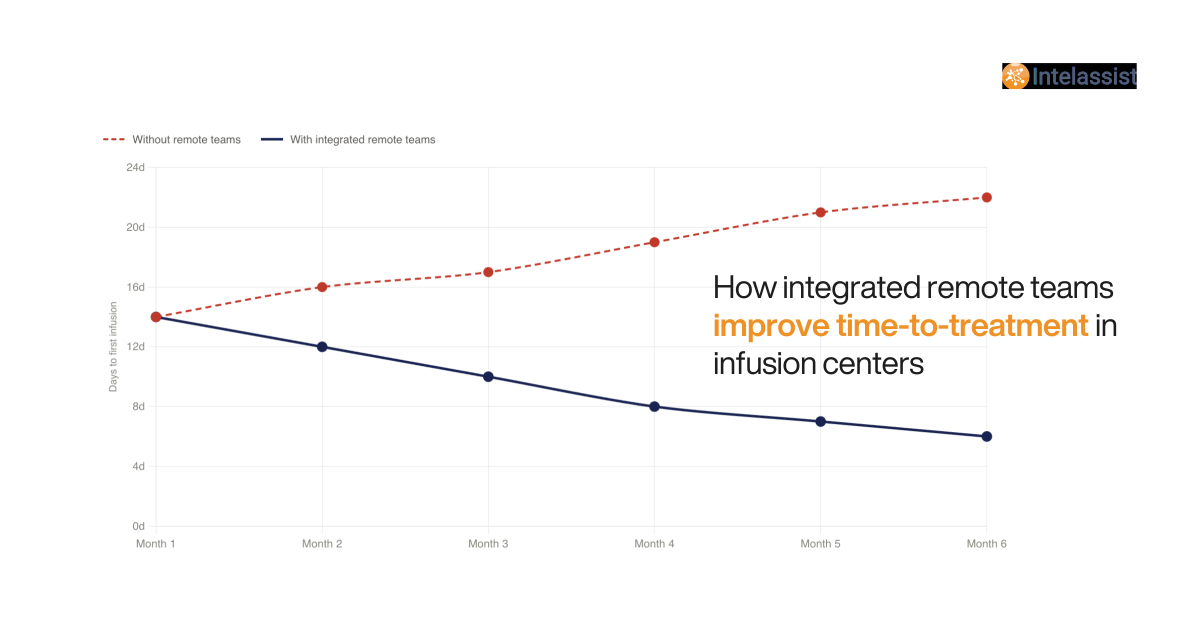
Integrated remote teams support this same structure by preparing complete, payer-specific authorization packets, tracking approvals in real time, escalating aging requests, and supporting appeals when needed. Tight alignment between clinical documentation and authorization materials reduces resubmissions and accelerates approval cycles. For many infusion centers, this approach removes days from the patient’s path to treatment.
Scheduling Optimization and Chair Utilization
Scheduling is one of the most powerful levers for improving infusion throughput. Effective scheduling must account for chair time, medication preparation, nursing ratios, pre-medication requirements, and patient availability. Small inefficiencies compound quickly.
Integrated remote teams support scheduling by managing appointment backlogs, monitoring cancellations, filling open slots, and reconciling schedules with pharmacy workflows. Continuous oversight allows adjustments throughout the day rather than periodic intervention.
A 2025 Oncology Nurse Advisor report demonstrated that process-driven scheduling redesign significantly reduced no-show and same-day cancellation rates, resulting in hundreds of additional completed infusion appointments and substantial annual cost savings. These changes improved access to care and increased effective use of infusion capacity without adding clinical staff (Oncology Nurse Advisor, 2025). While the study focused on on-site process redesign, infusion centers using integrated remote teams apply the same scheduling discipline at scale by managing appointment rules, monitoring cancellations, and maintaining patient communication outside standard clinic hours.
Documentation Readiness and Billing Support
Incomplete or inconsistent documentation is a frequent but underrecognized cause of treatment delay. Missing diagnosis codes, mismatched dosing details, or incomplete authorization packets can stall pharmacy preparation and billing workflows.
Integrated remote teams help ensure documentation aligns with payer requirements before patients arrive. By pre-loading authorizations, validating coding accuracy, and preparing documentation packets, they create a consistent operational baseline for nurses, pharmacists, and revenue cycle teams. This reduces downstream corrections and supports smoother treatment initiation.
Extended Administrative Coverage Windows
Administrative work does not stop when clinics close. Eligibility checks, authorization follow-ups, and scheduling updates often accumulate overnight, creating morning backlogs that delay treatment starts.
Integrated remote teams allow infusion centers to extend administrative coverage without extending clinical staff hours. Work completed after-hours supports smoother daily operations, reduces morning congestion, and improves chairside readiness. The result is fewer same-day delays and more consistent patient flow.
Why Administrative Redesign Has Become Strategic
What infusion centers are experiencing operationally is increasingly reflected across industry reporting, policy discussions, and academic research. Across these sources, a consistent pattern emerges: administrative coordination has become a primary determinant of treatment timing, independent of clinical readiness.
Reporting from Targeted Oncology following the 2025 Association of Community Cancer Centers Annual Meeting described how centralized ownership of prior authorization reduced internal rework and shortened approval cycles as payer scrutiny expanded. These findings align with broader industry observations that specialization and clear accountability in administrative workflows materially improve treatment access as requirements grow more complex.
At the policy level, the ASCO continues to identify administrative burden, particularly prior authorization, as a structural contributor to delayed care and patient abandonment. In parallel, payer-side developments signal growing recognition of the problem. In June 2025, Reuters Health reported that major U.S. insurers committed to standardizing electronic prior authorization data requirements by 2027, acknowledging that fragmented administrative systems impede timely care delivery.
Academic research reinforces this shift. A multicenter study published in Transplantation and Cellular Therapy found that delays in CAR T therapy were driven primarily by administrative coordination and referral logistics rather than clinical readiness. Even highly specialized therapies, the study concluded, can be constrained by administrative sequencing when workflows are not aligned.
Taken together, these signals suggest that administrative redesign is no longer a tactical optimization. It has become a strategic requirement for infusion centers operating in reimbursement environments where administrative alignment increasingly determines access to care.
Operational Implications for Infusion Center Leaders
For infusion center executives, time-to-treatment is both a clinical and operational indicator. Administrative delays directly affect patient experience, revenue cycle performance, staff utilization, and organizational resilience.
When implemented with clear governance, integrated remote teams support leadership priorities by accelerating authorization turnaround, improving eligibility accuracy, and strengthening scheduling discipline. Reduced rework and cleaner documentation help protect revenue, while clinical teams remain focused on patient care rather than administrative queues. Importantly, distributed administrative models allow centers to scale capacity and maintain continuity during volume surges or staffing disruptions without expanding physical space or clinical headcount.
A Framework for Implementing Integrated Remote Support
Executives evaluating this model should consider:
- Workflow mapping
Identify every administrative step between referral and first infusion. - Process standardization
Create unified SOPs for both on-site and remote teams. - Technology access & integration
Shared EHR modules, scheduling platforms, and CRM systems ensure seamless collaboration. - Performance metrics
Suggested KPIs:- PA turnaround time
- Eligibility completion before appointment
- Denial rate trends
- Average days from referral to first infusion
- Governance structure
Monthly review cycles, accuracy audits, and aligned training maintain quality across teams.
What This Means for Infusion Centers
Integrated remote teams are emerging as one of the most meaningful levers for improving time-to-treatment in infusion centers. While clinical excellence remains essential, administrative redesign is equally important in ensuring patients begin therapy quickly and safely. For many centers, integrating remote administrative support means:
- Faster access to care
- Reduced delays and denials
- Better staff utilization
- Stronger financial performance
- Improved patient experience
In a time of increasing regulatory scrutiny, payer complexity, and staffing constraints, remote-enabled administrative infrastructures allow infusion centers to deliver timely, reliable, and high-quality care.
About Intelassist
Intelassist empowers healthcare providers with integrated remote teams in the Philippines, delivering tailored support for administrative, financial, and compliance-driven operations. Our solutions drive measurable improvements in patient care while optimizing resources and expanding capabilities. Visit www.intelassist.com or email info@intelassist.com.